
Introduction
When someone watches an ad for a new car, the worst-case scenario is a regrettable purchase. When someone watches a healthcare video ad, the stakes are entirely different. They may be deciding whether to schedule a cancer screening, switch providers, pursue a treatment they've been avoiding out of fear, or simply trust a system they've doubted.
That difference changes everything about how healthcare video ads should be conceived, produced, and distributed.
A 2022 systematic review covering 455 articles found that empathy-led messaging had a positive, significant effect in 81% of analyses — and yet most healthcare organizations still default to showcasing technology, rankings, and clinical capabilities. The gap between what the research supports and what actually gets produced remains stubbornly wide.
This guide covers why healthcare video advertising operates under different rules, which creative formats consistently earn audience trust, how to navigate compliance requirements that trip up even experienced marketing teams, and what separates ads that inform from those that actually move people to act.
Key Takeaways
- Healthcare audiences approach ads with skepticism — empathy and authenticity consistently outperform institutional capability showcases
- Format choice matters: testimonials, explainers, and brand films each serve distinct goals
- Compliance goes beyond HIPAA: FDA rules, FTC standards, and patient consent require pre-production planning
- YouTube and connected TV deliver the strongest reach for healthcare video campaigns
Why Healthcare Video Ads Require a Different Approach
Most advertising needs to be persuasive. Healthcare advertising needs to be persuasive and credible, sensitive to vulnerable audiences, and often navigating subjects like illness, recovery, and mortality. The emotional stakes are higher — and the margin for a misstep is narrower.
The Trust Gap Is Real
Healthcare audiences arrive skeptical. KFF research found that 45% of U.S. adults believe marketing and advertising costs are a major factor in high prescription drug prices — and 82% view those prices as unreasonable. That skepticism doesn't stay contained to pharma. It colors how patients and caregivers evaluate all healthcare messaging.
The consequences of a tone-deaf or misleading ad aren't just reputational. They can influence decisions about treatment, provider selection, and whether someone seeks care at all.
Outcomes Beat Capability Showcases
Most healthcare organizations default to highlighting what they have: new equipment, high rankings, specialized staff. Patients care about something else entirely: will I be okay?
OhioHealth's 2024 "Keep Making Plans" campaign illustrates this gap. Built by Doe-Anderson to address the cancer center's awareness rate of just 5%, the campaign deliberately avoided clinical details. It showed patients pursuing life goals — earning a black belt, running a marathon — and was recognized at the Healthcare Marketing Impact Awards for reframing cancer care around hope rather than protocol.
That shift from capability to outcome changes everything about how a video is written, cast, and edited. Effective healthcare video tends to lead with:
- Patient experiences and life-after-treatment moments
- Emotional reassurance before clinical proof points
- Specific, relatable goals rather than survival statistics
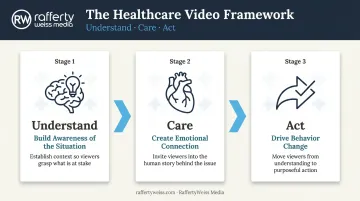
The "Understand, Care, Act" Framework
The OhioHealth example works because it follows a natural sequence: it helps viewers understand the situation, connects emotionally, then points toward action. That same progression — understand, care, act — maps directly onto effective healthcare video strategy.
It's the framework RaffertyWeiss Media applies to every project. Clients like HealthCare.gov, CDC, SAMHSA, and the American College of Cardiology have each faced the same core challenge: move an audience from awareness to action on a high-stakes health topic. In healthcare, that sequence isn't a creative nicety. It's the difference between a video that gets watched and one that actually changes behavior.
Key Types of Healthcare Video Ads and When to Use Each
There's no universal format. The right choice depends on campaign objective and where the audience is in their decision-making process.
Patient Testimonials
Best for overcoming hesitation and building peer trust. These work because prospective patients hear directly from people who've faced the same fears and concerns — not from an institution asserting its own excellence.
What makes them work:
- Authentic, conversational delivery (scripted recitations feel corporate)
- Specific outcomes rather than vague satisfaction ("I was back to work in three weeks" beats "the staff was great")
- Real patients whose demographics and experiences match the target audience
Educational and Explainer Videos
Ideal when the goal is to reduce anxiety about a procedure, clarify a diagnosis, or pre-qualify patients who self-refer. A 2023 systematic review published in JMIR found strong evidence that video-based tools improve patient knowledge across chronic illness contexts.
One regional hospital that added animated explainer videos to its website cut pre-surgery anxiety calls by 25%. A dermatology clinic saw a 30% boost in patient compliance after deploying short how-to videos on their patient portal.
Brand and Culture Videos
Suited for hospital systems and multi-location practices that need to differentiate on values, staff, and community presence rather than services alone. Yale New Haven Health's "We Ask Because We Care" campaign — built around reducing healthcare disparities by understanding patient characteristics — is an example of values-based positioning that goes beyond service promotion.
A Note on Animation
Animated explainers and motion graphics are most useful when sensitive topics or conditions make real patient footage difficult or inappropriate to obtain. Animation allows clear, compassionate communication without putting individuals on screen.
It's especially effective for:
- Explaining complex procedures step by step
- Visualizing medication schedules or treatment timelines
- Depicting internal processes that live footage can't capture
Creative Best Practices: How to Make Healthcare Video Ads That Work
Prioritize Storytelling Over Feature Lists
Leading with institutional achievements or equipment specifications is one of the most common mistakes in healthcare marketing. Patients don't care about a hospital's newest imaging suite — they care whether they'll be okay.
Frame every script around a patient's journey, fear, or aspiration. The "results, not process" principle is useful here: show what life looks like after successful treatment, not the clinical pathway that led there. OhioHealth's campaign succeeded because it put the patient's future — not the hospital's capabilities — at the center of every frame.
Lead With Empathy, Not Authority
The most effective healthcare video ads acknowledge what viewers are already feeling before introducing the organization as a solution. Fear, frustration, confusion — validating those emotions builds the trust necessary to act. Dismissing them creates distance.
This dynamic is especially pronounced for historically underserved patient populations. Christ Hospital Health Network's "Your Voice Matters" campaign directly addressed the documented reality that women's health concerns are too often dismissed or overlooked. Naming a real experience — rather than speaking in generalities — is what separates campaigns that resonate from those that merely inform.
Keep Messaging Clear and Jargon-Free
Medical terminology alienates general audiences. When the target viewer is a patient rather than a physician or payer, the video should communicate at the broadest accessible health literacy level — the same clarity that empathy demands.
Practical rules:
- Replace clinical terms with plain-language equivalents wherever possible
- Read scripts aloud — anything that stumbles verbally will confuse viewers
- Keep ad length focused; awareness-goal ads generally perform better under 30 seconds, while education or storytelling formats can support one to three minutes
Match Production Quality to Brand Credibility
In healthcare, production quality is a trust signal. Shaky footage, poor audio, or amateurish editing doesn't just look bad — patients transfer that perception of unprofessionalism onto their assessment of the care itself.
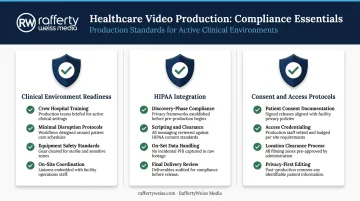
This is where healthcare-specific production experience matters. A crew unfamiliar with clinical environments can slow a shoot, create compliance risks, or make staff and patients uncomfortable. What experienced healthcare production looks like in practice:
- Crews trained to work in active hospital and clinical settings without disrupting care
- HIPAA compliance built into the process from discovery through final delivery — not added as a post-production step
- Familiarity with consent protocols, facility access requirements, and patient privacy standards
RaffertyWeiss Media has produced video for HealthCare.gov, CDC, NIH, and SAMHSA over more than 25 years, with crews who understand both the technical and regulatory demands of healthcare environments.
Compliance and Sensitivity: What Healthcare Marketers Must Get Right
Understand HIPAA Implications for Video
HIPAA compliance in video advertising covers far more than avoiding patient names. Any individually identifiable health information — including images that could identify a patient — requires valid written authorization before use.
Three Boston hospitals learned this the hard way: OCR settled with Boston Medical Center, Brigham and Women's Hospital, and Massachusetts General Hospital for $999,000 combined after they allowed TV film crews to access areas where patients were present without proper authorization. HHS is explicit that blurring or masking after filming is not sufficient — authorization must happen before cameras roll.
Pre-production compliance checklist:
- Documented written consent for every patient appearing on screen
- Legal review of scripts for any identifiable health information
- Final cut review before distribution, not just before filming
Know the Regulatory Landscape Beyond HIPAA
Pharma and medical device marketers face a distinct and more heavily regulated set of rules. FDA's 2023 rule requires that major statements about side effects and contraindications in DTC TV and radio ads be presented clearly, conspicuously, and neutrally — the "fair balance" requirement.
The FTC enforces equally stringent standards on health claims. In 2025, the FTC took action against telehealth provider NextMed for misleading pricing, fake reviews, and deceptive weight-loss claims — resulting in a $150,000 settlement and a ban on misrepresenting testimonials. Unsubstantiated health claims in video can trigger regulatory action regardless of HIPAA compliance status.
Handle Sensitive Topics With Deliberate Care
Healthcare video ads routinely touch on cancer, mental illness, addiction, chronic pain, and pediatric illness. Each subject requires deliberate choices about tone, imagery, and framing.
A useful framework:
- Lead with agency — what is possible for this patient, not what they face
- Acknowledge difficulty without exploiting it — validate without traumatizing
- Show whole people — patients are not their diagnoses; avoid imagery that reduces them to a condition
Fear-based messaging can motivate action in narrow contexts, but it can also alienate or shame vulnerable viewers when deployed carelessly. In most cases, framing around what treatment makes possible — rather than what the patient stands to lose — produces stronger engagement without the risk of alienating the audience you're trying to reach.
Vet All Medical Claims Before Production Wraps
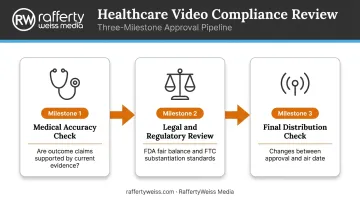
Every factual claim about treatments, outcomes, or clinical capabilities should be reviewed by a medical or legal professional before the video is finalized. Claims that are accurate at scripting can lose their evidentiary footing by the time distribution begins — studies get updated, approvals change, or language shifts in regulatory guidance.
Build a compliance review into your post-production schedule as a named milestone with a deadline, the same way you'd treat color correction or sound mix. Key review points include:
- Medical accuracy check: Are all outcome claims still supported by current evidence?
- Legal/regulatory review: Do claims meet FDA fair balance and FTC substantiation standards?
- Final distribution check: Has anything changed between approval and air date?
Distribution Strategy: Where to Run Healthcare Video Ads
YouTube
HINTS 2020 research found that 40.8% of U.S. adults used YouTube to watch health-related videos — making it one of the most important channels for reaching audiences actively seeking health information. It functions less like a traditional ad platform and more like a search engine for health questions.
Key YouTube formats for healthcare:
- Skippable in-stream (TrueView): Paid only when watched past 30 seconds; best for longer brand narratives or educational content where self-selection matters
- Bumper ads (6 seconds): Best for brand awareness and retargeting; reinforces a message but cannot carry a complex story
Connected TV
Connected TV
Where YouTube captures active health searchers, CTV reaches audiences in a different mode entirely. Nielsen reported that streaming accounted for 43.8% of U.S. TV time in March 2025 — up 10 percentage points over two years. That lean-back environment allows longer, more emotional brand narratives to land without the distraction of active search behavior. Hospital systems, local urgent care networks, and specialty service lines running awareness campaigns are natural fits for CTV.
Social Platforms
Facebook and Instagram enable precise demographic targeting useful for reaching specific patient populations — but with important restrictions healthcare marketers must understand before building campaigns:
- Meta removed detailed targeting options related to health causes effective January 2022
- Platform advertising standards prohibit ads that imply knowledge of a user's personal health attributes
- Audience segment construction requires a careful policy review before launch
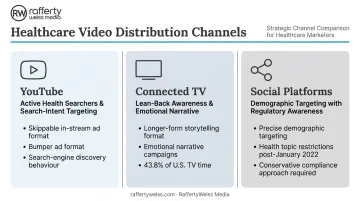
These constraints don't eliminate social platforms as a channel, but they do require a more conservative targeting approach than other verticals allow.
Frequently Asked Questions
What makes healthcare video ads different from other types of video advertising?
Healthcare video ads carry higher trust requirements and compliance obligations than general commercial advertising. Audiences are often vulnerable and making consequential decisions about their health — so tone, accuracy, and sensitivity matter in ways that don't apply to consumer product advertising.
How do you ensure a healthcare video ad is HIPAA compliant?
Start with documented written consent for every patient who appears on screen, and ensure no individually identifiable health information is captured without prior authorization. All scripts and final cuts should undergo legal review before distribution.
What video format works best for healthcare advertising?
Format depends on campaign objective and where the audience is in their decision journey. Testimonials build peer trust, explainer videos reduce procedure anxiety, and brand films differentiate on values — but no single format works for every goal.
How long should a healthcare video ad be?
Shorter formats — 15 to 30 seconds — work well for awareness goals. Longer formats, from one to three minutes, support education and emotional storytelling where the audience is already engaged and motivated to learn more.
What platforms are best for distributing healthcare video ads?
YouTube is the priority for reaching audiences actively researching symptoms and providers. CTV works well for local brand awareness campaigns. Social platforms enable demographic targeting but require careful compliance with platform-specific health advertising policies.
How much does it cost to produce a healthcare video ad?
Costs vary based on format, production complexity, and talent. Healthcare productions also carry additional expenses for compliance workflows, patient authorization, and legal or medical review — budget for these before production begins.