Introduction
Your front-line team shapes how customers feel about your company far more than any ad campaign ever will. A single frustrating interaction can undo months of brand-building. A genuinely helpful one can turn a one-time buyer into a loyal advocate. The difference usually comes down to training.
Video has become the go-to format for corporate learning, and the data backs it up. According to Training Magazine's 2024 Training Industry Report, 79% of organizations used virtual classroom, webcasting, or video broadcasting as part of their training delivery.
Text and slide decks can't show tone, facial expression, or the moment an agent's word choice shifts a tense call in the right direction. Video can.
This article covers a curated list of the best customer service training videos available online, what makes each one worth your team's time, how humor fits into the mix, and how to build these resources into a training program that actually sticks.
Key Takeaways
- Customer service training videos are among the fastest, most cost-effective tools for building consistent front-line performance.
- The best free resources cover empathy, active listening, de-escalation, and communication.
- Short, focused videos (5–10 minutes per topic) outperform long-form sessions in both completion and retention.
- Free videos from TEDx, HubSpot, and industry experts are solid starting points; custom-produced content covers what they can't.
- This list is organized by skill type so you can match each video to your team's specific needs.
Why Video Works for Customer Service Training
Written guides describe how to handle an angry caller. Video shows it: the pause before responding, the tone shift, the body language that signals patience rather than dismissal. For skills like empathy, active listening, and de-escalation, that difference matters.
The Case for Short-Form Learning
Research backs the instinct to keep training modules brief. ATD's microlearning research identifies 10 minutes as the ideal length for a microlearning segment, with 2–5 minutes being most effective for single-concept retention. A 2019 academic review defines microlearning units as typically 1–10 minutes, supporting the case for topic-specific video modules over marathon training sessions.
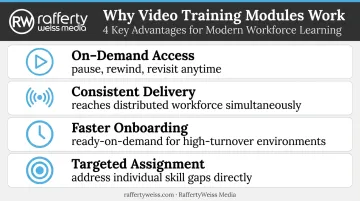
Short video modules also solve several practical problems that written guides and live training can't:
- Videos can be paused, rewound, and revisited — something a live trainer can't offer at 2 a.m. before a morning shift
- A single well-produced video reaches a distributed workforce simultaneously, with no variation in delivery
- High-turnover environments can onboard new hires faster when core content is ready on demand
- Managers can assign specific videos to address specific gaps, rather than scheduling team-wide refreshers for one person's weak spot
Video rarely works best in isolation. But for organizations that need consistent messaging across locations, teams, or shifts, it solves a problem that no other format handles as efficiently.
Best Customer Service Training Videos Online
These videos were selected based on how widely training professionals use them, the clarity of the skill being taught, quality of delivery, and direct applicability to customer-facing roles. Each one earns its place on a training playlist.
Brené Brown: Empathy vs. Sympathy
This animated RSA short — under four minutes, over 23 million views — has become one of the most-used tools in customer service training globally. Brown draws a sharp distinction between empathy and sympathy, and explains why well-meaning phrases like "at least it's not worse" actually push people away rather than comfort them.
For service teams, the lesson is immediate: when a customer is frustrated, the goal isn't to fix their feelings — it's to make them feel heard. The animated format makes the concept stick in a way that a bullet-pointed policy document never will.
| Attribute | Detail |
|---|---|
| Video Type | Animated short (RSA) |
| Core Skill | Empathy in customer interactions |
| Best For | All customer-facing roles; particularly effective for onboarding |
HubSpot Academy: Delivering Exceptional Customer Support
HubSpot Academy's free customer support course covers empathy, active listening, problem-solving, and productivity across five lessons and six videos, with quizzes built into each module. The structured delivery holds attention without feeling like a lecture.
It's also practical to deploy: managers can assign individual modules to address specific skill gaps rather than putting the whole team through content they don't need.
| Attribute | Detail |
|---|---|
| Video Type | Animated instructional course |
| Core Skill | Broad customer support skill set |
| Best For | New hire onboarding; team-wide refreshers |
TEDx: John Boccuzzi Jr. — "I Was Seduced By Exceptional Customer Service"
In this TEDx talk, sales and customer experience executive John Boccuzzi Jr. uses a personal story to argue that exceptional service is the most powerful marketing tool a company has — and that giving customers what they need, not just what they ask for, creates lasting loyalty.
With over 816,000 views, this talk works well as a session opener. The storytelling format makes it watchable, and the central argument — that service drives retention more effectively than advertising — gives front-line teams a reason to care about their role beyond completing tickets.
| Attribute | Detail |
|---|---|
| Video Type | TEDx Talk (live presentation) |
| Core Skill | Customer loyalty through service excellence |
| Best For | Team motivation; new hire orientation; leadership training |
Shep Hyken on Ritz-Carlton Service Standards
Customer experience expert Shep Hyken breaks down how the Ritz-Carlton built its reputation — not through vague aspirations, but through a documented, repeatable system of behaviors any team can study and adapt. The documented behaviors translate directly to any service environment where trust and repeat business matter — retail, healthcare, financial services, or B2B support alike.
Use this one with high-performers or team leads. It sets an ambitious benchmark without feeling abstract.
| Attribute | Detail |
|---|---|
| Video Type | Expert commentary / case study |
| Core Skill | Service standards; building a service culture |
| Best For | Advanced training; team leads and managers |
Celeste Headlee: "10 Ways to Have a Better Conversation" (TED)
This TED Talk has over 32 million views for good reason. Radio host Celeste Headlee lays out ten practical principles for genuine conversation — including not multitasking during interactions, asking open-ended questions, and listening to understand rather than respond.
It's not labeled as customer service training, which is part of why it works so well in that context. The rules feel like common sense, which makes them easier to internalize and apply immediately during calls, chats, or in-person interactions.
| Attribute | Detail |
|---|---|
| Video Type | TED Talk (live presentation) |
| Core Skill | Active listening; conversational quality |
| Best For | Call center teams; chat agents; any direct customer contact role |
Funny Customer Service Training Videos Worth Watching
Humor belongs in training for a practical reason: it lowers resistance. A team dreading a session will engage more with a three-minute clip they recognize than with a module they've seen variations of before.
The key is pairing the comedic moment with a specific, discussable takeaway. To use these clips effectively:
- Cue the clip at the start of a topic, not as filler
- Pause after viewing and ask one focused debrief question
- Connect the scene to a real situation your team has faced
Jim and Dwight's Sales Call (The Office, Season 3, Episode 13)
Jim's quick responsiveness to a client's needs wins the account over a competitor. It's a familiar scene that makes a clear case for service as a competitive advantage. Use it as an opener, then ask: Where do we respond that fast — and where don't we?
The Soup Nazi (Seinfeld, Season 7, Episode 6)
Where the previous clip rewards responsiveness, this one punishes its absence. A business with a genuinely great product still loses customers when the service experience is abrasive and unpredictable. The scene drives a concrete conversation: product quality and service quality aren't interchangeable. Customers who feel disrespected leave, even when the product is excellent.
The Zootopia DMV Scene
This clip from the 2016 film captures the specific frustration of slow service with comedic precision — the kind of scene that gets nods of recognition from every audience. Zendesk reports that 60% of customers say long wait times are the most frustrating part of a service experience. Pair that statistic with this clip in a debrief, and the point sticks in a way a slide on response-time benchmarks never would.
What Makes a Customer Service Training Video Effective
Not all training videos are worth your team's time. The ones that actually change behavior share a few consistent qualities.
Single-skill focus. A video that tries to cover "all of communication" teaches nothing actionable. A video that teaches exactly how to respond when a customer interrupts — that's something a rep can practice and apply on the next call.
Real scenario grounding. Generic content covers universal principles. Custom content covers your customers, your product, and your service protocols. The gap between those two is where behavior change actually happens or doesn't. This is why high-performing organizations typically combine free foundational videos with custom-produced content that mirrors their specific environment.
Production quality. Poor audio, flat lighting, and uneven pacing undermine the message before the content even registers. In regulated industries — healthcare, government, financial services — this matters especially. Credibility is established in the first 30 seconds, and a technically poor video signals that the training itself isn't worth taking seriously.
Modular structure. Libraries built on 5–10 minute topic-specific segments are easier to maintain, easier to assign, and more likely to be used than long-form courses broken into chapters. Each module should stand alone.
The custom-vs-generic gap is what organizations with large or distributed workforces consistently identify when they move beyond off-the-shelf content. RaffertyWeiss Media has spent over 25 years producing training and eLearning content for clients including Lockheed Martin, the American Red Cross, and HealthCare.gov. Their modular, LMS-ready content (including microlearning formats) is built to meet each client's specific brand standards, accessibility requirements, and scenario needs.
How to Use These Videos in Your Training Program
A video watched once during onboarding rarely changes behavior. The structure around the video is what does the work.
Follow these three steps to get actual behavior change out of the videos you assign:
Start with skill gaps, not playlists. Pull your CSAT scores, listen to call recordings, or ask managers where interactions most often break down. Then assign videos to those specific gaps — not a general "customer service fundamentals" playlist.
Mix free resources with custom content. Free videos work well for foundational concepts and team motivation, but they aren't built for your products, your customer base, or your service protocols. A blended approach — free for universal skills, custom for scenario-specific application — gives you both cost efficiency and relevance.
Build in accountability. Pair each video with at least one of the following:
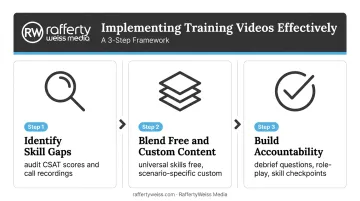
- A debrief question for team discussion (for example: What's one phrase from this video you could use this week?)
- A short role-play exercise applying the skill
- A skill checkpoint or quiz to confirm comprehension before moving on
The videos on this list are useful. But watching a video and applying a skill are two different things — and the gap between them closes when you build deliberate practice into the experience.
Conclusion
The best customer service training videos online are widely accessible, often free, and genuinely effective — when they're used with intention. A curated playlist built around your team's actual skill gaps will outperform a generic library every time.
Start by auditing where your team's customer interactions break down most consistently. Then build a video library around those specific gaps rather than trying to cover everything at once.
Off-the-shelf videos cover the fundamentals, but they can't replicate your service environment, your brand voice, or the specific scenarios your team actually faces. For organizations that want training content built around those specifics, RaffertyWeiss Media has spent over 25 years producing custom training videos for corporate and government clients. Get in touch to explore what a tailored training video series could look like for your team.
Frequently Asked Questions
What is the best training for customer service?
The strongest approaches combine soft skill development (empathy, active listening, communication) with scenario-based practice and company-specific knowledge. Video-based learning paired with coaching and role-play has solid evidence behind it for retention. Watching, discussing, and practicing together is what drives lasting behavior change.
What do the 5 C's of customer service stand for?
One widely referenced framework lists the 5 C's as: Care, Competence, Culture, Consistency, and Communication. Definitions vary across frameworks, so align on which version your organization uses before building training content around it.
What are the 5 P's of customer service?
Common versions of this framework include Promptness, Politeness, Professionalism, Personalization, and Problem-solving — each one representing a trainable behavior rather than an abstract value.
What is the 10/5/3 rule in customer service?
This proximity-based guideline — originating in hospitality and retail — says: acknowledge a customer at 10 feet, make eye contact and smile at 5 feet, speak at 3 feet. The principle extends beyond in-person service to any customer-facing role: proactive acknowledgment before a customer has to ask for help is a trainable standard.
How long should a customer service training video be?
ATD's microlearning research recommends 10 minutes as the ideal length, with 2–5 minutes being most effective for single-concept modules. Breaking longer content into topic-specific segments improves both completion rates and retention, and makes it easier to match individual videos to specific skill gaps.
Should teams use free online training videos or commission custom ones?
Free videos work well for foundational skills and team motivation. Teams with specific brand standards, regulated compliance requirements, or unique service scenarios consistently get stronger results from custom-produced content that reflects their actual workflows and customer base. A blended approach — free for universal skills, custom for the rest — is usually the most practical path.