Introduction
Animation has moved well beyond consumer advertising. Federal agencies use it to explain public health policy. Healthcare systems use it to simplify complex treatments. Corporations use it to onboard employees and communicate strategy. According to Wyzowl's 2024 State of Video Marketing report, 96% of marketers say video has helped users better understand their products or services — and animated formats consistently outperform static content for retention.
The challenge is that "good" animated video is harder to define than it looks. Dozens of animation styles exist, budgets vary wildly, and generic explainer templates flood the market. Without a clear benchmark, it's difficult to know what separates a forgettable video from one that actually moves an audience.
This guide addresses that directly — examining standout real-world examples, breaking down what makes each one work, and offering a practical framework for your own project, whether you represent a corporation, a government agency, a healthcare organization, or a nonprofit.
Key Takeaways
- Animated corporate videos earn attention when they're built around a single, clear communication objective — not a list of features or talking points.
- The best examples pair storytelling with an animation style that fits the audience and the subject's tone.
- Vidyard's 2024 benchmark found 65% of viewers completed videos under one minute, versus just 20% for videos over 20 minutes — keep it short.
- Style choice is strategic: 2D motion graphics fit most corporate use cases; 3D is high-impact but costly; whiteboard works well for training.
- Plan for multi-platform use from the start, since animated videos typically have longer shelf lives than live-action equivalents.
What Makes an Animated Corporate Video Effective?
Start With One Clear Objective
The most common mistake in animated video production isn't poor animation quality — it's trying to say too many things at once. The strongest corporate animations are built around a single communication goal: explain this process, build awareness of this program, or drive this specific action.
This is why scripting matters more than most organizations expect. Many clients invest heavily in production quality while underinvesting in strategic development. A beautifully animated video built on a muddled script will underperform no matter how polished it looks.
Storytelling Over Feature Lists
Audiences respond to narrative structure, even in short-form corporate content. A 60-second animation that frames a problem, raises the stakes, and shows a resolution is consistently more memorable than one that simply walks through product features or organizational facts.
NewYork-Presbyterian's immunotherapy campaign illustrates this directly. Their own newsroom described the animation as using "heroes, villains, intrigue, and hope" to make cancer immunotherapy understandable and personally relevant. That framing — not the medical accuracy alone — is what made it work for a general audience.
Wistia's engagement research reinforces this: cutting a lengthy onboarding intro down to a 10-second hook increased viewer engagement by 5 percentage points. Front-load the conflict, not the context.
Match Style to Your Audience
A playful character animation might be perfect for a recruitment campaign or a public health PSA aimed at general audiences. That same style applied to a cybersecurity briefing for IT professionals, or a financial policy explainer for regulators, would undermine credibility before the first sentence finishes.
Mismatched style and audience is one of the most consistent failure points in corporate animation. The LinkedIn B2B Institute and MediaScience studied 109 real B2B ads and found that 81% failed to generate adequate attention or brand recall — a result that points directly to weak visual-audience alignment.
Visual Consistency Signals Credibility
Strong animated corporate videos use a controlled color palette, consistent character or icon design, and transitions that feel purposeful rather than decorative. For institutional audiences in particular, visual consistency is directly tied to how credible and trustworthy a video feels. If your animation looks like it came from a generic template, it reads that way too.
Length and Platform Context
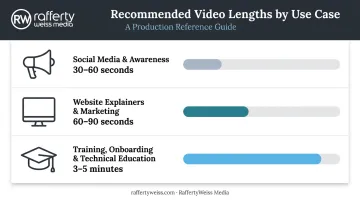
60–90 seconds is the well-supported sweet spot for top-of-funnel explainer and marketing videos. Wyzowl's production guidance supports this range, and Wistia reported a roughly 90-second announcement video achieving 86% engagement — nearly double benchmark.
Length should follow context:
- Social media and awareness campaigns: 30–60 seconds
- Website explainers and marketing: 60–90 seconds
- Training, onboarding, or technical education: 3–5 minutes is reasonable
Top Animated Corporate Video Examples
Each of these five examples solves a specific communication problem — explaining abstract processes, conveying organizational mission, or demonstrating product value — in ways that live action simply couldn't match as efficiently.
Slack — "Work, Simplified"
This 2D motion graphics explainer opens on chaos — a frantic work environment with messages flying in every direction — then shows how Slack cuts through it. What's technically interesting is the perpetual motion technique: the main character never stops moving, which maintains viewer attention without relying on fast cuts or sound design tricks alone. Slack's brand colors are woven into nearly every scene without ever feeling forced.
It dramatizes a relatable B2B problem rather than explaining product features. The animation style is professional but has personality — which matters for a product trying to feel like an antidote to corporate stiffness.
BlueCross BlueShield NC — "Today We"
A character-driven 2D animation that tracks the organization's community impact across multiple settings — hospital, classroom, home, outdoor spaces — using a continuous superpan technique that flows from scene to scene without hard cuts. Warm colors, detailed character work, and careful pacing give it a sense of scale and humanity.
For institutional organizations: This one dismantles the assumption that animation has to feel casual. With the right execution, 2D animation can communicate mission, community presence, and organizational values just as effectively as live action — and without the logistical complexity of filming across multiple locations.
NewYork-Presbyterian — Immunotherapy Explainer
A minimalist 2D animation explaining how cancer attacks the body and how immunotherapy fights back. The restricted three-color palette — black, white, and red — does specific work here: it signals urgency and seriousness while keeping the visual language simple enough for a general audience. Icon-to-icon transitions keep complex biological processes genuinely clear.
For healthcare communicators: Abstract medical or scientific processes that cannot be filmed are one of animation's strongest use cases. This video shows how a restrained visual system — rather than stylistic complexity — can make sensitive content both credible and understandable to patients without medical backgrounds.
Starbucks — Coffee Blending Process
A roughly 60-second animation telling the story of how Starbucks blends beans from different regions. The illustration style and warm, earthy palette mirror the brand's existing visual identity so closely that the animation feels like an extension of the brand, not a separate content type. It uses fluid transitions rather than hard cuts, which reinforces the "craft" quality the video is communicating.
It's a useful model for organizations that want animation to do more than explain functionality — the style itself carries a message about quality and care. The execution elevates brand perception rather than just informing viewers.
Microsoft — Whiteboard App Demo
Rather than a standard screen recording walkthrough, this demo uses loose, sketch-style characters moving fluidly across a shared digital canvas — a visual metaphor that mirrors the product's actual purpose. The warm, open aesthetic keeps the tone energetic without feeling like a sales pitch.
Animating around the outcome — collaboration, creativity, connection — rather than the UI keeps the value proposition universal. It also extends the video's shelf life: as the product interface evolves, the animation doesn't become outdated.
Animation Styles Best Suited for Corporate Use
| Style | Best For | Relative Cost & Time |
|---|---|---|
| 2D Motion Graphics | Explainers, B2B, policy, data-driven content | Moderate; typically 6–8 weeks |
| Character Animation | Storytelling, public outreach, training scenarios | Moderate–high; depends on complexity |
| Kinetic Typography | Fast-paced messaging, multilingual campaigns | Lower; quick to iterate |
| Whiteboard Animation | Compliance training, policy, educational content | Lower–moderate |
| 3D Animation | Product showcases, technical visualization | Highest; can require 8–12 weeks+ |
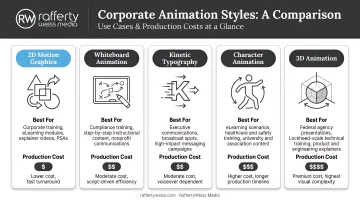
Style is a strategic decision, not just an aesthetic one. Organizations working on sensitive topics — healthcare explanations, government policy, legal compliance — benefit from minimalist, professional styles that signal credibility. Consumer-facing or recruitment content can afford more expressive approaches.
On cost: Vidico's 2026 production guide lists motion graphics at $1,000–$15,000 per minute and 3D at $10,000–$50,000+ per minute. These are directional ranges to inform budget planning, not project quotes — actual cost depends on script complexity, character development, revision rounds, and delivery requirements.
2D motion graphics deliver strong results at accessible budgets for most corporate, government, and nonprofit use cases. 3D is worth the investment when three-dimensional understanding of a product or mechanism genuinely matters.
How to Plan Your Animated Corporate Video
Pre-Production Is Where Projects Win or Lose
Most organizations underinvest in the strategy and scripting phase relative to production. The decisions made before a single frame is animated determine whether the finished video actually achieves its objective.
Cover these four areas before production starts:
- Define one communication objective — what should the viewer understand, feel, or do after watching?
- Identify the audience and what they already know — this shapes both style and script complexity
- Choose animation style strategically — based on audience, tone, and budget, not just visual preference
- Write a script that ends with a clear call to action — narrative structure first, then visuals
The script is the leverage point. It's far cheaper to rewrite a sentence than to reanimate a scene.
Work With a Team That Knows Your Sector
Corporate, government, and nonprofit animated videos carry requirements that consumer advertising doesn't. Federal agency work requires Section 508 compliance — closed captioning, audio description, color contrast standards. Healthcare content requires HIPAA compliance built into production, not added afterward. Government projects have multi-stakeholder review cycles that don't exist in commercial work.
A production partner with genuine sector experience navigates these requirements without slowing down the project. RaffertyWeiss Media, for example, has spent over 25 years producing animated and motion graphics content for federal agencies including the CDC, Department of Labor, and Department of Justice, as well as nonprofits like AARP and the American Red Cross.
That depth shows in projects like their AARP SmartDriver series (20 animated explainer videos produced in five languages for nationwide distribution) — a scale and complexity that only sector-specific experience makes manageable.
Plan for Multi-Platform Use From the Start
Animated videos typically have a longer useful life than live-action equivalents. There are no dated wardrobe choices, location constraints, or on-camera talent schedules to manage. When a statistic changes or a product UI updates, the fix is often a voiceover swap or a single scene revision — not a reshoot.
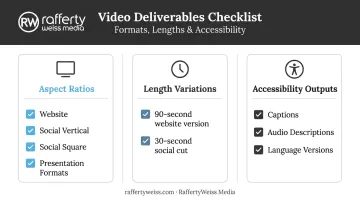
Plan for this upfront by specifying:
- Aspect ratios for website, social media (vertical and square), and presentation formats
- Length variations — a 90-second website version and a 30-second social cut of the same core message
- Accessibility outputs — captions, audio descriptions, and language versions if your audience requires them
Conclusion
The best animated corporate videos aren't defined by production budget or visual sophistication. They're defined by how clearly and memorably they serve a specific communication goal: explaining a healthcare process, building stakeholder trust, training employees on compliance, or driving action from a public audience.
If your organization is considering an animated video for marketing, training, or advocacy, the production partner you choose matters as much as the animation style. RaffertyWeiss Media has spent over 25 years producing video content for federal agencies, major corporations, healthcare organizations, and nonprofits — clients like the CDC, Lockheed Martin, and the American Red Cross — where communication has to be accurate, credible, and clear.
Explore how the RaffertyWeiss team approaches animated and motion-enhanced video production.
Frequently Asked Questions
What should be included in an animated corporate video?
A clear objective, a concise script built around a single message, visuals aligned with your brand and audience, professional voiceover or strong kinetic text, and a specific call to action. For marketing and explainer purposes, aim for 60–90 seconds total length.
How much does a 20-minute animated corporate video cost?
A 20-minute animated video is unusually long for corporate use. Per-minute rates vary by style — motion graphics run roughly $1,000–$15,000/minute, 3D runs $10,000–$50,000+/minute — but projects at this length should be scoped individually, not priced by simple multiplication.
What is the ideal length for an animated corporate video?
Most corporate explainer and marketing videos perform best at 60–90 seconds; training content can reasonably run 3–5 minutes, and social media formats should stay under 60 seconds. Platform, audience attention, and message depth all shape the right call.
What animation style works best for corporate explainer videos?
2D motion graphics are the most widely used for corporate explainers — professional in appearance, cost-effective, and versatile across subject matter. Whiteboard animation is often preferred for training and compliance content; 3D is best reserved for product showcases where three-dimensional understanding genuinely matters.
Can animated videos be used for government or non-profit communications?
Animation is highly effective for both sectors — particularly for explaining complex policies, public health information, safety messages, and mission storytelling. Its ability to depict abstract concepts and control tone without live-action constraints makes it a strong fit, especially when multilingual or accessibility requirements apply.
How long does it typically take to produce an animated corporate video?
A 60–90 second animated corporate video typically takes 4–8 weeks from script approval to final delivery. Projects involving multilingual versions, complex animation styles, or federal review and approval cycles should plan for a longer window — up to 10 weeks or more from initial kickoff.