The numbers back this up. According to Wyzowl's 2026 report, **93% of video marketers say video increased brand awareness**, 85% say it generated leads, and 83% say it increased sales. Meanwhile, LinkedIn's analysis of 13,000+ B2B video ads found that authentic emotion alone lifted brand-awareness engagement by 78%.
The tools work. The format works. What breaks down is the story.
This post breaks down 9 real-world corporate video storytelling examples — spanning legal tech, outdoor gear, SaaS, enterprise software, and more — examining what makes each one land and what any organization can take away, regardless of budget or sector.
Key Takeaways
- Corporate video storytelling works when it centers real people, real challenges, and real outcomes — not features or talking points
- Strong examples use documentary, animation, humor, and character-driven formats — proof that the approach matters less than the story
- The best videos share a clear structure: a relatable protagonist facing a real conflict, resolved in a way that connects back to the brand's purpose
- Budget isn't the deciding factor — narrative clarity is
- Organizations in any sector — corporate, government, or nonprofit — can apply these lessons directly
Why Corporate Video Storytelling Actually Works
The Brain Responds to Narrative Differently
Researcher Paul Zak's work, published in Cerebrum, found that compelling video narratives trigger oxytocin release and can shift attitudes, beliefs, and behaviors. A 2019 Journal of Neuroscience study confirmed that storytelling activates an extended brain network — including regions tied to memory and empathy — that data-only content simply doesn't reach.
The practical implication: a whitepaper delivers facts. A story creates the emotional context that turns those facts into action.
What This Means Across Sectors
The mechanism is the same whether the audience is a procurement officer, a federal employee, or a first-time donor. What changes is the context:
- Corporate clients: Storytelling builds trust with prospects faster than feature lists
- Government agencies: It translates complex initiatives into content citizens can understand and act on
- Nonprofits: It moves donors and volunteers by showing impact, not just describing it
RaffertyWeiss Media's nonprofit philosophy captures this directly: "People do not donate to causes — they give to stories." The same holds for corporate and government audiences, where the stakes range from contract decisions to public policy adoption.
What Makes a Great Corporate Storytelling Video
The Narrative Arc That Always Works
The structure is consistent across formats and budgets: a protagonist faces a problem, something changes, and the resolution connects back to the brand's purpose. That arc works in 60 seconds or 6 minutes. What varies is execution.
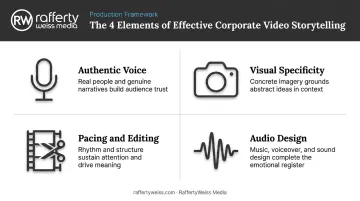
Four production elements determine whether the story lands:
- Authentic voice — Real people speaking naturally outperform polished scripts almost every time
- Visual specificity — Show the thing happening; don't just describe it
- Pacing and editing — Every cut should serve the narrative, not fill time
- Audio design — Music and tone shape how the audience feels before they've processed a single word
The Most Common Mistake
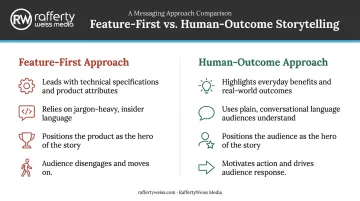
Knowing the arc matters less if you start from the wrong point of view. The biggest failure in corporate video is leading with the company's perspective instead of the audience's. The brand explains what it does, lists its capabilities, describes its values — and the viewer disengages immediately because none of it is about them.
The best corporate storytelling videos make the viewer — or someone who looks like them — the hero. The brand's role emerges from the story rather than being announced at the top.
RaffertyWeiss Media's approach reflects this directly: every project starts with a discovery phase focused on the audience's goals and the message they need to receive — before a camera is ever turned on. That sequence is what separates video that performs from video that just exists.
9 Best Corporate Video Storytelling Examples in 2026
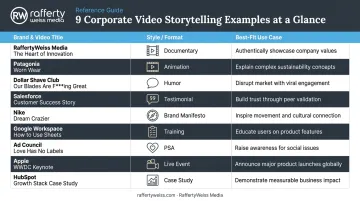
These examples were selected across industries and formats to show that compelling storytelling is achievable whether you're selling software, inspiring donors, or explaining a government program. Budget matters less than you'd think. What separates these videos is how they're built narratively.
1. Thomson Reuters x CoCounsel: The Innocence Center
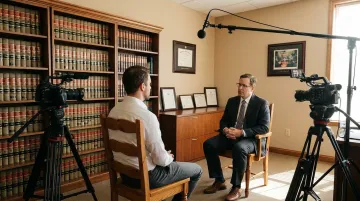
Thomson Reuters produced a documentary-style testimonial showing how its AI legal assistant, CoCounsel, helped The Innocence Center work on overturning wrongful convictions. The story centers on a real attorney and her clients — not the product. According to Thomson Reuters' published case study, the organization tripled its filings without adding staff or budget, and without burning out their team.
The technology's role emerges entirely from context — viewers care about the outcome before the product is ever explained.
| Element | Details |
|---|---|
| Style | Documentary-style testimonial with interviews and on-site footage |
| Why It Works | Focuses on people and outcomes — makes complex AI feel human and purposeful |
| Best For | Enterprise B2B, legal, government, or nonprofit brands explaining complex solutions through real-world impact |
2. Johnson Controls: Don't Surprise Bob
Johnson Controls used an animated, humor-led narrative to explain a technically complex HVAC product. The "Bob" concept personifies the problem — unexpected chiller downtime — through a relatable character rather than a spec sheet.
Humor and a distinct visual style make a dry subject watchable. The animation removes the stiffness of a traditional explainer while still delivering a precise product message. RaffertyWeiss Media has produced video work for Johnson Controls, including recruitment content for their Navy Systems Engineering division — a similar challenge of making highly technical work accessible to a broader audience.
| Element | Details |
|---|---|
| Style | Animation with puppetry-style motion and voiceover narration |
| Why It Works | Humor and visual personality make a technical message easy to understand and hard to forget |
| Best For | Corporate brands needing to simplify complex products without a large traditional production budget |
3. Square: The Corner Store
Square built a documentary around a real pop-up community hub in San Francisco's Mission District, capturing authentic vendor stories and neighborhood voices. There's no product demonstration — just the community Square serves, doing what it does. Block renewed the lease in 2026, signaling ongoing commitment to the initiative.
The brand shows up as a participant rather than an advertiser — and that positioning does more work than any campaign tagline could.
| Element | Details |
|---|---|
| Style | Community documentary with authentic local voices and real-world activation footage |
| Why It Works | Brand embeds itself in the community it serves — demonstrates values instead of stating them |
| Best For | Brands connecting with a specific community or audience segment through shared values |
4. Patagonia: Worn Wear — Stories We Wear
Patagonia's episodic series features real people who repair, reuse, and live out the brand's sustainability values. One episode follows a repair specialist who rescues clothes from landfills — not a spokesperson, not a marketing construct, but someone who genuinely does this work.
Rather than lecturing on environmental impact, the video shows someone who already believes what Patagonia believes. The brand's mission feels achievable rather than aspirational.
| Element | Details |
|---|---|
| Style | Documentary short — intimate, character-driven, minimal brand intrusion |
| Why It Works | Brand values come through via a real person's story — feels earned, not marketed |
| Best For | Purpose-driven organizations, nonprofits, and brands with a strong mission or sustainability angle |
5. Cisco: Making Security Human in a Hybrid World
Cisco's Security Service Edge video avoids technical jargon entirely. Instead of listing feature specifications, it reframes the product around everyday human outcomes: easier remote access, simpler day-to-day management, and a workforce that doesn't have to think about security to benefit from it.
This solves the core B2B storytelling problem — translating technical capability into something a non-technical stakeholder can see themselves benefiting from. The technology becomes a background detail; the human experience is front and center.
| Element | Details |
|---|---|
| Style | Clean B2B explainer with a human-outcome-first narrative |
| Why It Works | Reframes complex tech as an everyday enabler — makes the audience the center of the story |
| Best For | B2B and government technology vendors explaining infrastructure-level products to mixed audiences |
6. Airbnb: The Grand Adventure
Airbnb's Grand Adventure campaign blended live-action footage with claymation-style animation to promote its relaunched Experiences platform. The 60-second spot tells a travel story that feels personal and curiosity-driven rather than promotional.
The video taps into a universal desire — meaningful travel — and positions Airbnb Experiences as the vehicle for that feeling. There's no platform walkthrough, no feature checklist. The emotional journey carries the entire message.
| Element | Details |
|---|---|
| Style | Live-action and animation hybrid with an emotional, curiosity-led narrative |
| Why It Works | Frames a platform feature as an emotional journey — sells the feeling, not the product |
| Best For | Consumer and lifestyle brands launching or repositioning a product or platform feature |
7. Grammarly: The Term Paper
Grammarly's student-focused video follows a single character navigating the pressure of writing a term paper. Her emotional journey — the anxiety, the false starts, and ultimately the relief — drives the narrative. The product's value is revealed through her experience, not announced in an opening title card.
By choosing a universally relatable scenario and committing to a specific character, the video generates genuine investment in the outcome before the product is ever mentioned.
| Element | Details |
|---|---|
| Style | Character-driven narrative with a clear emotional arc and relatable protagonist |
| Why It Works | Audiences root for the character — the product's role makes its value tangible and emotionally satisfying |
| Best For | EdTech, SaaS, or any brand whose product directly supports user performance or confidence |
8. Shopify: Jill's Homestead
A fine leather goods operation out of Chariton, Iowa isn't the obvious subject for a platform case study — which is exactly what makes Shopify's video about Jill's Homestead work. The documentary follows a real entrepreneur and shows, without editorializing, how the platform helped her grow the business and reach customers well beyond her small town.
The setting — a small town, a specific craft, a real person — gives the video something no product demo can manufacture: a sense of place. The platform's role in the story is genuine, not constructed.
| Element | Details |
|---|---|
| Style | Customer journey documentary — location-driven, community-rooted |
| Why It Works | Focuses on the human behind the business, not the software — makes the brand feel like a partner |
| Best For | Platforms, SaaS tools, or service brands demonstrating real-world impact through customer stories |
9. Salesforce: Not Cool — What AI Was Meant to Be
Salesforce's "Not Cool" campaign used celebrity talent (Matthew McConaughey and Woody Harrelson) and sharp humor to flip the "AI is scary" narrative around its Agentforce platform. The campaign ran across broadcast TV, YouTube, and social — including Super Bowl LIX.
Rather than explaining what AI does, the video focuses on how it feels to use it. The tone disarms skepticism, and the humor makes the brand genuinely memorable. Even enterprise software, it turns out, can lead with a confident, distinct personality rather than a feature list.
| Element | Details |
|---|---|
| Style | Celebrity-led humor with fast editing and a strong, unexpected narrative hook |
| Why It Works | Personality and humor remove the intimidation factor from complex tech — makes the brand approachable |
| Best For | Enterprise tech and SaaS brands ready to lead with voice and confidence instead of feature explanations |
How We Selected These Examples
Each video was evaluated on three criteria:
- Narrative structure — Does it have a clear protagonist, conflict, and resolution?
- Authenticity — Does it feel real, or manufactured?
- Relevance — Does it apply to organizations beyond consumer brands with large budgets?
The diversity of formats and industries reflects a core argument: great storytelling is a craft, not a budget line. Wistia's 2026 State of Video Report, which analyzed 13 million videos and 79 million viewing hours, found that roughly 40% of companies spent under $5,000 on video production. What separates memorable videos from forgettable ones isn't the budget — it's narrative clarity.
That holds across every sector. A federal agency explaining a new program, a nonprofit running a fundraising campaign, or a B2B brand launching a product — all of them can produce video that resonates when the story is built with intention.
Conclusion
Every example on this list shares one thing: a commitment to the audience's perspective. They center real people, real challenges, and real outcomes. The brand's role emerges from the story rather than being announced at the top.
That's not a creative preference. It's why these videos get remembered and shared while most corporate video gets skipped.
Building that kind of video takes the right production partner — one who brings more than cameras and editing. Whether you're a corporate communications team, a government agency explaining a complex initiative, or a nonprofit trying to move donors to act, that partner needs the experience to find the story worth telling and the craft to make it connect with audiences.
RaffertyWeiss Media has spent more than 25 years producing corporate image films, testimonial videos, PSAs, and training content for clients including the American Red Cross, Lockheed Martin, Georgetown University, and federal agencies from the CDC to the Department of Justice. The work that has resonated most — the videos that moved audiences to act — has always started the same way: a clear story built around the audience, developed well before production begins.
If you have a message that matters, get in touch with RaffertyWeiss Media to talk through your next corporate video project.
Frequently Asked Questions
What are the 5 C's of storytelling?
The 5 C's typically referenced in corporate storytelling are Circumstance, Curiosity, Characters, Conversations, and Conflict. Together, they establish context, create tension, and give viewers someone to follow through to a resolution.
What is an example of corporate storytelling?
Patagonia's Worn Wear series is a strong example. Rather than describing its sustainability mission, Patagonia follows real people who repair and reuse gear, letting the brand's values come through a specific person's story. The result feels earned rather than marketed.
What is telling a story through video called?
It's called video storytelling or visual storytelling: using narrative structure, characters, and cinematic craft to communicate a message through moving image.
What makes a corporate video storytelling approach effective?
Four factors matter most: a relatable protagonist, a clear conflict or challenge, an emotionally honest resolution, and production quality that supports the narrative rather than overshadowing it. Critically, the story should center the audience, not the organization.
How long should a corporate storytelling video be?
Length depends on platform and purpose. Social cutdowns typically run 15–60 seconds; brand films and testimonials can run 2–4 minutes. Vidyard's benchmark data shows 65% completion for videos under one minute versus 20% for videos over 20 minutes. The practical rule: make it exactly as long as the story requires, and no longer.
What types of corporate videos benefit most from storytelling?
Testimonial videos, brand films, nonprofit impact videos, product launch videos, and recruitment videos all benefit significantly. Each format depends on emotional connection to drive a specific action: a purchase, a donation, an application, or a call.