The challenge is that producing video that actually drives donations, volunteer sign-ups, or awareness requires far more than pressing record. Results vary widely based on preparation, storytelling choices, and execution — and many nonprofits learn this the hard way.
This guide covers everything you need to know: the video types that work best, a step-by-step production process, the elements that separate high-performing nonprofit videos from forgettable ones, common pitfalls, and how to decide between doing it yourself and hiring a professional.
Key Takeaways
- Nonprofit video production follows three phases — pre-production, production, and post-production — each with distinct planning demands.
- The most effective nonprofit videos center on real people and stories, not the organization itself, and always end with a clear call to action.
- Different video types serve different goals: fundraising films, mission overviews, testimonials, and event videos all require their own approach.
- Budget, timeline, and story sensitivity should all factor into your DIY vs. professional decision.
- Video investments — at any budget level — can deliver measurable returns through higher donor engagement and grant success.
Types of Nonprofit Videos and When to Use Each
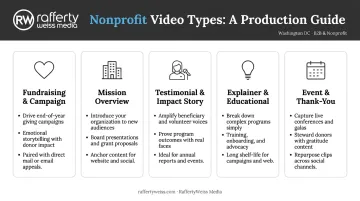
Choosing the right format before production begins is essential. The wrong format for the wrong goal wastes time and budget. Here are the five core types and when each one earns its place.
| Video Type | Best Used For |
|---|---|
| Fundraising & Campaign | Giving Tuesday, year-end drives, specific campaigns |
| Mission Overview | Homepages, grant applications, board presentations |
| Testimonial & Impact Story | Donor cultivation, volunteer recruitment |
| Explainer & Educational | Social media, email, complex issue communication |
| Event & Thank-You | Galas, volunteer recaps, post-donation follow-up |
Fundraising and Campaign Videos
These are purpose-built to inspire giving around a specific campaign — typically documentary-style, emotion-driven, and built around a single impact story. Best deployed during fundraising drives, Giving Tuesday, or year-end campaigns.
The key is specificity. One person's story outperforms broad organizational claims every time. Research published in Judgment and Decision Making found that donations dropped from $2.38 to $1.43 when statistics were added alongside an individual story — meaning leading with data dilutes emotional response rather than strengthening it.
Mission Overview and Organizational Videos
This is your "home base" video asset — introducing the organization, its work, and its impact to new audiences. Ideal for website homepages, grant applications, and board presentations. These have the longest shelf life of any video type, often serving multiple campaigns over two to three years.
According to Candid, nonprofit explainer and mission overview videos typically run 90 seconds or less for maximum effectiveness.
Testimonial and Impact Story Videos
These feature the people your organization serves, sharing their experiences in their own words. Authentic proof of mission effectiveness. Strong tools for donor cultivation and volunteer recruitment — especially when a potential major donor is weighing whether to give.
Explainer and Educational Videos
Shorter, often animated or motion-graphics-driven, designed to explain a specific program, process, or cause. Best for social media and email marketing where brevity matters. These work well when you need to communicate a complex issue quickly to an audience with limited time or context.
Event and Thank-You Videos
Gala highlights, volunteer event recaps, post-campaign thank-yous. Lower production intensity, but they build community and encourage shares. A well-edited thank-you video sent after a donation is one of the simplest ways to improve donor retention — and one of the most overlooked.
How to Produce a Nonprofit Video: A Step-by-Step Guide
Nonprofit video production follows three phases: pre-production, production, and post-production. Skipping or rushing any phase is the most common cause of poor results — particularly when budgets are tight and you only get one chance to capture a beneficiary's story.
Step 1: Pre-Production
Define your goal and format first. Are you driving donation conversions, recruiting volunteers, building awareness, or promoting an event? Each requires a different approach.
Develop a narrative framework. For most nonprofit videos, a three-act arc works best:
- Open with the problem or challenge your community faces
- Introduce your organization's work as the solution
- Close with a clear, specific call to action
Structure your story so the person you serve drives the narrative — your organization supports them, not the other way around.
Script or outline your video. For documentary-style pieces, develop interview questions rather than a verbatim script — you want natural responses, not rehearsed ones. For explainer or campaign videos, write a full script and create a storyboard to plan shots visually before shoot day.
Scout locations and secure consent. Schedule subjects early and obtain signed video release forms before filming begins. This matters most when working with vulnerable populations — minors, individuals in crisis, or patients — where COPPA and other consent requirements apply. Consult legal counsel if you're unsure.
Step 2: Production
Core equipment you need:
- Camera — smartphone (recent models work for lower-stakes content) or DSLR/mirrorless for professional results
- Microphone — lavalier or directional; poor audio is a credibility killer
- Lighting — natural light positioned in front of your subject, or a basic three-point setup
Research from USC summarizing Newman and Schwarz's work confirms that poor audio quality causes viewers to distrust both the information and the speaker. Viewers forgive technical video flaws far more readily than muffled or noisy audio.
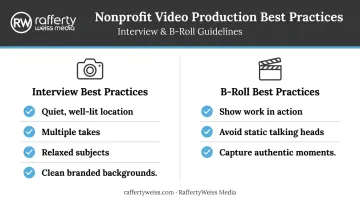
Interview and b-roll best practices:
- Conduct interviews in quiet, well-lit locations
- Capture b-roll showing your organization's work in action — talking heads alone feel static
- Give subjects multiple takes; help them feel relaxed rather than performed
- Ensure backgrounds are clean and consistent with your brand
Step 3: Post-Production
Edit for the arc, not the footage. Trim unnecessary pauses, sequence the narrative, and keep the final video tight. General length benchmarks by platform:
| Platform / Use Case | Recommended Length |
|---|---|
| Social media (LinkedIn, Instagram, Facebook) | 30–90 seconds |
| Website / fundraising pages | 2–3 minutes |
| Gala / event presentations | 3–5 minutes |
Music, color, and motion graphics set emotional tone — and any music used must be properly licensed. Unlicensed music can result in content removal or legal exposure.
Captions are non-negotiable. A 2019 Verizon/Publicis Media study of 5,616 adults found that 80% of viewers were more likely to watch a full video when captions were available. Beyond engagement, captions are required for prerecorded synchronized media under WCAG Success Criterion 1.2.2. YouTube Studio, Descript, and Rev all offer accessible captioning options — but always review auto-generated captions for accuracy before publishing.
Deliver multiple format cuts optimized for each platform: horizontal for YouTube and website, vertical for social, square for Instagram.
Key Elements That Make Nonprofit Videos Effective
Technical quality matters, but what separates impactful nonprofit videos from forgettable ones comes down to storytelling discipline and strategic structure.
Authentic Human Stories at the Center
The most effective nonprofit videos focus on one specific person's journey — not statistics, not organizational accomplishments. A single face and voice creates emotional connection; broad claims do not. Think of your organization as the guide — the person you serve is the hero of the story.
A Clear and Specific Call to Action
Every nonprofit video must end with one unambiguous ask. "Donate $50 by December 31" outperforms "learn more about our mission" every time. Vague CTAs create friction; specific, time-bound requests create momentum. Reinforce the CTA in the video's caption and any accompanying links.
Emotional Resonance Without Exploitation
Authentic emotional storytelling and manipulative portrayals that exploit a subject's vulnerability are not the same thing. Respecting the people you feature — while still capturing genuine emotion — is both an ethical imperative and a donor trust requirement. Audiences recognize the difference, and getting it wrong damages credibility rather than building it.
Production Quality That Signals Credibility
High-budget cinematic production isn't always necessary. But poor audio, blurry footage, or erratic editing signals carelessness — and carelessness erodes donor trust. In practice, low production quality makes an organization appear less credible — and that perception directly affects donor confidence. The bar isn't perfection; it's professionalism.
Strategic Length and Platform Fit
Video length should be driven by purpose and context, not padding. As a general rule: social media clips should run 60–90 seconds, website overview videos 2–3 minutes, and donor appeal videos no longer than 3 minutes. Cut ruthlessly — viewer drop-off increases significantly beyond these thresholds regardless of content quality.
Common Mistakes Nonprofits Make in Video Production
These patterns consistently weaken nonprofit video performance, regardless of budget.
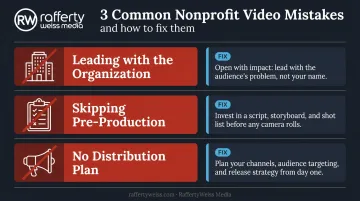
Three mistakes come up repeatedly — and each one is avoidable with upfront planning:
- Leading with the organization, not the cause. Videos that open with the nonprofit's history, staff, or accolades lose viewers before an emotional connection forms. Donors give to people and causes. If your first minute is about you, you've already lost them.
- Skipping pre-production. No clear narrative, unvetted release forms, or an undefined CTA means footage that can't be assembled into a coherent story. That's wasted shoot time and budget you can't recover in the edit.
- Producing without a distribution plan. Posting a video once to a single channel squanders the investment. Strategic distribution — website integration, email campaigns, event screenings, grant applications — multiplies reach and ROI. 86% of nonprofits use email marketing, and adding video to email can lift click-through rates by up to 65%. That's impact sitting unused if no plan exists.
DIY vs. Hiring a Professional Nonprofit Video Production Company
The right choice depends on the video's purpose, budget, story sensitivity, and your organization's internal capacity. Both paths can deliver results when matched to the right project type.
When DIY Makes Sense
In-house or smartphone-based production works well for:
- Short social media content and reels
- Thank-you and donor acknowledgment videos
- Event recaps and volunteer spotlights
- Internal communications
Canva and CapCut handle basic editing and graphics at no cost. For better results, invest in a decent lavalier microphone (~$30–$60), film with natural light in front of your subject, and minimize background noise. These three steps alone will dramatically improve quality.
When to Hire a Professional
High-stakes videos benefit significantly from professional production:
- Fundraising films and year-end campaign videos
- Mission overview videos for your website or grant applications
- Gala and event presentations
- Donor cultivation videos for major gift campaigns
That's because professionals bring more than technical skill. They bring storytelling expertise, professional-grade equipment, experience interviewing sensitive populations, and the ability to deliver multiple optimized cuts for every channel. They also understand the donor psychology that drives action, not just how to frame a shot.
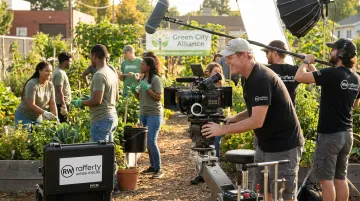
RaffertyWeiss Media, based in Washington D.C. with over 25 years of nonprofit video experience, has produced mission-driven content for organizations including the American Red Cross, United Way, AARP, Girl Up, and Fourblock. Their full-service model covers every stage of production under one roof:
- Scripting and creative development
- Filming and on-site direction
- Editing, sound design, and motion graphics
- Captioning and platform-optimized delivery
Evaluating Production Partners
When vetting a nonprofit video production company, look for:
- A nonprofit portfolio that demonstrates authentic, people-centered storytelling (not just technically polished footage)
- Demonstrated understanding of fundraising psychology, not just creative execution
- Experience managing consent processes for sensitive or vulnerable populations
- A collaborative, communicative working style with a clear production process from discovery through delivery
Frequently Asked Questions
How much does it cost to produce a 2-minute video for a nonprofit?
Costs vary widely based on scope. Candid cites $2,500 to $30,000+ for large-scale nonprofit explainer videos; general market research from Clutch places professional video production projects at $10,000 to $49,999. Key cost drivers include shoot days, crew size, number of locations, travel, animation level, and number of deliverables.
What are the five elements of an effective nonprofit video?
The five core elements are: a human-centered story, a clear problem-solution arc, authentic emotion, professional production quality, and a specific call to action. These work together rather than independently — a strong story with a weak CTA still underperforms.
How long should a nonprofit video be?
Length should match platform and purpose: 30–90 seconds for social media, 2–3 minutes for website and fundraising pages, and 3–5 minutes for gala or event use. Viewer engagement drops significantly beyond these thresholds regardless of content quality.
Should nonprofits hire a professional video production company or create videos themselves?
It depends on the stakes. DIY works well for casual social content and internal communications. High-impact fundraising films, mission overview videos, and gala presentations benefit from professional expertise in storytelling, equipment, and donor psychology — areas where production quality directly affects whether viewers take action.
What types of nonprofit videos work best for fundraising?
Fundraising campaign films — documentary-style, built around a single impact story — and gala/event videos are the most effective for driving donations. Testimonial videos from those served by the organization are particularly persuasive for major gift cultivation.
How do nonprofits handle consent and releases for people featured in their videos?
All individuals appearing in nonprofit videos should sign a written video release form before filming begins. Minors require parental or guardian consent; organizations working with patients or vulnerable populations must follow COPPA and HIPAA requirements, respectively — consult legal counsel before filming any of these groups.