Introduction
Many organizations budget for video production without a clear picture of what they're actually purchasing. Marketing managers and communications directors often assume they're paying primarily for a crew to show up and film — and that everything else is relatively minor.
That assumption tends to produce scope mismatches, unexpected costs, and finished videos that don't do what they were supposed to.
Professional video production is a structured, multi-phase process. According to LinkedIn's 2025 B2B Marketing Benchmark, 78% of B2B marketers now use video, and 56% planned to increase that investment. More organizations are entering conversations with production companies than ever before — often without a clear sense of what the engagement actually involves.
This article is written for marketing managers, communications directors, and organizational leaders evaluating professional video production services. It covers what's actually included, how the process works, and the factors that shape scope and cost.
Key Takeaways
- Professional video production covers the full lifecycle: strategic planning, scripting, filming, and post-production
- Each phase — pre-production, production, and post-production — has its own defined deliverables and team responsibilities
- Post-production often represents the majority of a project's labor, not a minor add-on
- Scope and cost are driven by filming days, locations, video length, complexity, and distribution channel requirements
- A full-service company provides strategic counsel, project management, and quality oversight alongside camera work
What Professional Video Production Services Actually Include
Professional video production is a managed creative and operational engagement — one that takes a project from strategic brief to finished, deployment-ready asset. Every phase is intentional, documented, and tied directly to the client's goals.
Strategic Foundation Before Filming Begins
The first deliverable in any professional engagement is a strategic foundation — not footage. Goal-setting, audience definition, key messaging, and concept development all happen before any equipment is scheduled.
At RaffertyWeiss Media, every project begins with a discovery and strategy phase: understanding business goals, target audience, and key messages before cameras are turned on. This brief becomes the reference point for every creative decision that follows.
Scriptwriting and Storyboarding
Script and storyboard development are core inclusions in professional production — not optional upgrades. A professional team develops the narrative, on-screen language, interview questions or scripted dialogue, and a shot-by-shot visual plan before any equipment is deployed.
Both documents are delivered to the client for review and approval before production proceeds. This checkpoint catches misalignments early — before they become expensive problems on set.
Production-Day Services
The shoot itself involves more than pointing a camera. On a professional production, a dedicated crew manages:
- Directing talent or interview subjects toward natural, on-message performance
- Lighting design appropriate to the environment, subject, and intended look
- Audio capture using dedicated equipment — not camera-mounted microphones
- Crew coordination across all technical departments simultaneously
Post-Production
Post-production is where raw footage becomes a finished, broadcast-ready video. A full-service engagement includes:
- Editorial assembly and pacing
- Color correction and grading for visual consistency
- Sound design, dialogue editing, and music
- Motion graphics, lower-thirds, and text elements
- Multiple rounds of client review and revision
- Final delivery in formats appropriate to the distribution channel
Final Delivery
Final delivery goes beyond a single exported file. A professional team provides format-specific exports for each intended use — broadcast, web, internal distribution, or social platforms — along with guidance on the technical specifications each channel requires.
How Professional Video Production Works: The Three Phases
Understanding the three-phase structure helps clients know what to expect — and what their own responsibilities are — at each stage.
Pre-Production: Planning, Scripting, and Logistics
Pre-production is where the project is built before filming begins. It's the phase that determines whether production day runs efficiently or unravels.
A professional pre-production phase includes:
- Creative brief development and concept approval
- Scriptwriting and storyboarding
- Location scouting and permitting
- Casting or interview subject coordination
- Scheduling and crew logistics
- Equipment planning
This is also where clients contribute: messaging direction, subject access, brand guidelines, approval sign-offs, and timeline alignment. The client's responsiveness during pre-production directly affects whether the project stays on schedule.
Freelancers often compress or skip this phase entirely. Thorough pre-production is one of the clearest distinctions between a full-service production company and a single-operator shoot.
Production: Filming and On-Set Management
Production is the execution of everything planned in pre-production. A full crew arrives with cinema-grade cameras, lighting rigs, and audio equipment, operating under a director's guidance to capture footage with purpose and precision.
On a properly staffed production, roles are clearly defined:
- Director — oversees performance and visual execution
- Producer — manages logistics and client communication on set
- Camera operator — executes the director's visual plan
- Audio technician — captures clean, usable sound
- Lighting specialist — builds and adjusts the lighting environment
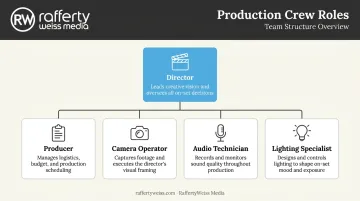
This structure is fundamentally different from a single-operator shoot, where one person manages all of the above simultaneously — which means none of them get full attention.
Post-Production: Editing, Finishing, and Delivery
Post-production transforms raw footage into a polished final product. The process goes well beyond cutting clips together:
- Color grading — creates visual consistency across different shooting environments
- Sound design — ensures audio clarity and appropriate atmosphere
- Motion graphics — adds context, branding, and visual emphasis
The revision process typically follows a structured workflow. RaffertyWeiss Media, for example, delivers a rough cut, fine cut, and final cut for each project — giving clients defined opportunities for feedback and refinement rather than open-ended, timeline-disrupting revision cycles.
AICP's post-production guidelines treat scope or schedule changes as billable change orders requiring written authorization from a designated client representative. This structure protects both parties — it keeps projects on schedule and ensures clients understand that mid-production pivots have real cost implications.
Types of Videos Included in Professional Production Services
Professional production services span a wide range of formats. The right format depends on the organizational objective — not personal preference.
Common formats for corporate and government clients include:
- Brand and image films establish organizational identity and mission for external audiences
- Training and onboarding videos replace or supplement written documentation and improve consistency across distributed teams. Training Magazine's 2025 survey found 77% of U.S. organizations with at least 100 employees use video for training delivery
- PSAs and public communications campaigns are built for broadcast or digital distribution, often with accessibility and language requirements included
- Testimonial and case study videos feature real voices supporting a product, program, or cause
- Explainer and overview videos translate complex processes, policies, or offerings into accessible content
- Event coverage captures conferences, announcements, or milestones for internal or external distribution
- eLearning modules deliver structured instructional content for LMS platforms, including SCORM or xAPI compatibility
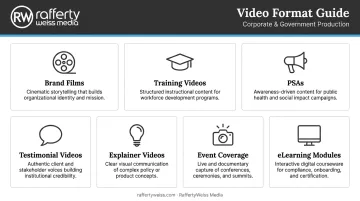
A good production partner helps confirm which format best serves the objective — and can surface options the client may not have considered.
What a Full-Service Production Company Delivers Beyond the Camera
The core distinction between a freelance videographer and a full-service production company isn't equipment — it's infrastructure.
A freelancer typically handles camera operation and basic editing. A production company provides:
- A managed team with defined specialist roles
- Strategic counsel on messaging and format
- Creative direction from brief through delivery
- Dedicated project management tracking timeline, budget, and approvals
- Quality oversight at every phase
Why Project Management Matters
Project management is one of the most undervalued inclusions in a professional engagement — particularly for corporate and government clients with complex approval workflows.
A dedicated producer or project manager tracks every moving part: scheduling, budget, stakeholder sign-offs, feedback consolidation, and version control. Without this function, projects drift — revision cycles multiply and deadlines slip.
RaffertyWeiss Media assigns a dedicated producer and project manager to each engagement. Jonathan Stein, Producer and Project Manager, serves as the central coordination point between clients, creative teams, and external partners — translating complex messaging needs into clear production structure.
For federal clients — including agencies like the CDC, Department of Labor, and Department of Justice — this coordination function is essential given the multi-tiered review and approval structures involved.
The Post-Production Misconception
Many clients assume filming represents the majority of a project's cost and that post-production is minor. In practice, editorial assembly, color grading, sound design, graphics, and revision management frequently account for the majority of total project labor. A full-service package bundles all of this into a predictable engagement — no negotiating add-ons after the shoot.
Key Factors That Shape the Scope and Cost of a Video Project
No two projects are identical. These are the variables that drive scope and cost in any professional production engagement:
| Variable | Impact on Scope |
|---|---|
| Number of filming days | More days = larger crew, more footage, more post-production |
| Number of locations | Each adds logistics, travel, and permitting considerations |
| Scripted talent vs. interview subjects | Casting, rehearsal, and direction add pre-production time |
| Video length (final runtime) | Longer runtime requires more shooting and editorial work |
| Graphics and animation requirements | Motion graphics and 2D animation add significant post-production hours |
| Revision rounds and approval structure | More stakeholders = longer revision cycles; define this upfront |
| Distribution channel | Broadcast, web, government, and social platforms each have distinct technical specs |
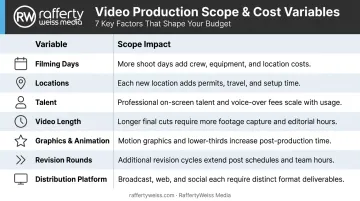
RaffertyWeiss Media has produced projects ranging from $5,000 to more than $100,000, showing how quickly scope and cost can scale. Clients should request a detailed quote that separates pre-production, production, and post-production costs — not a single flat number.
Distribution channel requirements deserve specific attention. Each platform imposes distinct technical requirements that must be built into the project plan from the start:
- PBS broadcast must meet PBS Technical Operating Specifications, including MXF OP1a container format at specific resolutions and frame rates
- Social media requires platform-specific aspect ratios and caption integration
- Government deliverables must comply with Section 508 accessibility standards — closed captions, audio description, and accessible file formats
Conclusion
Professional video production services encompass far more than a crew and a camera. From strategic brief through final delivery, a full-service engagement covers creative development, scripting, on-set management, post-production, and format-specific delivery — all coordinated by a team with defined roles and accountability.
Understanding this scope helps decision-makers evaluate proposals accurately. When reviewing a quote, look for clear line items across all three phases. Ask specifically about project management, revision structure, and final deliverable formats before signing anything.
A production partner worth hiring owns the entire process — from the first briefing call to the final exported file — so your team isn't left managing the gaps between phases.
Frequently Asked Questions
What does a professional video production company actually do?
A professional video production company manages the full lifecycle of a video project — from strategic planning, scripting, and filming through editing, sound design, and final delivery. They function as both a creative and operational partner, not just a technical crew.
What deliverables should I expect at the end of a video project?
Final deliverables typically include the finished video in multiple file formats and resolutions, platform-specific versions where required, and the approved final cut. Clarify this list in writing before signing a contract — format requirements vary significantly by distribution channel.
How long does the video production process take from start to finish?
Timelines vary by project complexity. Straightforward productions can wrap in two to four weeks; more complex multi-location shoots or eLearning modules typically run six to ten weeks or longer. Government productions requiring multi-stakeholder review should build in additional approval time.
What is the difference between a videographer and a video production company?
A videographer is typically one person handling camera work and basic editing. A video production company provides a full team — director, producer, editor, and technical crew — along with strategic counsel, project management, and quality oversight across the entire engagement.
How much does professional video production cost?
Costs vary based on filming days, locations, video length, crew size, and post-production complexity. Projects can range from a few thousand dollars to well over $100,000 for large-scale productions. For corporate and government clients, multi-day shoots, compliance review requirements, and accessibility deliverables (such as captions or Section 508-compliant formats) are common cost drivers worth discussing upfront.
What do social media video services include?
For corporate clients distributing content across channels, video production teams can provide platform-adapted edits — reformatted versions of the primary video optimized for LinkedIn, internal portals, or agency websites. This typically includes aspect ratio adjustments, caption integration, and shorter cuts derived from the same shoot.