Professional corporate event filming changes that calculation. When executed with intent, it turns a single day into a durable communication asset that works for your organization long after the last attendee leaves.
This article covers the concrete ways corporate event filming extends reach, strengthens credibility, and generates lasting content value — for corporations, government agencies, and nonprofits alike.
Key Takeaways
- Professional filming extends your event's reach to remote teams, future clients, board members, and media who weren't in the room
- Production quality directly affects stakeholder trust; 89% of consumers say video quality impacts their trust in a brand
- One filming session can generate a full library of reusable assets: highlight reels, speaker clips, social cuts, training content
- Live events cannot be reshot — skipping professional filming means losing key moments for good
- Align production goals with your communication strategy before filming to get the most from every session
What Is Corporate Event Filming?
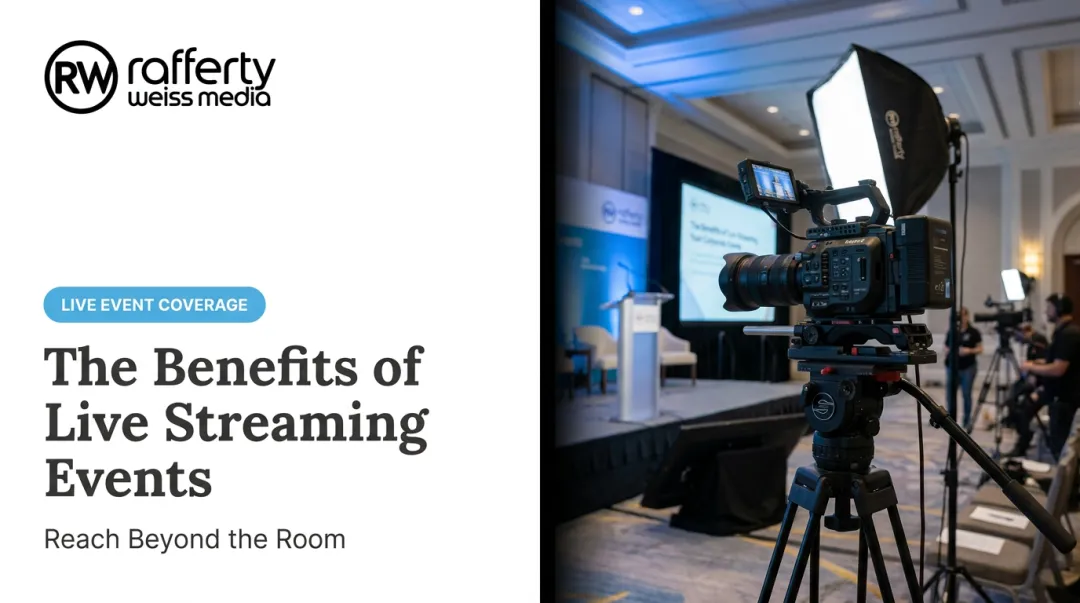
Corporate event filming is the professional capture, editing, and delivery of video content from business events — conferences, summits, award ceremonies, product launches, town halls, annual meetings, and government convenings.
It goes well beyond pressing record. A professional engagement includes:
- Pre-event planning — venue scouting, shot list development, AV coordination
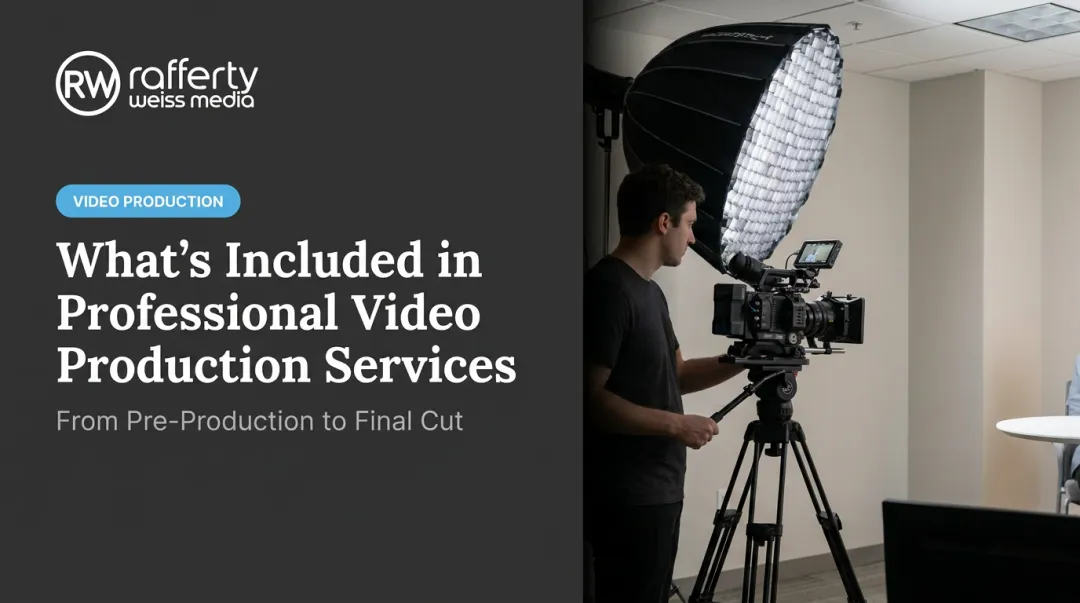
- On-site production — multi-camera capture, professional audio engineering, proper lighting
- Post-production — editing, sound mixing, branded lower-thirds, motion graphics, and delivery in formats suited to each intended use
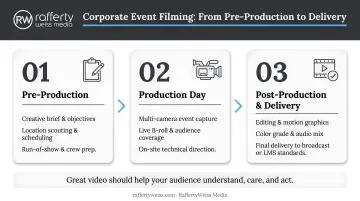
The distinction matters. Documentary-style filming produces a file that sits on a hard drive. A strategic production approach produces content your stakeholders can use for months — across internal communications, training, and external outreach.
Key Advantages of Corporate Event Filming
The advantages below go beyond the shoot itself — each one ties directly to how your organization communicates, builds credibility, and gets more from the investment.
Your Event Reaches Far Beyond the Room
Without filming, a corporate event's audience is limited to whoever showed up. Gallup's 2025 workplace research found that 51% of remote-capable U.S. employees worked hybrid, averaging just 2.3 office days per week. For national organizations, multi-site teams, or any company with distributed leadership, in-person events routinely miss large portions of their intended audience.
Professional filming solves this. A keynote address becomes on-demand content; an executive statement becomes a shareable asset for board communications; a product launch becomes a reference video for sales teams in every region.
The engagement data supports this format's staying power. ON24's 2025 Webinar Benchmarks Report found that 47% of event-style video engagement comes from on-demand viewing — meaning filmed content keeps accumulating views after the live date, not just during it.
Who benefits most from extended reach:
- Hybrid events where remote attendees need the same experience as those in the room
- National or multi-site organizations with distributed workforces
- Events with messages that need to reach audiences beyond the immediate attendee list — board members, constituents, media, or future employees
KPIs this affects: Stakeholder reach, post-event content views, internal communications coverage, social impressions
Professional Filming Strengthens Brand Credibility
Production quality communicates before a single word is spoken. When a viewer clicks play on your event recap, the visual and audio quality they encounter in the first ten seconds forms an immediate judgment about your organization.
Wyzowl's research found that 89% of consumers say video quality impacts their trust in a brand. TechSmith's 2024 Video Viewer Trends Report adds a sharper point: fuzzy audio was tied as the top reason viewers stop watching a video entirely.
Professional event filming addresses this through elements that a staff-operated smartphone simply cannot replicate:
- Calibrated multi-camera coverage that captures presenters and audience reaction
- Dedicated audio engineering for clean speech capture at podiums, panels, and Q&A
- Proper lighting that ensures speakers are visible and professionally framed
- Branded lower-thirds, titles, and speaker identification in post-production
For external-facing events — where prospects, media, or partners are watching — this isn't cosmetic. A poorly filmed executive address or panel discussion can undermine the speaker's authority and the organization's credibility, especially when shared publicly.
For government agencies and nonprofits, the stakes are equally concrete: accountability and public trust depend on the perception that an organization takes its communications seriously.
KPIs this affects: Brand perception, stakeholder trust, video completion rates, professional impression among prospects and partners
One Event Becomes a Year-Long Content Library
A professional filming engagement doesn't produce one video. It produces raw material that, with skilled editing, becomes a full suite of assets for different audiences, channels, and purposes.
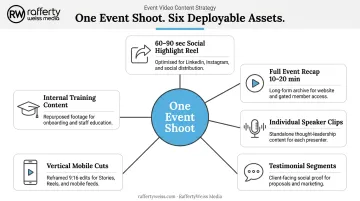
A typical content library from a single event shoot might include:
- A 60-90 second social highlight reel for LinkedIn, email campaigns, and the company website
- A full event recap (10-20 minutes) for board members and key stakeholders
- Individual speaker or panelist clips for thought leadership distribution
- Testimonial segments captured during the event for sales and marketing use
- Vertical cuts optimized for Instagram and other mobile-first platforms
- Internal training or onboarding content derived from keynote presentations
LinkedIn's analysis of over 13,000 B2B videos found that video posts are shared 20 times more than any other content type on the platform. Named subject-matter experts — exactly the executives and speakers featured at corporate events — drove a 40% lift in engagement.
This multiplier effect is where event filming earns back its cost. Organizations that treat filming as a content production investment extract more per dollar than those treating it as a one-time documentation expense.
KPIs this affects: Content output volume, cost-per-asset, post-event social engagement, marketing pipeline influence, internal training efficiency
What Happens When Corporate Event Filming Is Skipped
Organizations that rely on attendee phones or a single staff-operated camera routinely encounter the same set of outcomes:
- An executive statement, a product reveal, an award moment — live events cannot be reshot. If it wasn't captured cleanly, it doesn't exist.
- Footage that reflects badly on the organization can't be shared externally. Footage that sits unused delivers no return.
- Venue costs, speaker fees, attendee travel, and planning hours all compound the value of what was said in that room. Without professional capture, that value evaporates.
Underinvestment in post-production compounds the problem. Raw footage without editing, sound mixing, or branded graphics rarely gets used — even when the underlying capture was technically adequate. A rough, unedited four-hour recording doesn't get watched. A crisp 90-second highlight reel does.
How to Get the Most Value from Your Corporate Event Film
Professional event filming delivers maximum value when production goals align with communication strategy before a camera is ever turned on.
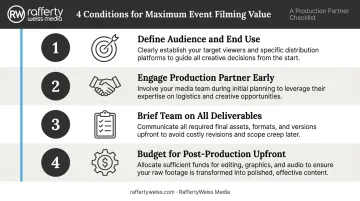
Four conditions for maximum return:
Identify your audience and end use before filming. A board presentation, an internal all-hands, a social highlight reel, and a media release all require different capture priorities and edit structures — and knowing the output upfront changes what gets captured.
Bring your production partner in early. Venue scouting, AV coordination, shot list development, and run-of-show alignment all happen in pre-production. Skipping this stage compresses quality and limits what's possible on shoot day.
Brief the team on every deliverable before filming. When the production crew knows every intended use upfront, footage is captured with each format in mind — not reverse-engineered afterward.
Budget for post-production from the start. The edit is where raw footage becomes content that gets used. Cutting corners here wastes the entire production day.
RaffertyWeiss Media structures every engagement around these conversations. With over 25 years filming events for clients like Lockheed Martin, Georgetown University, and the American Red Cross, their pre-production process — covering strategic briefing, venue planning, and AV coordination — ensures the footage captured directly serves the organization's communication goals.
Conclusion
Professional event filming turns a single gathering into a communication asset with a much longer shelf life.
The same footage that becomes a stakeholder recap this month can anchor onboarding content next quarter, a conference promotion next year, or a board presentation whenever it's needed. That compounding value is why the organizations that treat event filming as a strategic investment consistently extract more from their events than those that treat it as an optional line item.
Plan your next event with production goals defined from the start. When filming is planned strategically — not bolted on as an afterthought — the return on that investment compounds well beyond the event itself.
Frequently Asked Questions
How much does corporate event filming cost?
Pricing varies based on crew size, event duration, and post-production scope — a single-camera half-day shoot costs far less than a multi-camera full-day production with multiple deliverables. Request an itemized quote based on your specific event format rather than a flat rate.
Are you allowed to film in businesses?
Filming in private business venues generally requires venue permission and may involve location agreements or insurance requirements. Professional production companies handle these logistics as part of pre-event planning, so this rarely falls to the client to navigate alone.
What types of corporate events benefit most from professional filming?
Conferences, executive town halls, product launches, award ceremonies, annual meetings, and nonprofit fundraisers are all strong candidates — essentially any event where the message or moments have value beyond the day itself.
What deliverables should I expect from a corporate event filming engagement?
Common deliverables include a social highlight reel, a full event recap, individual speaker or testimonial clips, and platform-specific cuts. Agree on the full list before filming begins so footage is captured with each format in mind.
How far in advance should I hire a corporate event videographer?
Engage a production partner at least 4-6 weeks out to allow time for venue scouting, shot list development, AV coordination, and brand alignment. Last-minute bookings compress pre-production and limit what's possible on the day.
How long does it take to receive the finished corporate event video?
Turnaround depends on scope and the number of deliverables. Social highlight reels are often delivered within a week; full-length event recaps typically take 2-4 weeks depending on revision rounds agreed upon in advance.