Live streaming removes that constraint. More than that, it transforms a single-day event into a multi-channel communications asset with measurable, trackable outcomes. We're not talking about a trend here. We're talking about attendance numbers, content libraries, audience analytics, and brand perception — all of which shift when you add a professional live stream to your event strategy.
This article covers the concrete, operational benefits of live streaming corporate events: what each benefit actually delivers, which KPIs it affects, and when it matters most.
Key Takeaways
- Live streaming removes geographic barriers, letting distributed teams, clients, and stakeholders attend any event in real time
- 82% of event organizers already generate video-on-demand content from events — organizations that don't are falling behind established practice
- Streaming platforms generate engagement data (watch time, drop-off points, poll responses) that in-person events cannot capture
- On-demand recordings can increase total event views by up to 80% compared to live-only formats
- Production quality directly shapes how remote viewers perceive your brand — invest in a polished stream or risk undermining your credibility
What Is Live Streaming for Corporate Events?
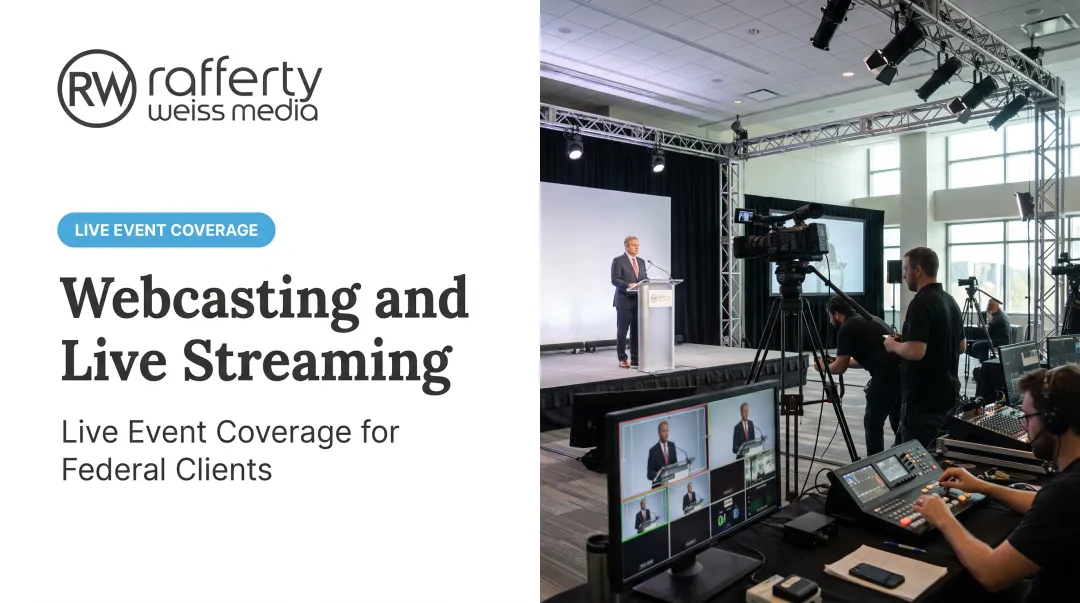
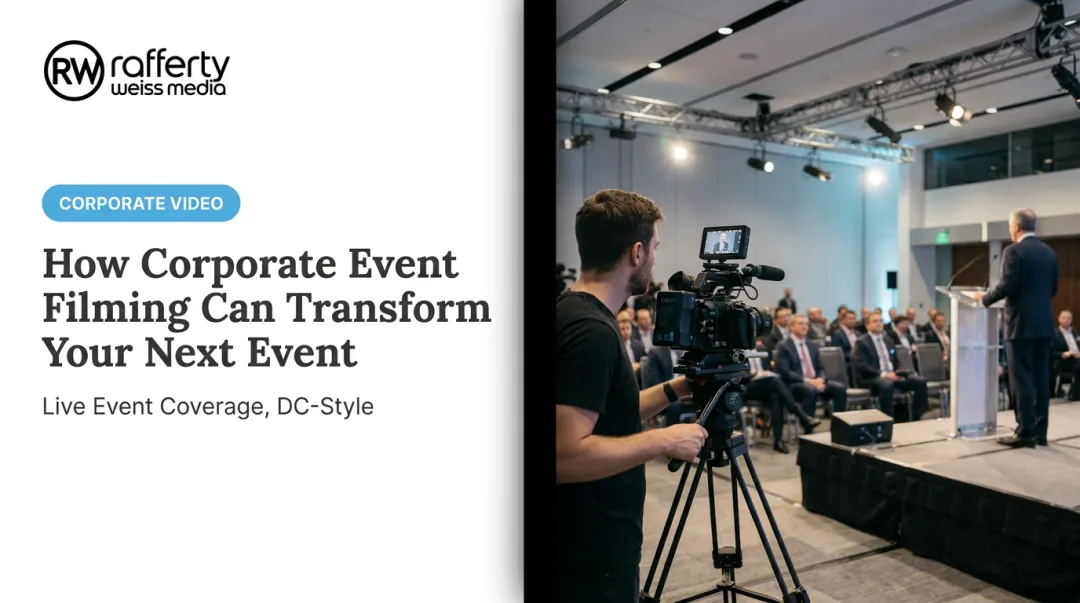
Corporate event live streaming is the real-time broadcast of an event — via camera, encoder, and streaming platform — to an online audience watching remotely and simultaneously.
The range of events it applies to is broad:
- All-hands meetings and executive town halls
- Annual conferences and leadership summits
- Product launches and press events
- Board and AGM meetings
- Training sessions and onboarding programs
- Government and nonprofit stakeholder briefings
The more useful framing is strategic, not technical. The real question is whether your organization is capturing the full value of every event it produces — and for most, there's significant room to do more.
Key Benefits of Live Streaming Your Corporate Events
The benefits below aren't abstract. Each one maps to outcomes that communications managers, event producers, and executive stakeholders actually track and report on.
Benefit 1: Expanded Reach and Inclusive Access
Live streaming decouples attendance from physical presence. A single event can reach distributed employees, remote clients, international partners, and stakeholders who can't travel — without adding venue or logistics costs.
Consider what this looks like in practice. An organization headquartered in Washington, D.C. runs a leadership summit. With a professional live stream, team members in five states, agency partners across multiple departments, and nonprofit stakeholders nationally can all attend simultaneously — with no travel budget required and no follow-up briefings needed.
That last point matters more than it might seem. When key stakeholders miss a critical announcement, information asymmetry creates misalignment — misalignment that requires follow-up calls, email summaries, and corrective communications to resolve. Grammarly's 2024 State of Business Communication Report estimates miscommunication costs U.S. businesses $1.2 trillion annually, with 100% of knowledge workers experiencing it at least weekly. Live streaming doesn't eliminate miscommunication, but it closes one of its most common sources: unequal access to information at the moment it's delivered.
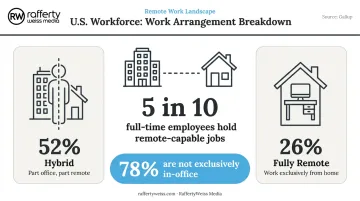
The workforce context reinforces the urgency. Gallup reports that 5 in 10 full-time U.S. employees hold remote-capable jobs, with 52% currently working hybrid and 26% fully remote. Designing events exclusively for in-person attendance means designing them to exclude the majority of your workforce.
KPIs this affects: Total event attendance, attendance-to-invite ratio, geographic reach of participants, stakeholder engagement rates
When it matters most: Distributed teams, events involving external partners or clients, public-sector announcements, and situations where travel budgets are constrained.
Benefit 2: Real-Time Engagement and Post-Event Audience Analytics
Live streaming doesn't just broadcast content — modern platforms layer interactive tools on top of the stream. Live Q&A, polls, and moderated chat turn passive viewers into active participants.
Speakers can respond to questions from remote attendees in real time. Polling surfaces audience sentiment mid-session. Chat often surfaces feedback that wouldn't come through in a formal Q&A format.
Where live streaming pulls ahead of in-person events, though, is in the analytics layer.
What streaming platforms track that in-person events can't:
- Concurrent viewers at any point in the broadcast
- Peak watch time and when viewership drops
- Replay rates and on-demand viewing behavior
- Q&A participation and poll response rates
- Individual viewer attendance duration
ON24's 2025 Webinar Benchmarks Report puts average webinar engagement at 51 minutes, with an average of 130 poll responses per session. That's a level of behavioral data in-person events simply don't generate.
The strategic application is direct. If viewer retention drops sharply 40 minutes into a two-hour keynote, that's a specific signal to restructure future programming — one you'd never have without the data to show it.
KPIs this affects: Viewer retention rate, peak concurrent viewers, Q&A participation rate, poll response rate, replay views, post-event survey completion
When it matters most: Training-heavy events, large conferences where session quality varies, and any organization trying to justify event budgets with measurable engagement data.
Benefit 3: Extended Content Value Through Professional Repurposing
A well-produced live stream doesn't end when the broadcast does. The recording becomes raw material for a range of content outputs:
- On-demand replays for stakeholders who missed the live event
- Training modules and LMS-ready content
- Social media clips and highlight reels
- Blog-supporting video and internal knowledge bases
- Executive thought leadership content
Instead of measuring a single-day event against venue and production costs, organizations can measure the cumulative reach and utility of every asset that event generates over weeks or months — a materially different ROI picture.
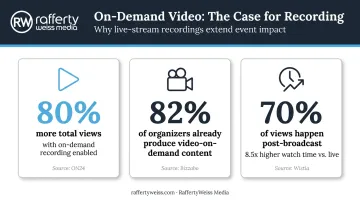
The numbers support this approach. According to ON24, making recordings available on-demand by default can increase total event views by up to 80%. Bizzabo's 2025 State of Events report found that 82% of organizers already generate video-on-demand content from events — and 53% gate that content as a lead generation asset.
One Wistia case study illustrates the potential at scale: 70% of total event views happened after the live broadcast via on-demand access, and clips from the recording generated more than 800,000 views with watch time 8.5x higher than the live event itself.
One requirement: all of this depends on professional production quality. Footage captured with proper lighting, clean audio, multiple camera angles, and skilled direction is usable as marketing and training content. Footage that falls short of broadcast standards typically isn't — and that opportunity doesn't come back.
This is where experience makes a measurable difference. RaffertyWeiss Media's work on the Global Auto Policy Summit — a multi-continent broadcast connecting U.S. EV policy discussions with automotive executives in Germany and Japan — was produced with broadcast-grade audio, enterprise-level streaming infrastructure, and redundant transmission paths. That level of production creates footage with real downstream utility, not just a functional day-of broadcast.
KPIs this affects: Post-event content views, on-demand replay rate, content pieces generated per event, social media engagement on event clips
When it matters most: Recurring events (annual conferences, quarterly all-hands, regular training sessions) where a library of professional footage compounds in value over time.
What Happens When Organizations Skip Live Streaming
The consequences are operational, not theoretical:
- Capped attendance leaves key stakeholders out of announcements, creating follow-up overhead, misalignment, and second-hand communication gaps
- No recording means the investment in speakers, logistics, and production yields value for one day only — no reusable assets
- No analytics lets poor session structures and disengaging content repeat across future events without correction
- No content library means every future content need requires a standalone production budget
- Public-sector and nonprofit organizations face an additional risk: without archived event coverage, governance and transparency gaps can emerge. All 50 states already live-stream legislative floor proceedings, per NCSL's 2025 reporting — a benchmark that applies pressure to associations, agencies, and mission-driven organizations alike
Organizations that build a live streaming practice accumulate content libraries, audience data, and stakeholder reach over time. The gap widens with every event — because each one either adds to that foundation or doesn't.
How to Get the Most Value from Your Live Stream
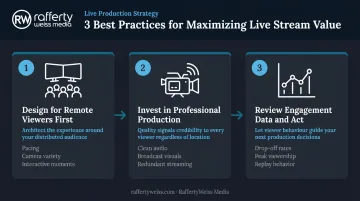
Three practices separate high-performing live streams from forgettable ones:
1. Design for remote viewers from the start — before the run-of-show is finalized. Pacing, visual variety (multiple camera angles, motion graphics, transitions), and interactive moments need to be built into the content plan. An in-person event adapted for streaming rarely performs as well as one designed with both audiences in mind.
2. Invest in professional production quality. Every remote viewer forms an impression of your organization based on what they see and hear. Clean audio, broadcast-level visuals, and reliable connectivity aren't optional — they're the baseline. A technically poor stream signals a technically poor organization, regardless of the content quality.
For mission-critical events, that means redundant streaming paths, pre-event bandwidth testing, and experienced technical direction on-site. RaffertyWeiss Media supports simultaneous streaming to:
- YouTube Live and LinkedIn Live
- Zoom Webinar and Microsoft Teams Live Events
- Vimeo and custom client portals
Failover infrastructure is standard for events where a dropped connection isn't an option.
3. Review engagement data after every event and act on it. Drop-off rates, peak viewership windows, and replay behavior are a roadmap for improving future events. Organizations that treat this data as a standard post-event review — not an occasional exercise — run measurably better events over time.
Conclusion
The value of live streaming corporate events shows up in concrete outcomes: broader attendance, richer audience data, longer-lived content, and stronger brand perception across every event your organization produces.
These advantages compound. Organizations that build a consistent live streaming practice accumulate content libraries, audience insights, and stakeholder reach that grow in value over time. Organizations that treat each event as a one-day, in-room experience start each new event from zero.
Live streaming is a communications strategy first. The technology enables it, but professional execution — reliable audio, clean switching, stable encoding — determines whether your audience stays engaged or drops off. Organizations that invest in production quality see the difference in every metric that matters.
Frequently Asked Questions
How much does it cost to live stream a corporate event?
Costs vary based on event length, number of cameras, venue requirements, and whether post-event editing is included. Simple single-camera webcasts can start around $2,500, while full multi-camera hybrid productions are scoped per event. The resulting footage — repurposed as clips, training assets, or highlight reels — often delivers value well beyond the original broadcast.
What are the top live streaming platforms for corporate events?
Commonly used platforms include YouTube Live, Vimeo Livestream, Zoom Webinars, Microsoft Teams Live Events, and BigMarker. Platform choice should be driven by audience size, security requirements, and the engagement features you need — such as polls, Q&A, and post-event replay access.
What types of corporate events are best suited for live streaming?
Events where broad access, real-time participation, and documentation matter most are the strongest candidates. These commonly include:
- All-hands meetings and leadership summits
- Product launches and annual conferences
- Training sessions and board meetings
- Government or nonprofit stakeholder briefings
Do you need a professional production team to live stream a corporate event?
Basic streaming is technically accessible, but professional production is necessary when the event reflects on your brand, involves executives or external stakeholders, or when you need footage reusable as marketing or training content. Production quality directly affects how remote viewers perceive your organization.
Can live streamed events be accessed on-demand after the broadcast?
Yes. Most platforms support post-event recording and on-demand access. Professionally produced streams are especially well-suited to repurposing as clips, training modules, and highlight reels — extending reach long after the live broadcast ends.
How do you keep remote viewers engaged during a live stream?
Interactive tools like live Q&A, polls, and moderated chat maintain participation, while multi-camera coverage and motion graphics sustain visual interest. The most effective approach is designing the content experience for a virtual audience from the start — not simply broadcasting what was planned for an in-person room.