Corporate event photography transforms those moments into lasting marketing assets: LinkedIn posts, press releases, sponsor reports, email campaigns, and promotional material for next year's event. The photos do work long after the event ends.
This guide covers everything you need to know — how to build a shot list, brief a photographer effectively, understand pricing and contracts, and turn your event photos into weeks of content.
Key Takeaways
- Corporate event photography drives marketing, PR, internal communications, and sponsor reporting — not just archiving memories.
- Share a detailed shot list at least one week out — it's what separates generic snapshots from usable marketing content.
- Pricing depends on event duration, deliverable volume, and photographer experience; always get a written contract with usage rights defined.
- Photos and video together produce more reusable content than either alone; brief both teams simultaneously.
What Is Corporate Event Photography and Why Companies Invest in It
Corporate event photography is the professional documentation of business gatherings — conferences, trade shows, award ceremonies, product launches, and networking events — with a specific goal: producing content that serves marketing, PR, and internal communications.
This isn't a photographer capturing candid moments for personal albums. Every frame should be usable somewhere: a LinkedIn post, an email newsletter, a sponsor fulfillment deck, an annual report, or a press release.
The Business Case for Professional Event Photos
LinkedIn reports that company page posts with images receive a 2x higher comment rate than posts without images. A 2023 LinkedIn and Ipsos B2B Benchmarking Report also found that in-person events ranked as the most effective and most used channel in B2B marketing.
Put those two facts together: events are your highest-value marketing channel, and professional photography is what makes that investment visible to audiences who weren't in the room.
Event photos get reused across:
- Social media (day-of posts and post-event recaps)
- Email newsletters to attendees and prospects
- Press releases and media pitches
- Company website event galleries
- Sponsor fulfillment and reporting decks
- Future event promotional materials
That range of uses is what separates corporate event photography from general event work.
Corporate vs. General Event Photography
The output requirements are fundamentally different. Corporate event photos must align with brand standards and serve specific stakeholder audiences — sponsors, board members, media contacts. That shapes every decision a photographer makes on the floor.
A few things a corporate photographer accounts for that a general event photographer often doesn't:
- Brand consistency — backdrops, banners, and signage must be framed deliberately, not cropped out
- Speaker and executive coverage — no mid-blink shots, no unflattering angles for featured presenters
- Stakeholder-specific needs — sponsors may require logo visibility; PR teams need clean, publishable images
- Editorial judgment — knowing which moments are usable, not just technically correct
The Essential Shot List for Corporate Events
A shot list is often thought of as a photographer's tool. It isn't — it's a client responsibility. The photographer doesn't know your sponsor commitments, your VIP relationships, or which board member needs to appear in the annual report. You do. A structured shot list shared at least one week before the event aligns expectations and ensures no business-critical moment gets missed.
Venue and Brand Moments
Capture these before guests arrive:
- Exterior signage and building entrance
- Branded registration desks and welcome displays
- Empty stage setup with lighting active
- Sponsor banners and logo placements
- Event collateral: name badges, gift bags, printed programs
These shots establish visual context and fulfill a direct business requirement: many sponsors contractually require photographic proof of logo placement and brand visibility.
Speaker and Stage Coverage
Every speaker needs three distinct shots, each serving a different purpose:
- Wide establishing shot: Speaker on stage with audience visible in the foreground — shows event scale and energy
- Close-up for expression: Captures a specific gesture, moment of emphasis, or emotional beat
- Audience reaction: Applause, note-taking, engaged faces responding to the speaker
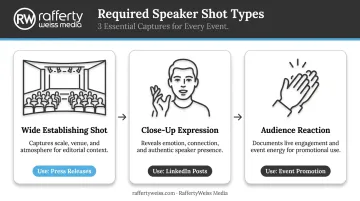
The wide shot works in press releases. The close-up works on LinkedIn. The audience reaction shot sells the next event registration.
Networking and Candid Interactions
Candid networking photos are the most powerful content for promoting future events. They don't sell the program agenda; they sell the attendee experience — which is harder to manufacture and more persuasive to show.
Prioritize these moments:
- Small groups in conversation between sessions
- Attendees engaging with exhibitor booths
- Spontaneous laughter or reaction shots
- Handshakes and introductions in progress
Group Photos and VIP Moments
Planned group shots require advance scheduling. This includes:
- The organizing or leadership team
- Award recipients immediately after recognition
- VIPs and board members
- Speakers together as a group
Brief the photographer on who these individuals are before the event. Asking a photographer to identify your CEO from a crowd of 300 guests mid-session doesn't work.
Don't overlook detail shots: catering before service begins, décor elements, event technology, signage close-ups. These round out the visual record and give your communications team usable assets for post-event recap emails, social media carousels, and internal reports.
How to Plan and Brief Your Corporate Event Photographer
A detailed pre-event brief matters more than any piece of equipment the photographer brings. Without it, even an experienced photographer is guessing at your priorities.
A complete brief should include:
- Full event schedule with session times and transitions
- Shot list with prioritized moments
- VIP faces to recognize (names, roles, photos if possible)
- Brand guidelines and any visual restrictions
- No-flash zones or off-limits areas
- Dress code requirements
Before the Event
Grant the photographer access to the venue 45–60 minutes before guests arrive. This time is used for location scouting, testing ambient and stage lighting, identifying ideal vantage points, and capturing empty venue and branded detail shots. These can't be recreated once the room fills.
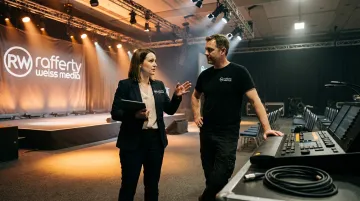
Introduce the photographer to the AV and production crew. Lighting changes during keynotes, transitions between sessions, and spotlight timing all directly affect photo quality. A photographer who knows when stage lighting shifts can anticipate the shot rather than react to it. That's the difference between a technically strong image and a missed moment.
During the Event
A professional corporate event photographer moves unobtrusively and dresses to match the event — business casual at minimum. They prioritize authentic moments over posed setups, because candid interactions read as more credible marketing content than shots where subjects are visibly aware of the camera.
Designate a single internal contact for the photographer throughout the event — someone with a copy of the schedule who can signal when key moments are approaching: award announcements, VIP arrivals, panel transitions. This person doesn't need to follow the photographer; they just need to be reachable.
After the Event
Expect a professional photographer to deliver an edited, curated gallery — not a raw export of every frame taken. A standard professional deliverable is typically in the range of 30–50 polished images per hour of coverage, provided in both high-resolution (for print) and web-optimized formats (for digital). Turnaround for a typical corporate event gallery runs 5–7 business days.
If you need same-day or next-day delivery for press use, discuss this with the photographer before the event. Rush delivery is a different workflow and is typically scoped separately.
Pricing and What to Include in Your Photography Contract
Corporate event photography pricing varies considerably based on event duration, deliverable volume, turnaround speed, and photographer experience. According to PPA's event pricing guidance, there's no single market rate — photographers build pricing from their actual costs: day or half-day rates, preparation, travel, editing time, and overhead. Request itemized quotes — package pricing is rarely standard in this market.
When comparing quotes, ask specifically:
- Are web-optimized files for social media included alongside high-resolution files for print?
- Does the rate include post-processing and color correction?
- Are travel costs itemized separately?
- What's the fee for rush delivery?
What Your Contract Must Include
Don't proceed without a written contract that covers:
- Scope of work — exact hours of coverage, deliverable count, file formats
- Turnaround timeline — specific business days, not vague estimates
- Payment schedule — deposit amount, balance due date
- Cancellation policy — for both parties
- Usage rights — explicitly including commercial marketing use across digital and print channels
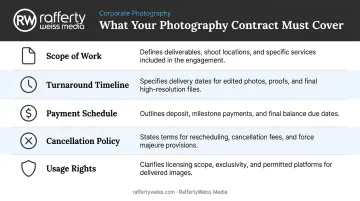
On usage rights: ASMP is clear that photographers own copyright and license specific uses to clients. For corporate marketing, the contract must explicitly authorize use in social media, email campaigns, press materials, internal communications, and paid advertising. Vague language like "internal use only" creates problems the moment you post a photo on LinkedIn.
Before signing, confirm whether additional editing fees apply beyond a set image count, and whether travel and parking are billed separately — these are the most common line items that inflate final invoices.
Integrating Photography with Video for Maximum Event ROI
The organizations getting the most from their event investments stopped treating photography and video as separate decisions. They commission both as part of a single, coordinated media strategy — and the content output is substantially larger as a result.
A photographer captures the stills powering LinkedIn posts, press releases, and email campaigns. A video team captures motion content for highlight reels, speaker clips, testimonial cutdowns, and social video. Both serve distinct formats; both amplify the other.
Wyzowl reports that 91% of businesses now use video as a marketing tool — and LinkedIn data shows native video earns 5x more engagement than other content on the platform. Photography and video together aren't redundant; they're complementary tools for different audience behaviors.
What Coordinated Coverage Looks Like in Practice
Coordinated photo and video coverage requires:
- A shared shot list reviewed by both teams before the event
- Aligned creative direction — consistent framing, brand emphasis, and moment prioritization
- Complementary positioning — photographer and videographer working different angles during key moments rather than competing for the same frame
- Unified post-event delivery — organized by moment type and format, ready for the content team
The Content Multiplication Effect
A single 8-hour corporate conference covered by both photo and video generates:
- LinkedIn posts and stories (day-of and post-event)
- A full event highlight reel
- Individual speaker clips
- Testimonial cutdowns
- Press-ready photography
- Email campaign imagery
- Next year's event promotional assets
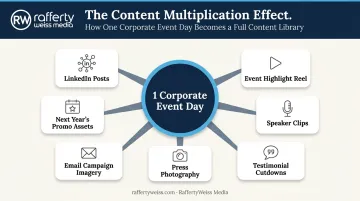
That's a full content library from a single shoot day — when both teams are planned and coordinated from the start.
RaffertyWeiss Media structures event engagements this way by default. With clients including the American Red Cross, Lockheed Martin, and Georgetown University, their approach combines multi-camera live event video, highlight reels, and professional still photography into one integrated package. The planning that shapes the content happens well before anyone arrives on-site — which is what separates a media strategy from a collection of footage.
Post-Event: How to Repurpose Your Corporate Event Photos
The most strategic clients don't start thinking about content distribution after the event. They build a repurposing plan before the photographer arrives.
Primary Distribution Channels
- LinkedIn and social media — day-of teasers and post-event recap posts
- Email newsletters — sent to attendees, prospects, and stakeholder lists
- Press releases — attached to media pitches for coverage
- Website — event gallery pages, "about" sections, case study pages
- Sponsor reports — visual proof of brand placement and audience reach
Organize Your Image Library Immediately
When the gallery arrives, tag and organize by:
- Moment type (speaker, networking, group, venue/detail)
- Subject, including VIPs or brand-specific individuals
- Format — horizontal for web and email, vertical for social and mobile
A disorganized image library wastes time before every campaign launch. Organized correctly once, it makes timed distribution far easier to execute.
Timing Your Posts
Post a handful of teaser images within 24 hours of the event to capture immediate audience interest while the experience is fresh. Hold the full gallery for a curated post-event recap — this creates a second engagement moment and extends the content's lifespan beyond the news cycle.
Bizzabo recommends repurposing event content into lead-generating formats including blog posts, social content, and video. A well-organized photo library makes that repurposing faster — and the content more consistent across every channel.
Frequently Asked Questions
How much should a photographer charge for company event photography?
For most professional corporate event photographers in the US, day rates run $1,500–$3,500 depending on experience, event duration, and location. PPA guidance notes that professional pricing accounts for preparation, editing, travel, and overhead — not just hours on-site. Request itemized quotes from multiple photographers and compare what each rate includes before deciding.
What types of shots should every corporate event photographer capture?
The four core categories are venue and brand details, speaker and stage coverage, candid networking interactions, and group or VIP portraits. A pre-event shot list ensures all four are covered and that business-critical moments — award presentations, sponsor placements, key speakers — aren't missed.
How do I brief a corporate event photographer effectively?
Share the full event schedule, identify VIPs and key moments, explain any brand or dress code restrictions, and grant venue access 45–60 minutes before guests arrive. Designate one internal contact for the photographer to communicate with throughout the event.
How many photos should I expect from a corporate event shoot?
A professional standard is approximately 30–50 edited images per hour of coverage, typically delivered within 5–10 business days in both high-resolution and web-optimized formats. The deliverable should be a curated selection of the best frames — not a raw export of every image taken.
What's the difference between corporate photography and event photography?
Corporate photography typically refers to controlled shoots — headshots, product photography, branded imagery. Corporate event photography documents live gatherings with a mix of candid and planned shots intended for marketing, PR, and stakeholder communications.
Do I need both a photographer and a videographer for my corporate event?
For most corporate events, yes — still images and video serve distinct purposes across your marketing and communications channels. Coordinating both under a shared brief and shot list produces significantly more usable assets from a single event than booking either service alone.