Introduction
Corporate video has become one of the primary ways organizations communicate from the top down — but not all video production is created equal. When a CEO needs to address shareholders, a federal agency needs to reach the public, or a defense contractor needs to document a major initiative, the production requirements shift considerably.
Executive video production is a distinct discipline. It demands message strategy, stakeholder coordination, compliance awareness, and the ability to make non-professional on-camera talent look and sound credible. Handled poorly, the organization's reputation absorbs the damage.
According to Gallagher's 2025 Employee Communications Report, 48% of organizations now use leader video as a direct communications channel — and those that do rate it among their most effective tools at 79%.
Key Takeaways
- Executive video production covers CEO messages, institutional films, government communications, and investor content — not just marketing clips
- An executive producer (EP) oversees strategic direction, budget, and final delivery — not day-to-day scheduling
- Non-professional executives need coaching, teleprompter support, and a controlled environment to perform authentically on camera
- Distribution channel (intranet, broadcast, public website) must be determined before production starts — it shapes format, length, and technical specs
- The right production partner brings structured project management, not just a creative reel
What Is Executive Video Production?
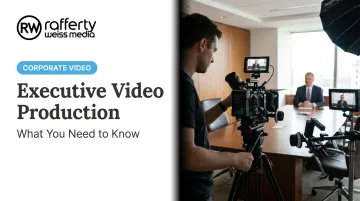
Executive video production refers to the professional creation of video content that serves organizational leadership communications. Think CEO messages, institutional image films, government public affairs videos, and investor relations content — not TV commercials or social media clips.
The term "executive" does double duty in this context. It describes both the seniority of the production leadership overseeing the project and, frequently, the subject matter itself: videos that feature or represent senior leaders and institutional voices.
Why This Category Demands More
Standard marketing video focuses on reach, engagement, and conversion. Executive video carries different weight. The audience may include investors, congressional stakeholders, federal oversight bodies, or the general public — and the stakes reflect that. Brand reputation, organizational credibility, and sometimes regulatory compliance are all on the line.
EVCOM defines corporate film as non-advertisement content created for businesses and organizations, with audiences spanning investors, consumers, and the internal workforce. That breadth of audience is exactly what separates executive video from a standard campaign asset.
Key differences from typical marketing content:
- Spans multi-day shoots, multiple locations, and extensive post-production
- Requires legal review, communications alignment, and executive approval chains
- Demands broadcast-quality lighting, audio, and editing as a baseline — not a premium add-on
- Ties every decision, from script to distribution format, directly to organizational objectives
What Does an Executive Producer Do in Corporate Video?
In a corporate or government production context, the executive producer (EP) is the top-level project authority. Their job isn't operating a camera or managing a shot list — it's ensuring the finished product delivers on its strategic objectives, not just its technical ones.
The EP bridges the gap between what an organization needs to communicate and what the production team actually builds.
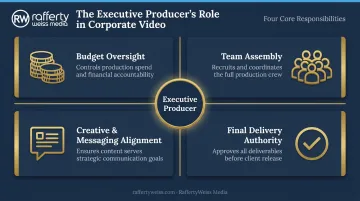
Core EP Responsibilities
- Budget oversight — securing resources, managing scope, and making final calls on where money is spent
- Team assembly — selecting the director, line producer, and key crew based on project requirements
- Creative and messaging alignment — ensuring scripts, visuals, and tone reflect the organization's strategic intent
- Final delivery authority — approving the finished product before it goes to the client
What the EP does not do: direct individual shots, manage daily scheduling, or coordinate crew logistics. Those responsibilities belong to the director and line producer, respectively.
The EP as Client Advocate
For corporate and government clients, having a strong EP on a project is particularly valuable because they function as the client's advocate inside the production. Business objectives, brand standards, and messaging accuracy don't get sacrificed for purely creative reasons.
That's exactly how Patrick Rafferty operates at RaffertyWeiss Media. As the company's Owner, Producer, and Director — with over 20 years of experience — he oversees projects from initial strategic planning through final delivery, keeping the client's goals at the center of every production decision.
Executive Producer vs. Producer: What's the Difference?
The EP holds final authority. The producer runs the operation day-to-day. Think of it as CEO versus COO — both essential, with clearly different lanes.
| Role | Primary Focus | Key Responsibilities |
|---|---|---|
| Executive Producer | Strategy & oversight | Budget, team, creative direction, final approval |
| Producer | Execution & logistics | Scheduling, crew coordination, client updates, daily management |
On smaller productions, one person may hold both roles. On larger or more complex productions — multi-location shoots, government communications campaigns, institutional films — separating these responsibilities is essential. Strategic oversight and operational precision require different kinds of attention.
RaffertyWeiss Media's team structure reflects this directly:
- Patrick Rafferty leads strategic and creative direction as Owner/Producer/Director
- Jonathan Stein handles operational coordination as Producer/Project Manager — serving as the central point of contact between clients, creative teams, and external partners
- Brie Bickmore manages post-production workflow as Producer/Editor
For clients, this translates to simple routing: escalate strategic concerns to the EP, and direct logistics questions, scheduling updates, and revision requests to the producer.
Common Types of Executive Video Productions
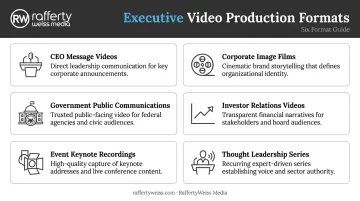
Executive video production covers a wide range of formats, each with distinct production requirements:
- CEO and leadership message videos — typically shot in a controlled studio environment, requiring on-camera coaching and tight scripting
- Corporate image films — multi-day productions with location shoots, scripted narration, and motion graphics
- Government public communications videos — subject to Section 508 accessibility standards, plain language requirements, and multi-tiered federal approval processes
- Investor relations videos — earnings announcements, shareholder communications, and board-level messaging with financial compliance considerations
- Event keynote recordings and highlights — live capture at high-stakes conferences, board meetings, or congressional hearings
- Thought leadership and spokesperson series — ongoing content positioning senior leaders as credible institutional voices
Scale and Scope Differ Dramatically by Format
A CEO message video might involve one shoot day, a teleprompter, and two weeks of post-production. A corporate image film is a different project entirely. RaffertyWeiss Media's work with Lockheed Martin — including the "1LMX Experience" and "Operational Excellence" films — required multiple locations, scripted narration, and substantial motion graphics work across extended timelines.
According to Wistia's State of Video Report, 40% of companies planned to increase video spending, with LinkedIn (81%) and YouTube (76%) as the dominant B2B distribution channels. That shift matters: executive video is increasingly a public-facing asset, not just internal communication.
Key Considerations for Corporate Executive Video
The On-Camera Executive Challenge
Most senior leaders are not professional on-camera talent. A CFO who commands a boardroom can freeze in front of a camera. Professional executive video production addresses this directly through:
- Pre-production coaching — message preparation, approved language, and scenario practice
- Teleprompter support — scripted delivery without the visual stiffness of reading from notes
- Controlled set environments — professional lighting, quiet locations, and a calm crew dynamic that reduces performance anxiety
RaffertyWeiss Media specifically builds this into their approach, emphasizing that they "create an environment where people feel comfortable — and the content shows it." Patrick Rafferty has directed executives and public figures including Bill Gates, Ross Perot, and multiple senior government officials. That depth of experience translates directly into getting authentic, credible performances from non-professional talent.
Compliance and Multi-Stakeholder Review
Government and large corporate productions rarely have a single approver. Scripts may require legal review, communications department sign-off, agency clearance, or all three. A production team without experience in these environments will underestimate how long this takes — and build timelines that fall apart.
RaffertyWeiss Media structures its process to accommodate these cycles, building review rounds into the production schedule rather than treating them as afterthoughts. For federal agency work, they incorporate Section 508 compliance requirements (captioning, audio description, accessible formatting) from day one, as required under federal accessibility standards.
Distribution as a Production Input
Where a video will ultimately live determines how it should be built. A video headed for an internal intranet has different length, tone, and format requirements than one going to a congressional committee or an investor presentation. These aren't post-production adjustments — they're pre-production decisions.
RaffertyWeiss Media's process starts with a discovery and strategy phase that identifies distribution channels before scripting begins. Their delivery phase then provides video optimized for each required platform, whether that's a corporate website, broadcast, internal LMS, or trade show display.
Choosing the Right Executive Video Production Partner
Not every production company can handle executive-level work. The gap between a capable commercial video team and a partner suited for government communications or investor relations content is significant.
What to Evaluate
- Relevant portfolio depth — a reel full of brand spots and social media clips doesn't demonstrate what's needed for a federal agency communications campaign or a CEO video for a Fortune 500 board. Look for demonstrated work with similar organizations.
- Structured project management — executive video timelines lock to external events: board meetings, product launches, legislative calendars. PMI data shows 52% of projects experience scope creep. Ask for evidence of process, not just creative portfolios.
- Security and confidentiality protocols — FAR requirements govern how contractors handle federal contract information. A production partner working with agencies like NCIS, the Department of Justice, or the Department of Defense needs to understand these obligations. RaffertyWeiss Media holds GSA Schedule No. 47QRAA20D0017 and is registered in SAM.gov, which streamlines procurement for federal contracting officers.
- Pre-production investment — the best partners ask hard questions about audience and distribution before a camera turns on. RaffertyWeiss Media's internal data shows clients who invest in pre-production planning see engagement rates 2–3x higher than those who skip it.
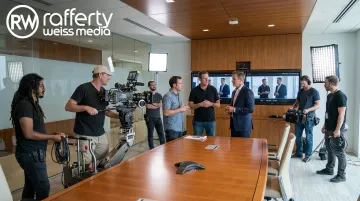
RaffertyWeiss Media has spent over 25 years producing corporate image films, government communications, and executive content for clients including Lockheed Martin, the American Red Cross, and federal agencies across DoD, HHS, DOJ, and CDC. That track record reflects both creative capability and the operational discipline executive-level work demands.
Frequently Asked Questions
What is an executive video producer?
An executive video producer is the senior-most authority on a video production, responsible for strategic direction, budget oversight, team assembly, and final delivery. In corporate and government contexts, the EP functions as the top-level decision-maker who ensures the finished product meets both creative and organizational objectives.
Is an executive producer higher than a producer?
Yes. The executive producer holds final authority over strategic and budgetary decisions, while the producer manages day-to-day operational execution — scheduling, crew coordination, and client logistics. On larger productions, these are distinct roles filled by different people.
What types of videos are considered executive video productions?
Common formats include:
- CEO and leadership message videos
- Corporate image films
- Government public affairs videos
- Investor relations content
- Event keynote recordings
- Thought leadership spokesperson series
Each format carries different production requirements based on audience, distribution, and compliance context.
How long does executive video production typically take?
A single executive spokesperson video typically takes 2–4 weeks from brief to delivery. A full corporate image film may run 2–4 months. Build in extra time for stakeholder review — approval chains at large corporations and federal agencies can add several weeks to the timeline.
What should we prepare before working with an executive video production company?
Clarify your target audience, intended distribution channels, core messages, and any compliance or approval requirements before the first production meeting. If you have sample videos that reflect your desired tone or style, bring those too.