The problem isn't production quality — it's that the video was built around what the organization wanted to say, not around what the audience needed to hear. Video has become the dominant format for business communication across internal and external channels, with 91% of businesses now using video as a marketing tool and 76% of B2B marketers incorporating it into their content programs. The format works. The execution is where most organizations lose the thread.
This guide covers what corporate video production actually involves, which formats deliver results, how the production process works from brief to final cut, what it costs, and the specific techniques that separate forgettable videos from ones that move audiences to act.
Key Takeaways
- Corporate video production is the end-to-end process of creating purposeful video content that serves a specific business goal, whether for internal teams or external audiences.
- Every production moves through three phases: pre-production (planning and scripting), production (filming), and post-production (editing and delivery).
- Captivating video starts with the audience's goals and pressures, not your organization's announcement agenda.
- Costs range from roughly $3,000 for basic single-operator work to $100,000+ for full-service productions, driven by complexity, crew, and post-production depth.
- The right production partner asks strategic questions before the camera turns on — not after the budget is spent.
What Is Corporate Video Production (And Why It Matters)
Corporate video production covers any video content made in service of a specific business goal — for internal audiences like employees and new hires, or external ones like customers, prospects, and government stakeholders. The category spans compliance training, brand films, onboarding modules, TV spots, and congressional testimony support.
The case for video over other communication formats is straightforward. According to Vidyard's 2024 benchmark research, 65% of viewers stay engaged to the end for videos under one minute — a completion rate that text-based content rarely approaches. On the buying side, 85% of people say a video convinced them to purchase a product or service, and 89% say video quality affects their trust in a brand.
That trust figure has real operational consequences: it affects whether a decision-maker returns a call, whether a donor gives again, and whether new employees actually retain onboarding content.
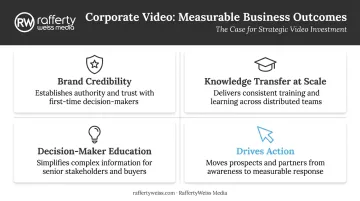
Corporate video supports measurable business outcomes across four categories:
- Builds brand credibility so audiences understand who you are before they ever speak with you
- Transfers knowledge at scale through onboarding, training, and compliance content
- Educates decision-makers on complex products, policies, or services
- Drives action — purchases, policy changes, donations, or behavioral shifts
Types of Corporate Videos Every Organization Should Know
Format selection matters as much as production quality. A beautifully shot brand film won't solve a compliance training problem. Choosing the right format means matching the video type to the audience, channel, and objective — before scripting begins.
External-Facing Formats
| Format | Primary Purpose |
|---|---|
| Brand/image films | Communicate who you are and what you stand for |
| Product and service demos | Show features in the context of real problems |
| Customer testimonials and case studies | Peer validation that builds credibility with prospects |
| Marketing and advertising videos | Designed for paid or organic distribution |
Wyzowl's 2026 survey found that testimonial videos are now produced by 57% of video marketers — the third most common type after social media videos (69%) and explainers (68%). For B2B audiences in particular, testimonials and case studies carry outsized weight because they let a peer do the persuading.
Internal-Facing Formats
- Employee onboarding and training — standardize knowledge transfer across locations and time zones
- Compliance and safety videos — reduce liability and ensure consistent understanding across workforces
- Leadership communications — town halls, organizational updates, executive messages
- eLearning modules — LMS-ready content with structured assessments and accessibility compliance
That last point — accessibility compliance — carries real weight for certain organizations. Government agencies and nonprofits often face mandatory requirements that go beyond standard production checklists.
Federal video content must meet Section 508 standards, including captions, audio descriptions, and compatible delivery formats. Organizations in regulated sectors face similar obligations: financial services under FINRA Rule 2210, healthcare under HIPAA, and defense contractors under agency-specific review processes.
The Corporate Video Production Process: From Brief to Final Cut
Pre-Production: Where Most Organizations Underinvest
Pre-production is where the real work happens, and where most organizations shortchange themselves. It covers everything from defining the video's purpose to finalizing logistics before a camera turns on.
Before any scripting begins, every organization should answer these questions:
- Who is the primary audience, and what do they already know or believe?
- What do we want them to feel, do, or think differently after watching?
- Where will this video live, and how will people find it?
- What's the single most important message — if they remember nothing else?
- What's the approval process, and who has final sign-off?
A tight brief prevents expensive reshoots. RaffertyWeiss Media's process starts with a discovery and strategy phase that covers business goals, target audience, and key messages before a camera turns on. Scripts and storyboards are then developed for client review, creating a checkpoint for messaging accuracy before any production dollars hit the set.
Regulated industries feel this most acutely. For the Department of Education, RaffertyWeiss produced Section 508-compliant training videos ("Access for Everyone: Creating a Culture of Accessibility") where scripting accuracy was a compliance requirement, not just a creative preference.
Production: Capturing What Matters
On set or on location, the work is executing the shot list while staying flexible enough to capture what you didn't plan for.
Three fundamentals during production that make the edit significantly easier:
- Audio quality is non-negotiable. Poor audio undermines credibility faster than poor visuals. Audiences forgive imperfect lighting; they stop watching when dialogue is hard to follow.
- Capture B-roll generously. The more contextual footage available, the more flexible the final cut can be. Tight B-roll coverage separates a polished edit from one that loops the same shot four times.
- Allow unscripted moments. For testimonials and culture-focused videos, the most credible moments often come from natural conversation, not a prepared answer delivered to camera.
What happens on set directly shapes what's possible in post.
Post-Production: From Raw Footage to Final Delivery
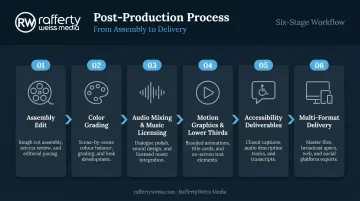
Post-production involves a layered series of decisions, each one affecting the final result:
- Assembly edit — establishing the structure and pacing
- Color grading — visual consistency across footage shot in different conditions
- Audio mixing and music licensing — clarity and tone
- Motion graphics and lower thirds — context, brand elements, and calls to action
- Accessibility deliverables — captions, audio descriptions where required
- Multi-format delivery — optimized cuts for each distribution channel
That last point is where many organizations leave value on the table. The same content often needs different aspect ratios, lengths, and caption treatments depending on whether it's living on a website, embedded in an email, posted to LinkedIn, or uploaded to an LMS. A 3-minute brand film doesn't get repurposed as a LinkedIn post by cropping the thumbnail : it requires a separate edit built for a different viewing context.
LinkedIn's own guidance recommends videos under 30 seconds for brand awareness, noting a 200% lift in completion rates for sub-30-second videos. Plan distribution formats before the edit begins, not after.
How to Captivate Your Audience Like a Pro
Technical polish doesn't hold attention. Story structure does.
The most common reason corporate videos fail isn't production quality — it's that they're organized around what the organization wants to say rather than what the audience needs to hear. Starting with your mission statement or logo animation is the video equivalent of leading a sales call by reading your company history aloud.
Structure for Engagement, Not Just Information
Even functional videos — training modules, compliance content, product demos — benefit from a clear purpose and through-line. The structure doesn't need to be dramatic — it needs to give viewers a reason to keep watching.
A training video structured around story might look like this:
- Open with a problem scenario the audience recognizes from their own work
- Show what happens when it's handled wrong — make the stakes real
- Introduce the information or process being taught as the path through
- Resolve by showing the employee handle the same scenario correctly
Compare that to the default format: slide 1, slide 2, slide 3, quiz. The story structure isn't longer — it's more engaging, and it gives viewers a reason to stay attentive rather than clicking through to the assessment.
Authenticity Over Polish
For B2B audiences and government stakeholders, credibility and sincerity carry more weight than production flair. Real employees, real clients, and real environments often outperform polished scripts with hired talent when trust is the goal.
AARP's SmartDriver series — a 20-video explainer program produced by RaffertyWeiss Media across multiple languages — worked partly because the content was built around genuine instructional clarity for older adult drivers, not around brand messaging.
Length Discipline
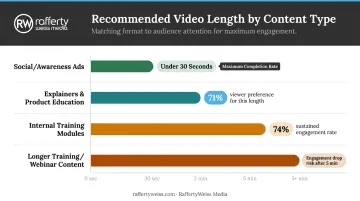
Most corporate videos run 30-50% longer than they need to. Every second should justify its presence. Wyzowl and Wistia research point to consistent patterns by video type:
- Social/awareness ads: Under 30 seconds for maximum completion
- Explainers and product education: 30 seconds to 2 minutes — 71% of viewers say this range is most effective
- Internal training modules: 3–5 minutes with structured content; Wistia found 74% engagement for instructional videos in this range
- Longer training/webinar content: Engagement drops significantly after 5 minutes
The First 10 Seconds
Viewers decide whether to stay within the first 5–10 seconds. That window is your only guaranteed chance to earn the next 30 — don't spend it on a logo animation or a mission statement.
Techniques that earn attention from the first frame:
- Open with a provocative question your audience is actually asking
- Lead with a human moment — a face, an expression, a specific scenario
- Start mid-action rather than building up to the subject
- Use sound as a hook — an unexpected audio cue creates immediate curiosity
The flip side matters just as much. Avoid opening with your logo, tagline, founding year, or any sentence that starts with "At [Company Name], we believe..." — these signal to viewers that the video is about you, not them.
Corporate Video Production Costs: What to Budget For
Costs vary widely based on crew size, production complexity, location requirements, talent, and post-production depth. The ranges below are directional, based on current industry guidance from production sources — not universal market averages.
Production Tiers
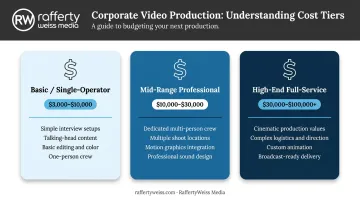
| Tier | Approximate Range | Typical Scope |
|---|---|---|
| Basic / single-operator | $3,000 – $10,000 | Simple interviews, talking-head content, basic editing |
| Mid-range professional | $10,000 – $30,000 | Dedicated crew, multiple locations, motion graphics |
| High-end full-service | $30,000 – $100,000+ | Cinematic production, complex logistics, animation, broadcast |
RaffertyWeiss Media's project range runs from $5,000 to more than $100,000, with cost determined by scope, number of shoot days, travel, and final runtime — a range that reflects the real variability in corporate production.
Key Cost Drivers
- Pre-production: scripting, storyboarding, discovery time
- Crew: director, DP, sound, production assistants
- Equipment and lighting
- Location fees or studio rental
- On-camera talent (internal staff vs. professional talent)
- Post-production: editing hours, color grading, audio mixing
- Motion graphics and animation
- Music licensing
- Accessibility deliverables (captions, audio description)
- Revision rounds
The Hidden Cost of Under-Investment
When a video fails to achieve its objective, the entire budget is lost — not just the production line item. Staff time spent reviewing scripts, leadership hours on camera, and distribution costs all return nothing.
89% of consumers say video quality affects their trust in a brand. A production that looks underfunded signals something to your audience about the organization behind it — particularly in regulated industries, government communications, and high-stakes B2B contexts where credibility is the entire message.
In-House vs. Hiring a Corporate Video Production Company
Wyzowl's 2026 data shows 59% of organizations create video themselves, 32% use a hybrid of in-house and external vendors, and 10% rely entirely on external production companies. The right answer depends on the stakes of the content and what "good enough" means for that specific communication.
When In-House Works
- Quick internal updates, town hall recordings, informal culture content
- High volume of simple, short-form content where speed matters more than polish
- Teams with genuine video expertise and appropriate equipment already in place
When to Hire a Production Partner
- Flagship brand films or executive-level communications
- Content designed for external audiences or public distribution
- Regulated industries where messaging accuracy is non-negotiable
- Campaigns where production quality directly reflects brand reputation
- Organizations without the internal bandwidth to manage production alongside their core work
For government agencies, large nonprofits, and major corporations, the reputational risk of a poorly produced video often outweighs any cost savings from internal production. A CDC public health video that fails accessibility requirements, or a financial services communication that violates FINRA Rule 2210, creates compliance problems no post-production fix can resolve.
What to Evaluate in a Production Partner
- Portfolio depth in your sector — have they worked with organizations facing similar audiences and constraints?
- Strategic input — do they ask about your objectives before discussing deliverables?
- Process clarity — is there a defined workflow for review, approval, and revisions?
- Compliance experience — especially for federal, healthcare, or regulated-industry clients
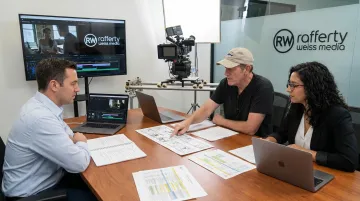
Those criteria matter most when the content is high-stakes. RaffertyWeiss Media has spent 25+ years producing video for organizations like Lockheed Martin, the American Red Cross, Georgetown University, and HealthCare.gov — translating complex organizational messages into content that informs, persuades, and drives action.
Frequently Asked Questions
What is corporate video production?
Corporate video production is the process of planning, filming, and editing content for a specific business purpose: internal communication, employee training, marketing, or stakeholder engagement. The scope covers everything from scripting and storyboarding through final delivery and distribution.
How much does corporate video production cost?
Costs range widely based on scope and quality. Basic single-operator productions typically start around $3,000–$10,000, while full-service professional productions can reach $30,000–$100,000 or more. Define your objectives and distribution context first — those factors drive most cost decisions.
What types of corporate videos work best for B2B audiences?
Customer testimonials, case studies, and explainer videos perform best with B2B decision-makers — they build credibility and establish expertise through a peer or subject matter expert rather than a direct sales message. These formats address specific questions without feeling like a pitch.
How long does corporate video production typically take?
A standard corporate video with professional production typically takes four to eight weeks from brief to delivery, with pre-production, shoot days, and post-production each requiring dedicated time. Timeline compression is possible but usually increases cost or requires trade-offs in quality or revision depth.
How do I measure the success of a corporate video?
Tie metrics to the original objective. For awareness content, track view duration and completion rates. For marketing videos, measure conversion rates or lead quality. For training content, use knowledge retention scores or LMS completion rates. For internal communications, qualitative stakeholder feedback and follow-through on communicated actions are often the most meaningful indicators.