The ones that actually work look completely different. They're built on real people, honest storytelling, and a clear sense of purpose — and they accomplish in 90 seconds what a capabilities document can't accomplish in 10 pages.
According to Wyzowl's 2026 video marketing research, 89% of consumers say video quality impacts their trust in a brand, and 93% of video marketers report video helped increase brand awareness. For organizations trying to close the trust gap with a prospective client, partner, or stakeholder, that's a significant opportunity.
This article covers what separates forgettable About Us videos from ones that actually perform: the key elements that make them work, six standout brand examples, and practical lessons you can apply to your own production.
Key Takeaways
- An About Us video builds trust by showing the people, values, and purpose behind your organization — not just your service list.
- The best examples share four traits: authentic storytelling, real human faces, a clear "why," and disciplined brevity.
- Great About Us videos open a door; they don't tell the whole story.
- The same principles apply whether you're a corporation, nonprofit, or government agency: show, don't just tell.
- Pre-production planning, not equipment, is what separates a high-performing brand film from an expensive one.
What Is an About Us Video and Why Does It Matter
An About Us video is a short-form brand film that introduces your company's story, people, values, and mission. It goes by several names — company video, brand film, culture video — but the purpose is the same: give your audience a reason to trust and remember you.
This format does its heaviest lifting during the consideration stage of the buyer journey, when a potential client, partner, or stakeholder is deciding whether they actually want to work with you. At that moment, a well-produced brand film communicates personality, credibility, and values in ways that a website page or capabilities statement simply cannot.
Where About Us Videos Live
Part of the ROI case for About Us videos is straightforward: the same asset works across nearly every channel you're already using.
- Homepage — Wistia's 2026 State of Video report confirms homepage, video gallery, and product page videos earn the highest play rates of any on-site placement
- LinkedIn — 8 in 10 B2B teams call LinkedIn their primary video distribution channel
- Pitch decks and presentations — a brand film running before a proposal meeting sets the tone before a word is spoken
- Email outreach — nearly half of marketing teams now include video in email campaigns
- Live events — used as an opening reel or lobby loop, a brand film primes an audience before any live interaction begins
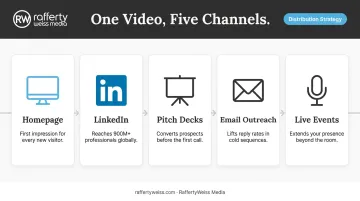
Produce it once, deploy it everywhere — that's a rare combination in content marketing.
What Makes a Great About Us Video: 5 Key Elements
1. Emotional Core
The most memorable About Us videos are driven by genuine passion — the "why" behind the company's existence. Simon Sinek's Golden Circle framework captures this well: people don't buy what you do, they buy why you do it. Viewers don't connect with service lists. They connect with belief systems.
A video that opens with the problem the founders set out to solve, or the mission that drives daily decisions, creates an emotional anchor the rest of the film can build on.
2. Human Faces and Authentic Voices
Putting real people on screen — founders, employees, even customers — is the single most effective trust signal available to any brand. According to Edelman's 2025 Brand Trust report, 73% of consumers say trust increases when a brand authentically reflects its culture, compared to just 27% for brands that focus solely on products.
Scripted, over-rehearsed delivery undermines that trust entirely. Letting employees speak within a structured framework — rather than reciting approved lines — produces far more watchable, believable results. The difference on screen is immediate:
- Over-rehearsed: Stiff delivery, eye contact with teleprompter, zero spontaneity
- Structured but natural: Genuine answers, real pauses, visible personality
- Off-script entirely: Inconsistent messaging, unusable takes, wasted production time
3. Visual Proof Over Abstract Claims
"We're committed to excellence" means nothing without proof. B-roll of real workspaces, teams collaborating, and processes in action transforms abstract brand values into credible demonstrations. Real environments and authentic footage outperform staged setups and stock imagery on every credibility metric.
4. Disciplined Brevity
60 to 90 seconds is the practical target for most About Us videos. Wistia's data shows videos under one minute average 52% engagement, and for B2B audiences specifically, Vidyard's 2024 benchmark found 65% of viewers complete videos under one minute.
A focused, well-structured video signals that a company knows its own value and respects the viewer's attention. Running long rarely adds persuasive weight; it usually signals an unclear message.
5. A Clear Narrative Arc
Even 90 seconds needs structure. The best About Us videos move through three beats:
- Origin — where the company came from and what problem drove it
- Values — what the organization stands for and how that shapes the work
- Direction — where it's headed and why that matters to the viewer
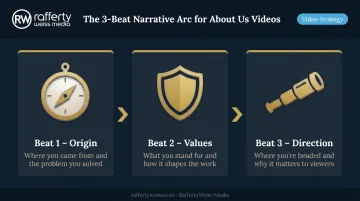
Building this arc requires deliberate pre-production work. The hardest part isn't knowing what to include — it's deciding what to cut before you ever turn on a camera.
Best About Us Video Examples That Get It Right
These six examples were chosen because each one excels at one or more of the principles above — and together they cover a wide range of industries, tones, and approaches.
Here's a quick look at what each example does well:
- Dropbox — unconventional format that lets individual personalities shine
- HubSpot — founding philosophy told through high-production brand film
- Founders Brewing Co. — vulnerability and near-failure used as a trust builder
- BambooHR — employees outside the office, redefining what company culture looks like
- Atlassian — unscripted employee voices delivering more credibility than any mission statement
- Zendesk — humor and self-deprecation in a technical industry
Dropbox
Dropbox used puppet-style characters voiced by real team members rather than putting employees on camera. What could have felt like a gimmick actually lands — individual personalities come through more vividly, and viewers lean in rather than tune out.
Takeaway: Authenticity doesn't require a conventional format. Originality signals confidence — and a video that surprises viewers earns more attention than one that plays it safe.
HubSpot
HubSpot's brand film combines interview footage, office B-roll, and animated metrics with a focus on the founders' driving philosophy: helping businesses grow by attracting customers rather than interrupting them. It's a high-production look at what the company genuinely believes, not just what it sells.
Takeaway: When a company has a strong founding philosophy, an About Us video is the ideal place to communicate it. The format rewards organizations that have a clear and genuinely held "why."
Founders Brewing Co.
The Founders Brewing team candidly walks through how the company nearly went out of business before finding its footing. Behind-the-scenes brewing footage runs throughout. The willingness to name the struggle — not gloss over it — is exactly what makes the video compelling.
Takeaway: Vulnerability builds more trust than polished perfection. If your brand's story includes a real turning point or near-failure, don't hide it. Build the video around it.
BambooHR
Rather than showing employees at their desks, BambooHR's culture video shows them swimming, running, dining, and living their lives outside the office. The implicit message is clear: work is something you do, not something you are. That distinction shapes how viewers perceive the company as both an employer and a brand partner.
Takeaway: An About Us video doesn't have to be about work. Showing what your organization values beyond the office creates a more memorable impression than a standard workplace showcase.
Atlassian
Atlassian's values video features dozens of employees speaking candidly — and unscriptedly — about what the company's core values actually mean to them day-to-day. Laughter, swearing, and unfiltered honesty are all present. The video has earned 132,000+ views on the official channel, and it's easy to see why: employees talking like real people is more convincing than any polished mission statement.
Unscripted employee voices are the most credible proof point any About Us video can offer. Values only mean something when you can show how they affect the way people actually work.
Zendesk
A tech company that could easily have defaulted to jargon-heavy corporate video instead chose lightness, humor, and self-deprecation. The result communicates culture, scale, and community involvement without a dull moment — and the 1:40 runtime flies by.
Takeaway: Humor, when it fits the brand, is one of the most effective trust-building tools available. For organizations in dry or technical industries, a well-timed comedic tone can be a real competitive edge.
Lessons to Apply When Creating Your Own About Us Video
Start With Strategy, Not a Camera
The most common mistake organizations make: they think about production before they think about message. Before any filming begins, map your organization down to five to ten headline statements — the essential truths about who you are, what you believe, and why that matters to your audience. These become the structural backbone of the video.
RaffertyWeiss Media's "strategy before cameras" philosophy delivers real results precisely here. Their pre-production process starts with a Discovery and Strategy session: understanding your business goals, target audience, and key messages before developing scripts and storyboards for client review. That upfront clarity prevents expensive revision cycles and ensures the final video communicates something specific, not just something general.
Design for the Platform and the Viewer
An About Us video rarely lives in just one place. It needs to work on your homepage, on LinkedIn, inside a pitch deck, and in an email — and each context demands different decisions around length, captioning, pacing, and aspect ratio.
A few practical considerations:
- Captions are non-negotiable — research shows consumers are 80% more likely to watch an entire video when captions are available, and 69% watch with sound off in public settings
- LinkedIn and homepage are your primary distribution priorities — plan your edit strategy around these two before anything else
- Build platform-specific cutdowns from the start, not as an afterthought
Platform-optimized versions are built into RaffertyWeiss Media's standard production process from day one, so nothing gets retrofitted after the fact.
Commit to Authenticity Over Production Polish
The highest-performing About Us videos are defined by genuine emotion and real people, not expensive equipment or over-produced visuals. Resist the urge to over-script, over-direct, or smooth out every rough edge in the human elements of your video.
Production quality still matters. But there's a clear difference between authentic and amateurish:
- Authentic: People speak naturally within a structured framework, guided by good questions
- Amateurish: Poorly lit, no narrative arc, no editorial direction
- Over-produced: Scripted to the word, stiff delivery, no genuine emotion
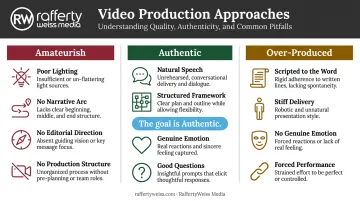
The goal sits squarely in the first category.
Conclusion
The About Us videos that stick — the ones that actually build trust — have one thing in common: they treat honesty as a production value. Every example in this article worked because the organization committed to being specific, human, and focused rather than impressive.
If your organization is ready to invest in an About Us video that informs, persuades, and performs, RaffertyWeiss Media brings over 25 years of production experience working with corporate clients, federal agencies, nonprofits, and associations across Washington, DC and the United States. From the initial strategy session through final delivery, the team handles concept development, production, and post — so your story comes through clearly at every stage.
Reach out to RaffertyWeiss Media to explore what a brand film could look like for your organization.
Frequently Asked Questions
How much does a 2-minute video cost?
Production costs vary widely based on scope, crew size, shoot days, and post-production complexity. RaffertyWeiss Media has produced videos ranging from $5,000 to over $100,000. Contact RaffertyWeiss Media directly for an estimate tailored to your project.
What should be included in an About Us video?
Cover your founding story or origin, the mission or "why" behind the organization, the people behind the brand, and a clear sense of your values or culture. Avoid trying to include every service or capability — the goal is connection, not comprehensiveness.
How long should an About Us video be?
60 to 90 seconds is the practical target for most About Us videos — it forces disciplined messaging and respects viewer attention. Longer documentary-style films can work when the story is compelling and the platform supports extended viewing.
What makes an About Us video feel authentic rather than corporate?
Authenticity comes from loosely guided employee voices (not memorized scripts), real environments over staged sets, honest storytelling that includes challenges, and avoiding stock footage or hollow corporate language. Genuine imperfection builds trust in ways that overproduced, scripted content simply cannot.
Can About Us videos work for B2B or government-facing organizations?
Yes — and these organizations often benefit most from the format. In B2B and government sectors, a well-produced video builds human connection and credibility that a capabilities statement or formal brochure rarely achieves.
How do you measure whether an About Us video is working?
Track watch-through rate, time-on-page when embedded on your website, and inbound inquiry volume after launch. Qualitative feedback from sales teams is often the most telling indicator. They hear directly from prospects after sharing the video and can report whether it's shifting conversations.