Introduction
Hiring has never been more competitive — and candidates are doing their homework. According to a Glassdoor/Harris Poll survey, 83% of job seekers research company reviews and ratings before deciding where to apply. A polished careers page helps, but it rarely tells the full story.
Company culture videos fill that gap. They show candidates what it actually feels like to work somewhere: the people, the energy, the values in action. Beyond recruiting, they serve a second audience too — potential clients and partners who use them to gauge whether an organization is worth trusting with their business.
This post covers 10 standout culture video examples, breaks down what makes each one work, and gives you a practical framework for creating your own. Each example is chosen because it solves a specific production or storytelling challenge — so you can take the technique and apply it directly to your own video.
Key Takeaways
- Culture videos show candidates, clients, and partners what it's really like to work at — or with — your organization
- The best examples feel authentic: real employees, real spaces, honest answers
- Format should match goal — testimonials, behind-the-scenes, values-focused, or recruiting
- Strong production choices (lighting, B-roll, editing pace) reinforce culture as much as the words do
- Distribution matters: LinkedIn favors short clips, careers pages support longer pieces, and Instagram stories reward raw, unpolished moments
What Is a Company Culture Video and Why Does It Matter?
A company culture video is a short-form video that gives audiences — job seekers, clients, and partners — an honest look at your organization's values, people, work environment, and mission. It communicates things a job description simply cannot — what the team dynamic actually feels like, whether leadership walks the talk. A written posting can't show that.
The business case is real. A 2021 iCIMS study of European Global Fortune 500 companies found that job seekers spend up to 37% more time on career sites when video testimonials are present, and applications can increase up to 34% when video is included in job descriptions.
Those numbers reflect something straightforward: people respond to video because it builds trust faster than text. That trust matters differently depending on who's watching.
Three Audiences, One Video
The most effective culture videos speak to three groups at once:
- Prospective hires — Does this culture fit who I am and where I want to go?
- Potential clients and partners — Is this an organization I can trust?
- Current employees — Do I feel seen and proud to be part of this?
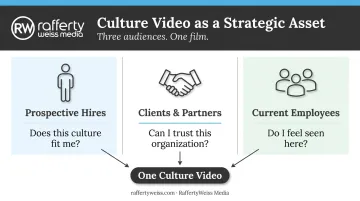
When a single video resonates across all three groups, it's doing the work of a recruitment campaign, a brand asset, and an internal communications tool simultaneously.
Types of Company Culture Videos
Choosing the right format starts with knowing what you want the video to do.
| Format | Best For |
|---|---|
| Employee Testimonials | Building candidate trust through peer voices |
| Behind-the-Scenes / Day-in-the-Life | Showing workplace environment organically |
| Values or Mission Videos | Communicating culture principles with narrative focus |
| Recruiting/HR Videos | Targeting specific roles or departments directly |
A fifth type worth noting: holiday and milestone videos. They carry less strategic weight than a recruiting video, but they humanize a brand in ways that polished productions often can't — and they rarely require a large budget.
The strongest examples blend formats. A recruiting video that opens with behind-the-scenes footage before cutting to an employee testimonial tends to feel more authentic than either format alone. The combination you choose should be driven by one question: what do you want a viewer to do or believe after watching?
10 Best Company Culture Video Examples
These ten examples span industries, company sizes, and production styles. Each illustrates a distinct technique worth borrowing.
Example 1: Nexthink — "Where Are You Going Next?"
Nexthink is a digital employee experience software company with offices across Switzerland, Spain, India, and the U.S. Their culture video uses location-based storytelling to reflect a global yet cohesive identity — each office hub gets its moment, building a cumulative sense of international scale.
Key lesson: Geographic diversity shown visually (not just stated) tells candidates they'll be working alongside a genuinely global team. It's more compelling than a bullet point on the careers page.
Example 2: Samsara — Culture & People Video
Samsara builds IoT-connected operations platforms for industries like fleet management and physical operations. Their culture video features employees across departments speaking candidly about why they joined and the tangible real-world impact of their work.
Key lesson: Letting employees articulate their personal "why" is the strongest authenticity signal a culture video can deploy. Viewers can distinguish rehearsed enthusiasm from genuine conviction and so can candidates evaluating your employer brand.
Example 3: Toast — Life at Toast
Toast's culture video pairs employee testimonials with cuts to their office spaces, letting the physical environment do as much storytelling as the words. Employees from different departments speak to the collaborative culture while the B-roll reinforces what they're describing.
Key lesson: Pairing authentic sound bites with purposeful B-roll creates a layered impression. Candidates don't just hear about the culture ; they see evidence of it in every frame.
Example 4: Fiverr — "Another Generic Recruitment Video"
Fiverr's video opens by satirizing every corporate recruitment cliché (the monotone voiceover, the stock-footage smiles) before pivoting to an honest case for why Fiverr is a genuinely good place to work. The self-awareness is the point.
Key lesson: Strategic humor signals that your company doesn't take itself too seriously, which is itself a culture statement. For creative and tech employers competing for talent with strong opinions about workplace culture, this approach lands where sincerity alone often doesn't.
Example 5: Celonis — "What Value Resonates With You Most?"
Celonis anchors their culture video around a single question asked to employees across their global offices: "What Celonis value resonates with you most?" Ten different people, ten different answers, one cohesive narrative thread.
Key lesson: A well-chosen central question creates structure without scripting. The diversity of answers is the proof , and that proof is far more convincing than a list of values on a slide.

Example 6: Clari — Life at Clari
Clari's 2024 culture video runs under three minutes and presents the company (an enterprise revenue orchestration platform) as inclusive, collaborative, and intentional about how community gets built across distributed teams. Employees describe how belonging and career growth are fostered deliberately, not assumed.
Key lesson: For distributed teams, belonging doesn't feel guaranteed — it feels earned or absent. Clari addresses that anxiety head-on: employees don't describe a policy; they describe a feeling. That distinction is what makes a candidate believe it.
Example 7: Hireology Culture Video
Hireology, a hiring platform for dealerships and multi-location businesses, opens their culture video with energy (upbeat pacing, candid employee clips) and sustains it through messages about empowerment and continuous learning.
Key lesson: Production choices are culture signals. Music tempo, editing rhythm, and shot selection should match the company's personality. A startup-energy culture that opens with slow, corporate-feeling footage has already broken its promise.
Example 8: GitLab — "Get to Know GitLab"
GitLab operates as a fully remote company, and their culture video makes that central rather than incidental. Employees from multiple countries use words like "inclusive" and "nurturing," describing cross-team collaboration in concrete terms rather than vague aspiration. The video serves as the human face of GitLab's all-remote handbook, one of the most detailed distributed work resources available.
Key lesson: Remote-first companies can't rely on office footage to communicate culture. GitLab shows what distributed work feels like through the people doing it — not through policy statements or org charts. That's the only proof candidates actually trust.
Example 9: Groove — Culture & Core Values Video
Groove's culture video matches its brand identity: energetic editing, strong graphics, and employee testimonials woven together to communicate values of integrity, passion, and customer focus. The production itself functions as a brand signal.
Key lesson: When your brand is design-forward, the video has to be too. Motion graphics, color palette, and editing pace aren't decoration ; they're part of the culture statement. A mismatch between brand identity and production style sends a confusing signal.
Example 10: Liberty Mutual — "Pursue Your Tomorrow Today"
Liberty Mutual's careers video leans into specific career development stories (describing what that investment actually looked like for them) are more persuasive than any superlative the marketing team could write.
What Makes a Great Company Culture Video?
Across all ten examples, the same qualities keep surfacing. Here's what actually moves the needle.
Authenticity Over Polish
The single most important quality is that the video feels real. According to LinkedIn's employer brand research, candidates trust company employees 3x more than the company itself for credible workplace culture information.
Unscripted or loosely guided employee responses consistently outperform polished talking points. Production quality matters — but it can't salvage a script that reads like a press release.
A Clear Goal and Target Audience
Every production decision — format, length, tone, distribution — should flow from one defined purpose. A recruiting video targeting software engineers requires different framing than a brand awareness video on a company homepage. Trying to serve every audience equally often means serving none of them well.
Purposeful Visual Choices
Visual decisions carry meaning:
- Drone shots signal openness and scale
- Close-ups on individuals build emotional connection
- Office environment footage communicates workspace culture without anyone having to say a word
- Editing pace reflects company energy
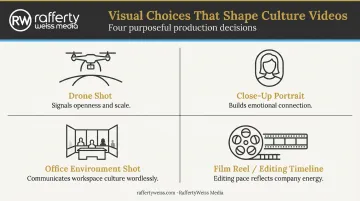
Lighting, clean spaces, and thoughtful shot composition raise production quality without requiring an inflated budget. The goal is intentionality, not extravagance.
Diverse, Representative Voices
Glassdoor's D&I survey found that 76% of job seekers consider workforce diversity important when evaluating job opportunities. Featuring employees from different departments, backgrounds, tenure levels, and locations serves both goals at once: more viewers see themselves in the story, and the narrative load gets distributed across multiple voices rather than resting on one spokesperson.
A Narrative Arc, Not a Sales Pitch
The most memorable culture videos answer "why" questions: Why do people work here? Why does this team's work matter? The goal is genuine curiosity, not conversion. When viewers feel informed rather than pitched to, they're far more likely to take the next step.
How to Create Your Own Company Culture Video
Start With Strategy
Before any filming, define:
- The goal — recruiting, brand awareness, onboarding, client trust-building
- The primary audience — candidates, clients, current employees, or all three
- The format — testimonial, behind-the-scenes, values-focused, or a blend
- The distribution channel — careers page, LinkedIn, homepage, email
These four decisions shape every downstream creative choice. Skipping this step is the most expensive mistake organizations make.
Plan the Production Process
A typical culture video production moves through five stages:
- Discovery and strategy — align on goals, audience, and key messages before a camera turns on
- Scripting or interview guide development — loosely structured questions work better than scripts for employee testimonials
- Production — filming at your location with attention to lighting, sound, and B-roll coverage
- Post-production — editing, color grading, sound design, and motion graphics
- Review and delivery — optimized for each distribution channel
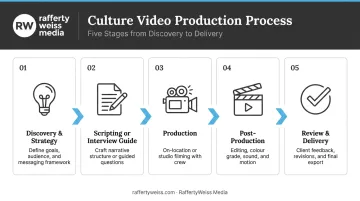
Culture videos don't require Hollywood budgets, but they do benefit from professional production support — particularly for organizations where brand credibility is non-negotiable. Government agencies, large corporations, and nonprofits often have compliance requirements, approval chains, and messaging standards that a generalist crew won't anticipate.
An experienced corporate video production partner like RaffertyWeiss Media, which has spent over 25 years producing culture and employer brand content for clients including Lockheed Martin, Fannie Mae, and the American Red Cross, can navigate those constraints while keeping the final product authentic and on-brand.
Distribute Strategically
Match the video to the right channel:
- Careers pages and LinkedIn — recruiting-focused content
- Homepage or About Us section — brand awareness
- Email campaigns — targeted outreach to specific audiences
- Social media — broader organic reach, often with shorter cuts
A well-produced culture video is a reusable asset. The same core footage can be cut differently for LinkedIn versus a careers page, and the underlying interviews can supply content for months of supporting material.
Frequently Asked Questions
What is a corporate culture video?
A corporate culture video is a short video that showcases a company's values, work environment, people, and mission. It's used to attract talent, build brand trust, and give audiences an honest look at what it's like to work at — or partner with — the organization.
How long should a company culture video be?
Most culture videos perform well in the 1.5–3 minute range for career pages and homepages, where viewers have context and intent. For LinkedIn and social feeds, shorter cuts under 60 seconds retain more viewers. Wistia reports that videos under one minute average 52% engagement across business video platforms.
Who should appear in a company culture video?
The most effective videos feature employees from different departments, tenure levels, and backgrounds — executives alone won't cut it. Peer voices carry more credibility with candidates, so HR shouldn't be the only face of your culture story.
What are common frameworks for describing corporate culture?
Frameworks like the 3 C's, 4 C's, and 5 P's offer structured ways to define and articulate organizational culture internally. What matters for video is that the framework you use internally is visible in the video — not referenced explicitly, but evident in how employees talk about their work and values.
Where should you share a company culture video?
Distribution depends on the goal: careers pages and LinkedIn for recruiting, the homepage or About Us section for brand awareness, email campaigns for outreach, and social media for organic reach. The same video can often be adapted across multiple channels with minor edits or format adjustments.