Most people have watched live television thousands of times. Far fewer understand what it actually takes to produce it. The gap between "we need to go live" and a professional broadcast involves weeks of planning, specialized crew, purpose-built infrastructure, and real-time decision-making under pressure. This guide walks through exactly how it works — operationally, technically, and organizationally.
Key Takeaways
- Live TV production means content is captured and broadcast simultaneously — no post-production fixes, no second takes
- It spans three phases: pre-production planning, live execution, and real-time distribution
- A coordinated crew — directors, engineers, camera operators — executes everything in real time during broadcast
- Common formats include news, sports, government announcements, corporate town halls, and award shows
- Choosing live over pre-recorded comes down to one question: does the audience need to experience this as it happens?
What Is Live TV Production — and Why It Matters
Live TV production means shooting, directing, mixing, and broadcasting video content to an audience at the exact moment it's captured. There's no editing pass, no second take, and no chance to pull something back once it's out.
That distinction separates it from every other format. Pre-recorded production gives teams the ability to refine, correct, and polish before anything reaches an audience. Live-to-tape sits somewhere in between — recorded sequentially with minimal stopping, but not transmitted in real time. True live production has none of those safety nets.
Where Live Production Is Used
The format is common across a wide range of contexts:
- Broadcast news — daily and breaking news programs
- Sports — from local games to events like the Super Bowl, which drew 127.7 million viewers across broadcast, cable, and streaming in February 2025
- Political events — debates, congressional hearings, presidential addresses
- Award ceremonies — the Oscars, Emmys, and similar telecasts
- Corporate communications — earnings calls, all-hands meetings, town halls
- Government briefings — agency announcements, public health communications
Why Format Choice Signals Something to Audiences
That range of use cases points to something beyond logistics. Choosing to broadcast live is a communication decision as much as a technical one. When an organization goes live, it signals transparency and accountability — there's no opportunity to hide behind editing. For government agencies and corporate communicators, that credibility carries real weight, especially in high-stakes announcements where audiences are watching closely for authenticity.
How Live TV Production Works: The End-to-End Process
Every live broadcast follows three phases: pre-production, live execution, and real-time distribution. Unlike film production where these phases happen sequentially, in live TV they compress and overlap — and what's locked in during week one of planning directly determines what's possible the moment cameras go live.
Phase 1: Pre-Production Planning
Pre-production for a live broadcast involves far more than booking a venue and a crew. The work includes:
- Defining broadcast objectives — What's the event? Who's the audience? What's the call to action?
- Building a run-of-show — A detailed running order that sequences every segment, pre-recorded insert, and live element
- Location or studio surveys — Assessing power, sightlines, connectivity, and logistics
- Technical commissioning — Cameras, switchers, graphics systems, comms, and encoding hardware
- Systems testing — Full technical rehearsals before go-live
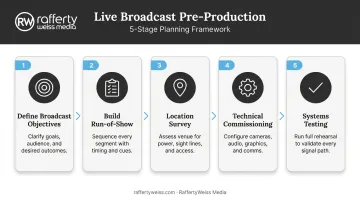
The timeline scales with complexity. FOX Sports planned Super Bowl LIX daily for 14 months before the February 2025 broadcast. A corporate town hall or government briefing requires far less runway, but the discipline of advance planning holds at every scale.
Phase 2: Live Execution
During broadcast, a live production operates as a real-time decision machine:
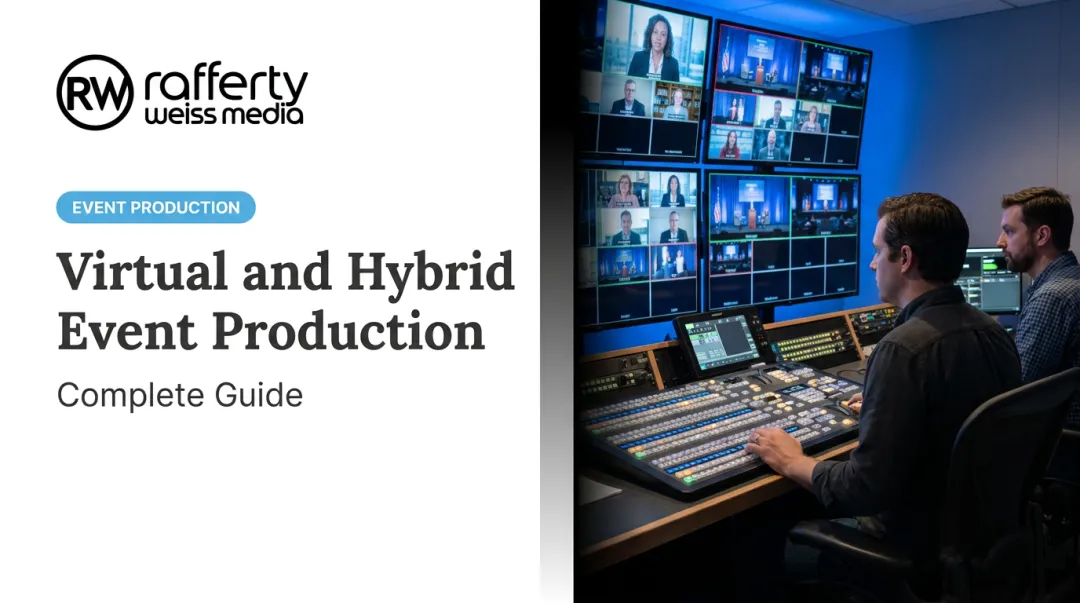
- The director calls shots from the control room — "take camera two," "ready graphics," "cue talent"
- The technical director executes those calls on the vision mixer, switching between feeds
- Audio engineers manage every sound input, mixing levels in real time
- The floor manager acts as the director's eyes and ears on set, relaying cues to talent
- Camera operators hold assigned angles and respond to direction through earpiece
Every role runs simultaneously. A delay of even a few seconds at any point creates an on-air problem. That's why RaffertyWeiss Media builds contingency protocols, runs pre-event technical rehearsals, and completes bandwidth and equipment checks before cameras roll — so the crew is executing a plan, not solving problems in real time.
Phase 3: Real-Time Post-Production and Distribution
Post-production doesn't wait for the broadcast to end. While the program airs, work is happening in parallel:
- Lower-thirds and on-screen titles are inserted via character generator
- B-roll or replay footage is cued and cut to the main feed
- The signal is simultaneously encoded and distributed — via broadcast transmission, livestream, OTT platforms, satellite, or a combination
- Footage is logged and archived during transmission for later use
For RaffertyWeiss Media's corporate and government clients, multi-platform distribution is built into the production plan: streaming to YouTube Live, Zoom, Microsoft Teams, Vimeo, LinkedIn Live, and custom portals from a single production. For mission-critical events, redundant backup paths are configured from the start.
Key Roles and Equipment in Live TV Production
Live production has no margin for role ambiguity. Every person has a specific, time-sensitive function. When roles overlap or go unclaimed, on-air errors follow.
Core Production Roles
| Role | Responsibility |
|---|---|
| Executive Producer | Overall vision, final decisions, client liaison |
| Director | Real-time shot-calling from the control room |
| Technical Director | Operating the vision mixer/production switcher |
| Floor Manager | Relaying director cues to on-camera talent |
| Camera Operators | Capturing assigned angles per director's calls |
| Audio Engineer | Managing all sound inputs, mixing levels live |
IATSE identifies broadcast technicians as including technical directors, audio technicians, camera operators, video technicians, capture playback operators, editors, graphic artists, and utility technicians — each a distinct specialization. Knowing which roles your production requires before the shoot day prevents last-minute gaps.
Essential Equipment Infrastructure
A professional live broadcast requires:
- Professional broadcast cameras — static, wireless RF, and POV/specialty configurations
- Production switcher (vision mixer) — the central hub for managing multiple video sources in real time
- Control room or OB truck — houses the director, technical director, and monitoring systems
- Intercom and communications systems — keeps control room and floor in constant sync
- Graphics and character generator — for lower-thirds, titles, and on-screen data
- **Signal encoding and distribution hardware** — converts the production signal for broadcast, streaming, or satellite delivery
For remote productions outside a fixed studio, an OB (outside broadcast) truck or flypack system brings full control room capability to any venue. Equipment requirements grow with the event — a single-camera corporate livestream has fundamentally different requirements than a multi-camera live awards broadcast.
What Makes Live TV Production Uniquely Complex
The Zero-Error Window
There is no edit pass in live production. When the 2013 Super Bowl suffered a stadium power failure, CBS broadcast a 34-minute interruption in front of the most-watched program of the year. Cameras and audio equipment powered by stadium infrastructure went dark. CBS stayed on air only because backup power systems were already in place.
That incident set the standard for how professional teams approach live production: every contingency planned, every failure mode anticipated before broadcast begins.
The 2019 Democratic presidential debate on MSNBC illustrated a separate kind of vulnerability: audio failures affecting moderators mid-broadcast. Unlike a recorded production, there's no fix after the fact — the error reaches millions of viewers in real time.
Coordination Complexity
Live production requires dozens of people making split-second decisions in sync. A misfire from the director, floor manager, switcher, or audio board disrupts the entire broadcast chain. Intercom systems and clear protocols are as operationally critical as the cameras themselves — without them, the chain breaks.
Infrastructure Dependencies
Live production is only as reliable as its weakest technical link:
- Signal routing must be stable and low-latency
- Remote or distributed productions require reliable connectivity at every location
- Power and signal redundancy determine whether a broadcast survives equipment failure
Professional production teams address these dependencies in pre-production, not during broadcast. Redundant signal paths, backup power systems, and defined decision trees for common failure scenarios are built into every plan before cameras roll.
Live TV vs. Pre-Recorded: Choosing the Right Format
Neither format is universally better. The right choice depends on what the communication needs to accomplish.
When Live Production Is the Right Call
- Breaking news, crisis communications, and real-time announcements where timing defines the message
- Town halls and live Q&As, where the unscripted format itself signals transparency
- Audience participation formats — live polling, call-in segments, real-time questions
- High-stakes public events (congressional hearings, earnings calls, government press conferences) where the "live" designation carries institutional credibility
When Pre-Recorded Is More Appropriate
- Regulated industries, legal disclosures, and compliance content where every word needs review before distribution
- Multi-location or documentary-style storytelling that depends on editing to create a coherent narrative
- Projects where the cost of a full live crew isn't justified by what going live actually adds
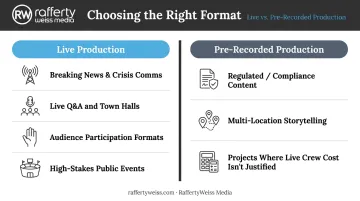
For corporate and government clients, this decision usually reduces to one tension: message control versus authenticity. Pre-recorded production gives communicators full control over every word and frame. Live production trades some of that control for credibility and immediacy.
RaffertyWeiss Media has worked across both formats for over 25 years — with federal agencies, Fortune 500 corporations, and national associations — and the starting question is always the same: what does this audience need to trust the message? That answer usually determines the format.
Common Misconceptions About Live TV Production
Two assumptions trip up organizations planning their first live broadcast — and both can lead to costly missteps.
| Misconception | Reality |
|---|---|
| "Live production is just pressing record and streaming." | Professional live broadcast requires weeks of pre-production, a specialized crew, dedicated technical infrastructure, and real-time decision-making across interconnected systems. Organizations that underestimate this complexity often discover the gap between expectation and execution while already on air. |
| "Live is always more expensive than pre-recorded." | Not always. Live production eliminates post-production editing entirely. For corporate town halls, government briefings, and event coverage, that translates to faster turnaround and comparable total cost — especially when immediacy and audience engagement are central to the value being delivered. |
Frequently Asked Questions
What does broadcast production mean?
Broadcast production is the process of creating and transmitting audio-visual content — television, radio, or streaming — to a distributed audience. It spans content creation, technical setup, signal encoding, and delivery across broadcast, cable, satellite, or OTT platforms.
Does broadcast TV exist anymore?
Yes. Broadcast TV still reaches large audiences via over-the-air, cable, and satellite signals. Nielsen reported broadcast accounted for 20.1% of total U.S. TV usage in May 2025, with streaming at 44.8% and cable at 24.1%.
What is the difference between live TV production and pre-recorded production?
Live TV is transmitted to audiences as it happens, with no editing window. Pre-recorded production is captured, edited, and refined before broadcast. Live production is higher-stakes and faster to distribute; pre-recorded is more controllable but slower to deliver.
How many people does it take to produce a live TV broadcast?
Scale determines the headcount. A corporate livestream might require 5–10 crew members; a major sports or entertainment broadcast can involve hundreds. Every production needs a director, technical director, camera operators, and an audio engineer at minimum.
What equipment is needed for live TV production?
Core infrastructure includes professional cameras, a production switcher/vision mixer, a control room or OB truck, intercom/communications systems, a graphics and character generator system, and signal encoding and distribution hardware.
What happens if something goes wrong during a live TV broadcast?
Experienced productions build contingency protocols into pre-production — backup signal paths, standby equipment, and clear response plans for common failure scenarios. When issues occur, trained crews execute those protocols to minimize audience disruption.