Introduction
Corporate event photography isn't a line item to fill in after the venue and catering. It's a media asset decision that determines whether your conference, product launch, or investor summit produces reusable content that works for weeks — or disappears the day after the event ends.
Demand has shifted. Real-time digital delivery, same-day social selects, and AI-assisted editing workflows have changed both what clients expect and what photographers charge. According to American Express Global Business Travel's 2025 forecast, 66% of meeting professionals expected budgets to grow, with average spend projected to rise 3.5% — meaning photography is increasingly part of a planned budget, not an afterthought.
The challenge: corporate event photography pricing varies enormously based on event type, photographer experience, deliverables, and usage rights. Misread those variables and you either overspend or end up with photos that can't be used in marketing.
This guide covers what experienced corporate photographers charge in 2026, what drives costs up or down, what packages typically include, and how to build a realistic budget before you start collecting quotes.
Key Takeaways
- Hourly rates: ~$150–$500/hour for experienced professionals
- Half-day packages: $1,200–$2,500; full-day coverage typically $2,400–$4,500+
- Price drivers: specialization, multi-photographer setups, rush delivery, and commercial licensing
- Smaller internal events can work with entry-level packages; conferences, launches, and PR-facing events need mid-to-premium coverage
- Higher-tier coverage is worth it when photos appear in press, investor materials, or marketing campaigns
How Much Does Corporate Event Photography Cost in 2026?
There's no fixed national rate for corporate event photography. Costs shift based on market, scope, photographer experience, and what's actually included in the package.
Choosing the wrong tier has real consequences: too low and you get photos unusable in marketing; too high and you've paid for capabilities the event simply didn't need.
Here's how the three main tiers break down, using published examples from named U.S. professionals.
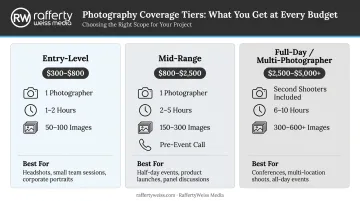
Entry-Level Coverage ($300–$800)
What's typically included:
- 1–2 hours of on-site coverage
- One photographer
- Basic editing and digital delivery
- Roughly 50–100 final images
Best for: Small internal meetings, team-building events, or informal staff gatherings where photos are for internal use only. Chicago-based Walking Visions, for example, lists essential coverage up to 2 hours at $325.
Mid-Range / Professional Coverage ($800–$2,500)
What's typically included:
- 2–5 hours of coverage with professional-grade equipment
- Curated, edited gallery of 150–300 images
- Standard usage rights for internal and promotional use
- Often includes a pre-event planning call
Best for: Conferences, product launches, award ceremonies, company galas, and trade shows where photos will run in social media, press releases, and marketing. Las Vegas photographer Christian Purdie lists half-day coverage (up to 4 hours) at $1,300. Stratabooth's published half-day range runs $1,500–$2,500.
Full-Day / Multi-Photographer Coverage ($2,500–$5,000+)
What's typically included:
- 6–10 hours of coverage
- Lead photographer plus one or more second shooters
- 300–600+ edited images
- Expedited delivery options
- Broad usage rights for promotional or commercial use
Best for: Large-scale annual conferences, investor summits, multi-day events, and events generating content for advertising or national media. San Francisco photographer Jack Simpson publishes full-day rates of $2,400–$3,800; Stratabooth lists full-day at $2,500–$4,500. For multi-day conferences requiring same-day selects, total costs can reach $9,000–$14,000.
A note on market variation: These ranges shift noticeably by geography. Top-tier metro markets like New York, San Francisco, and Washington D.C. consistently trend toward the upper end. NYC-based Erica Camille Productions publishes rates of $400–$500/hour with a two-hour minimum — meaning even a short two-hour engagement starts at $800 before any add-ons. Budget accordingly if your event is in a major metro.
Key Factors That Affect Corporate Event Photography Pricing
The quote you receive reflects multiple overlapping variables. Understanding them helps you evaluate bids fairly — and avoid comparing packages that don't actually contain the same things.
Photographer Experience and Specialization
A photographer who specializes in corporate events charges higher rates than a generalist. They understand hotel ballroom lighting, executive dynamics, and unobtrusive movement through conference settings — skills that translate directly into consistent results across a long day.
That expertise reduces the risk of unusable shots, which matters when you have one chance to document a keynote or board dinner.
Event Length and Complexity
Coverage duration scales cost directly. But complexity adds a separate layer: multi-room conferences, simultaneous breakout sessions, large attendee counts, and mixed indoor/outdoor venues each increase the shooting demands and post-production time required.
Number of Photographers Required
For events with 200+ attendees or multiple simultaneous activities, a second shooter isn't a luxury — it's a coverage requirement. Based on published vendor examples:
- Stratabooth lists additional photographers at $1,500–$3,000/day
- Jack Simpson (San Francisco) lists second photographers at $1,200–$2,000/full day
If your event has breakout sessions or multiple stages running in parallel, budget for this from the start.
Post-Production and Turnaround Time
Editing, culling, and color correction often take more time than the shoot itself — and rush delivery carries a premium on top of that:
- 24–48 hour rush delivery: $250–$500 (Jack Simpson, San Francisco)
- Same-day delivery: $350–$750
- On-site editor: ~$175/hour with a 4-hour minimum
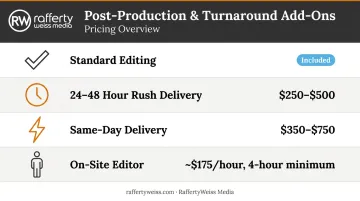
If PR or social media teams need images by the next morning, build this cost in upfront.
Usage Rights and Licensing
Standard packages cover internal use and basic promotional purposes. Commercial advertising, paid media, or syndicated publication require an explicit commercial license — negotiated separately.
Where clients frequently get caught: they assume the package price covers all future uses. It doesn't.
Using images beyond the licensed scope can result in retroactive fees that exceed what an upfront upgrade would have cost. ASMP's licensing guidelines confirm that rights stay with the photographer and that promotional, advertising, and editorial uses each require distinct terms.
Corporate Event Photography Cost Breakdown
The package price is not the total cost. Before signing any agreement, map out these line items separately.
Base Photography Fee (one-time) Covers the photographer's time on-site, equipment, and standard deliverables. Does not typically include travel beyond a local radius, rush processing, or retouching beyond standard color correction and exposure adjustment.
Travel and Location Fees (variable) Most photographers include travel within their immediate metro area. Events beyond that range incur additional costs. ASMP's commercial licensing examples reference mileage fees beyond an initial radius and out-of-town expenses billed at cost plus a percentage. Stratabooth notes that flights and hotels for nationwide events generally add $500–$1,200.
Post-Production Add-Ons (optional) Standard editing is included in most packages. Separate line items to ask about:
- Same-day social media selects
- Custom branded overlays or watermarks
- Slideshow or highlight gallery production
- Advanced retouching: Jack Simpson lists this at $50–$150/image beyond standard editing
Usage Licensing Upgrade (optional — but time-sensitive) Upgrading from internal/promotional rights to commercial licensing for advertising or media is always cheaper when negotiated at booking. Retroactive licensing (requested after the event when the need becomes clear) costs significantly more.
Organizations that use one vendor for both photography and video can negotiate content rights under a single agreement, which reduces administrative back-and-forth and avoids licensing gaps between deliverables. RaffertyWeiss Media, for example, covers still photography alongside video production for clients like Lockheed Martin and Georgetown University — meaning licensing terms for all event content get established once, upfront.
Budget vs. Premium Corporate Photographers: What's the Real Difference?
The gap between a $500 package and a $3,000 package isn't arbitrary. It reflects tangible differences across three practical dimensions:
Image Quality and Consistency
Entry-level photographers may struggle with inconsistent exposure and composition in challenging lighting — hotel ballrooms, convention centers with mixed sources, and dimly lit gala spaces. Experienced professionals come equipped with lighting rigs and appropriate lens selections for these environments, and they anticipate problems before they become unusable frames.
Professionalism and Discretion
Corporate events require photographers who move through executive-level settings without disrupting speakers, panel discussions, or networking conversations. This is a learned skill that takes years of corporate-specific work to develop well.
Long-Term Asset Value
Premium photos get reused — in annual reports, press kits, investor presentations, website refreshes, and marketing campaigns. Low-quality images have a short shelf life. Cision's 2024 State of the Media Report found that 87% of journalists use multimedia assets like images when supplied with pitches — making event photo quality directly relevant to PR outcomes.
On reliability, professional photographers operate with formal protections that budget options typically skip entirely:
- Cancellation clauses (ASMP sample terms allow 100% of the fee for cancellations within two business days)
- Backup equipment and liability insurance (PPA members carry up to $15,000 in equipment coverage)
- Contractual delivery terms specifying turnaround, file formats, and usage rights
- Unauthorized image use penalties invoiced at up to three times the customary rate
High-stakes events don't offer a second chance. A photographer who doesn't show, or delivers unusable work, creates a gap in your organization's record that no amount of post-event hustle will fill.
How to Estimate the Right Budget — and What Most Clients Get Wrong
The right budget starts with how the images will be used, not how long the event runs.
Factors to Assess Before Requesting Quotes
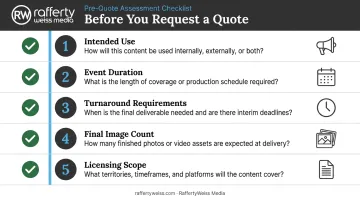
Answer these questions before reaching out to a single photographer:
- Intended use: Internal only, or will photos appear in social media, press releases, marketing, advertising, or investor materials?
- Event duration: How many hours of coverage are needed, and are there multiple simultaneous activities?
- Turnaround requirements: Do you need same-day selects for social, or is a standard 1–2 week delivery window acceptable?
- Final image count: How many edited, deliverable photos do you actually need?
- Licensing scope: Will images be used in paid media, national publications, or third-party platforms?
Providing clear answers to these five questions allows photographers to provide accurate quotes — and protects you from scope creep mid-project.
Common Mistakes That Inflate or Waste the Budget
- Focusing only on the hourly rate — post-production, travel, and licensing can double the actual total
- Under-specifying deliverables upfront — vague briefs invite scope changes after the event, when add-ons cost more and leverage is gone
- Booking one photographer for a large multi-room event — coverage gaps at a 300-person conference are not recoverable
- Choosing the lowest bidder for high-visibility content — when photos appear in press materials, investor decks, or national marketing, image quality reflects organizational credibility; the savings rarely outweigh the cost of unusable assets
Organizations that integrate event photography into a broader content strategy — pairing professional stills with video coverage for social, web, and press use — extract more value per event dollar. RaffertyWeiss Media's work with FourBlock, a nonprofit supporting veteran career transitions, illustrates this well.
Synchronized video and photo teams deployed across five cities in 48 hours produced a photo library used in grant applications, branded video for social media, and content for fundraising, all from a single coordinated production window. For organizations managing content across multiple channels, that kind of integrated approach changes the ROI calculation on event coverage.
Frequently Asked Questions
How much do corporate photographers charge?
Experienced corporate event photographers typically charge $150–$500/hour, with full-day coverage running $2,400–$4,500+ in most U.S. markets. Final pricing depends on event complexity, number of photographers, deliverables, and whether rush delivery or commercial licensing is required.
What is typically included in a corporate event photography package?
Standard packages include on-site coverage hours, professional editing, a curated digital image gallery, and usage rights for internal and basic promotional use. Travel beyond a local radius, rush delivery, in-depth retouching, and commercial licensing for advertising are usually quoted separately.
How many photographers do I need for a corporate event?
One photographer handles most events under 150 attendees with a single primary focus area. Events with multiple rooms, simultaneous sessions, or 200+ attendees generally warrant a second shooter. Budget an additional $1,200–$2,000+ to the base rate for a full-day second shooter.
What's the difference between hourly and flat-rate corporate photography pricing?
Hourly rates offer flexibility for shorter or variable-length events but can escalate if the event runs long. Flat rates provide cost certainty upfront and work better for events with predictable schedules and well-defined deliverables.
Do I need to pay extra for commercial usage rights?
Most standard packages cover internal use and basic promotional purposes. Using images in paid advertising, national media, or third-party publications requires a commercial licensing upgrade — confirm licensing terms before signing the contract.
How far in advance should I book a corporate event photographer?
For standard corporate events, 4–6 weeks is a reasonable minimum. Large-scale conferences, multi-day events, or high-profile gatherings in markets like Washington D.C. warrant 2–3 months' notice. Peak conference and awards season dates fill fast.