But before committing to a radio campaign, most businesses run into the same question: what does production actually cost? The honest answer is that it depends on scope, talent quality, and how the spot will be used. A functional 30-second ad for a local business looks nothing like a multi-version national campaign — and the price reflects that.
This guide breaks down realistic cost ranges by production tier, explains the variables that move pricing up or down, walks through what the production process actually involves, and helps you budget appropriately for the campaign you're running.
Key Takeaways
- Basic production: $200–$500 — templated or DIY-assisted, suitable for local or short-run campaigns
- Mid-range professional production: $500–$2,500 — vetted talent, custom sound design, suitable for regional advertisers
- High-end custom production: $2,500–$10,000+ — full creative development, union talent, multi-version deliverables for national campaigns
- Music licensing, talent usage rights, and revision overages are common budget surprises — account for them upfront
- 30-second spots are the research-backed standard — they outperform 15- and 60-second formats in both engagement and recall
How Much Does Radio Commercial Production Cost?
Radio commercial production doesn't have a standard price list. Costs vary based on the production route you choose, what the spot requires creatively, and who's doing the work.
Misreading the budget at the start creates real problems: underspending produces audio that undermines your brand, while overspending on features you don't need eats into media buy without adding measurable value. Understanding the three tiers helps you match investment to purpose.
| Tier | Typical Range | Best For |
|---|---|---|
| Basic / Entry-Level | $200–$500 | Local businesses, first-time radio advertisers |
| Mid-Range / Standard | $500–$2,500 | Regional advertisers, brand-consistent campaigns |
| High-End / Custom | $2,500–$10,000+ | National campaigns, major brand launches |
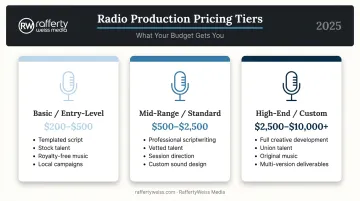
Tier 1: Basic / Entry-Level Production ($200–$500)
What's included:
- Templated scriptwriting or client-supplied script
- Single voice talent from a stock or freelance marketplace
- Basic audio editing and delivery in standard broadcast format
- Royalty-free music or sound effects
To put pricing in context, entry-level providers like LFM Audio offer 30-second ads starting around $79–$104 (with scriptwriting), with 72-hour delivery and standard licensing covering audiences up to 100,000 listeners.
Best for: Local businesses running short-duration campaigns, simple promotional announcements (store hours, sale events), or first-time radio advertisers testing the channel.
Tier 2: Mid-Range / Standard Professional Production ($500–$2,500)
What's included:
- Professional scriptwriting with pacing review
- Vetted voice talent with session direction
- Studio recording with custom sound design or licensed background music
- One to two rounds of revisions
This is the most common range for regional advertisers — enough budget to get real session direction and sound design without commissioning original music. It fits businesses with consistent radio budgets where brand tone and message clarity matter.
Tier 3: High-End / Fully Custom Production ($2,500–$10,000+)
What's included:
- Full creative development from brief to broadcast
- Multiple voice actors or character-driven spots
- Original music composition or premium music licensing
- Broadcast-standard mixing and mastering
- Multi-version deliverables (15, 30, and 60-second cuts)
This tier is the right call for national advertisers, political campaigns, and major brand launches — situations where the commercial anchors a significant media investment and cutting corners would be visible.
Key Factors That Affect Radio Commercial Production Costs
Pricing is driven by a combination of creative, technical, and logistical variables. Understanding each one shows where you have flexibility — and where cutting corners creates real risk.
Ad Length
The 30-second spot is the industry standard, and for good reason. Research from Veritonic and Audacy found that 61% of listeners stay through a full 30-second radio ad, and that 30-second spots outperform both shorter and longer formats in engagement, brand recall, and brand effect.
- 15-second spots: Lower production complexity, but limited storytelling room
- 30-second spots: Best-supported default for most campaign types
- 60-second spots: Higher scripting and production complexity; research suggests two 30-second spots often deliver better results than one 60
More content to script, direct, and mix means higher production fees at every length above 15 seconds.
Voice Talent Selection
Talent tier is one of the biggest cost variables:
- Stock/marketplace talent: Lower cost, less control over tone or delivery
- Freelance professionals: Mid-range pricing, more customization available
- SAG-AFTRA union talent: Premium pricing plus usage fees — the current SAG-AFTRA Year 2 rate sheet (effective April 2026–March 2027) lists a $420.50 session fee for actors, announcers, and solo singers, with $4,444.37 for one-year national terrestrial usage
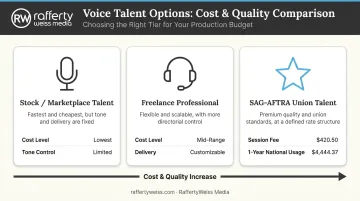
The voice is what listeners connect with. Mismatched talent undermines that connection — even when the copy is strong and the audio is clean.
Scriptwriting and Creative Development
A well-crafted 30-second radio script requires precise word economy. Westwood One found that adding just 24 extra words to a standard 30-second spot could mean significantly fewer web visitors among listeners. Overwriting a script doesn't just hurt pacing — it directly affects response rates.
Professional copywriting adds cost. But weak client-supplied scripts waste money already spent on talent and studio time, regardless of production quality.
Music and Sound Design
Music choices affect both cost and rights exposure:
- Stock/royalty-free libraries: Epidemic Sound's Business plan runs $360/year — predictable cost, but confirm broadcast rights before use
- Licensed commercial tracks: Require sync licensing and master use clearances; cost varies based on term, geography, and usage scope
- Original composition: Higher upfront cost, but full ownership in perpetuity with no ongoing licensing obligations
Studio Time and Technical Production
Studio recording, audio engineering, mixing, and mastering are each billed separately. Remote recording via tools like Source-Connect can reduce session costs (short-term licenses run $25–$100 for two days), but audio consistency may vary compared to in-studio sessions.
Revision Rounds and Rush Fees
Most production quotes include a fixed number of revision rounds. Changes requested after production begins typically carry additional charges. Rush delivery — same-day or next-day — is available from some providers but adds cost. Build both into your budget before signing off on a quote.
The Production Process: What Happens and Where the Money Goes
Creative Development and Scripting
This is where cost and quality diverge fastest. A clear brief with defined goals, audience, and message reduces rewrites. A vague brief leads to multiple script rounds, which adds time and money before a single word is recorded.
The script is also where word count decisions get made. A 30-second spot holds roughly 70–80 words at a natural pace — every word needs to earn its place.
Voice Casting and Direction
Casting involves reviewing talent demos, selecting a voice that matches brand tone, and directing the recording session. The direction quality matters as much as the talent: one clear director with a defined vision produces a clean session. Multiple stakeholders giving conflicting feedback in real time drives up session time and revision costs.
For campaigns with specific representation or compliance requirements, casting scope can be substantial. RaffertyWeiss Media, for example, auditioned over 150 voice artists for a national HIV awareness campaign — ultimately casting 25+ English and Spanish speakers to match authentic voices to specific audience segments.
Recording and Sound Design
The studio recording phase captures clean vocal audio, adds music beds, and layers in sound effects or additional audio elements. Each added element increases production time. Remote sessions cost less than in-studio, but the tradeoff is tighter quality control on the audio environment.
Editing, Mixing, and Mastering
Post-production is where the spot becomes broadcast-ready. Audio engineers edit takes, balance levels, and format the final file for delivery.
Each broadcast context has distinct technical requirements — Delivery versions typically need to be formatted for:
- AM/FM broadcast standards
- Streaming audio platforms
- Podcast pre-roll placements
RaffertyWeiss Media handles broadcast-quality mixing and mastering in-house for radio spots, PSAs, and audio campaigns, optimizing for each of these formats.
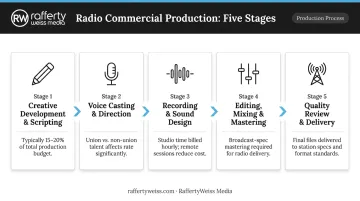
Quality Review and Delivery
The final phase covers approval, file formatting, and station delivery. Professional production companies handle technical spec compliance and direct station delivery — a detail that matters for corporate or government advertisers managing multi-market campaigns.
For organizations running campaigns across both radio and video, using a single production partner for both formats keeps brand voice consistent and eliminates the coordination overhead of managing separate creative teams.
Budget vs. Professional Radio Commercial Production: What's the Difference?
The gap between a $300 spot and a $3,000 spot goes well beyond audio polish. It affects brand perception, message clarity, and what listeners do after they hear your ad.
Lower-cost spots can deliver a functional message but often lack the scripting precision and audio quality that build listener trust. On a commercial station, your 30-second spot airs alongside national advertisers — and production quality gets noticed.
A well-produced spot also stretches further. It can run across multiple campaigns and be cut into 15, 30, and 60-second versions, spreading the initial investment across more placements. Budget spots are typically single-use.
When lower cost is acceptable:
- Local campaigns with limited airtime runs
- Simple directional ads (hours, location, sale announcements)
- A/B testing a concept before committing to full production
For campaigns with broader reach or higher stakes, the calculation changes.
When to invest more:
- National or regional campaigns with significant media spend
- Brand-critical messaging where credibility affects conversion
- Government or corporate campaigns with compliance requirements or multilingual versions
How to Estimate the Right Budget for Your Radio Commercial
The right production budget depends on the role the commercial plays in the campaign. A standalone 30-second spot for a local business is a different investment decision than a multi-version campaign running across regional or national stations. A few factors should shape that number before you finalize anything:
Key budget factors:
- Campaign length and total media buy — production costs should be proportional to airtime spend. A $500 spot supporting a $50,000 media buy is reasonable; a $50,000 production behind a $500 buy is not
- Number of versions needed — separate 15, 30, and 60-second cuts, or multiple market-specific scripts, each add production scope
- Downstream use — will the spot be adapted for streaming or podcast pre-roll? Different specs and potentially different licensing terms apply
Common budgeting mistakes:
- Treating production as an afterthought by allocating everything to airtime first
- Forgetting to account for music licensing and talent usage fees when extending a campaign's run
- Skipping a revision budget — standard quotes include a set number of rounds, and changes requested after production starts cost more
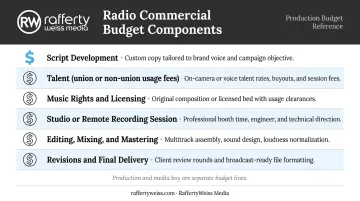
Production and media buy are separate budget lines. Scope production from its actual components:
- Script development
- Talent (union or non-union usage fees)
- Music rights and licensing
- Studio or remote recording session
- Editing, mixing, and mastering
- Revisions and final delivery
Frequently Asked Questions
How much does a 30-second radio commercial cost?
Professional production for a 30-second spot typically runs $500–$2,500, depending on talent, scriptwriting, and studio quality. This is production cost only — separate from airtime and placement fees, which vary by market and station.
What is a radio commercial?
A radio commercial is a paid audio advertisement broadcast on AM/FM stations or streaming audio platforms, designed to reach a targeted audience and prompt a specific action: a purchase, a website visit, or simple brand recognition.
How long does it take to produce a radio commercial?
A straightforward 30-second spot typically takes 3–7 business days from script approval to final delivery. More complex productions involving original music or multiple voice actors can take 2–4 weeks.
What is typically included in radio commercial production?
Core deliverables include scriptwriting, voice talent casting and recording, audio editing and mixing, music and sound design, and broadcast-ready file delivery.
What is the difference between local and national radio commercial production costs?
Local production costs less due to regional talent rates and simpler scope. National spots involve higher-tier talent (often union), broader music licensing rights, and more complex creative — pushing costs toward the higher end of the range.
Do I need a separate production company to make a radio commercial?
Some radio stations offer basic in-house production at low or no cost as part of an ad buy, but your input on casting, scripting, and audio quality will be limited. An independent production company keeps creative decisions in your hands throughout the process.