The stakes are real. According to Content Marketing Institute's 2025 B2B research, 58% of marketers rate video as the most effective content type — but that same data shows static visual assets still drive significant engagement across key channels. Neither format wins universally.
This guide gives you a practical framework for matching format to goal, channel, budget, and audience — so the decision is strategic, not a coin flip.
Key Takeaways
- Still photography delivers versatile, reusable assets with faster turnaround — ideal for press kits, websites, and reports
- Video drives storytelling, demonstration, and emotional engagement — the go-to for brand films, training, and advocacy campaigns
- Five factors drive the decision: your goal, audience, channel, budget, and how long the content needs to last
- A hybrid approach — coordinated stills and video production — often delivers the highest content value per dollar
- Neither format wins by default — the right choice depends entirely on what you need the content to do
Stills vs. Video: Understanding the Core Difference
The American Society of Media Photographers frames it cleanly: video is "time in motion," while a still image captures "a moment in time." That single distinction drives most format decisions worth making.
Still photography freezes a single high-resolution moment. It's immediate, scannable, and broadly deployable across print, web, social media, and presentations without modification.
Video recreates motion, sound, and sequence. It can carry a narrative arc, convey emotional transformation, and demonstrate process in ways no single frame can replicate.
The practical trade-off in a corporate context:
| Factor | Still Photography | Video |
|---|---|---|
| Strength | Speed, flexibility, wide reusability | Depth, engagement, storytelling |
| Best for | Identity, documentation, editorial, print | Narrative, training, persuasion, emotion |
| Production complexity | Lower | Higher |
| Shelf life | Generally longer | Can age faster |
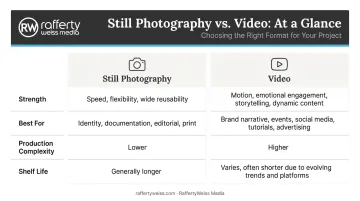
Once you know what each format does well, the real decisions — channel fit, budget, audience behavior — become much easier to work through.
Key Factors When Choosing Your Format
The format decision is rarely obvious. These five factors, weighed together, determine which medium will actually serve your goals.
Communication Goal
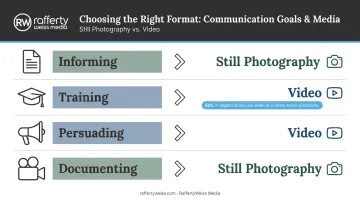
Start with intent. What are you trying to accomplish?
- Informing (annual reports, press releases, documentation) → stills
- Training (onboarding, compliance, process demonstrations) → video
- Persuading (fundraising appeals, sales content, advocacy) → video
- Documenting (events, executive portraits, editorial coverage) → stills
Panopto's 2024 Workforce Training Report found that **52% of organizations now use video as their primary training modality**, versus 24% text-based. For training specifically, video isn't just preferred — it's becoming the expected standard.
Nielsen Norman Group's eye-tracking research adds an important counterpoint: users pay close attention to information-carrying photographs but ignore decorative images. Purpose-shot stills earn attention; filler doesn't.
Target Audience and Distribution Channel
Where the content lives should shape what format it takes.
Video performs strongly on:
- Paid LinkedIn (members spend nearly 3x longer watching video ads than static Sponsored Content)
- YouTube as a searchable video library
- Website landing pages focused on conversion
- Internal training portals and LMS platforms
Stills anchor:
- Printed annual reports and collateral
- Press kits and media rooms
- Executive bios and website team pages
- Organic LinkedIn carousels (multi-image posts average 6.80% engagement vs. 5.90% for video, per Socialinsider's 2026 benchmark)
Corporate audiences on internal portals respond differently than external audiences scrolling social media. The same organization may need video for employee onboarding and stills for the press kit — and both choices are correct.
Budget and Production Timeline
Video demands more resources across every phase. Production costs include:
- Pre-production planning and scripting
- Crew, equipment, and audio capture
- Post-production editing, color grading, and captioning
- Multiple review and approval cycles
Still photography carries its own variables — licensing rights, finished-image count, location logistics, retouching — but the overall footprint is smaller.
Two practical rules:
- Compare end-to-end costs, not just shoot-day fees. Post-production for video frequently exceeds the cost of the shoot itself.
- Factor in update costs. If the content features specific personnel, current messaging, or product interfaces, it may need to be replaced sooner than planned. Stills are generally cheaper to update.
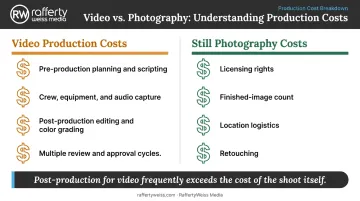
Ask for scoped, itemized bids rather than relying on industry averages — project-specific variables move costs substantially in both directions.
Required Emotional Impact and Narrative Complexity
When a message needs to move an audience — generate empathy, demonstrate transformation, or build trust through a human voice — video is the stronger vehicle. The CDC's Tips From Former Smokers campaign illustrates this at scale: the testimonial-based video campaign was associated with more than 16.4 million quit attempts and approximately 1 million sustained quits between 2012 and 2018.
Stills work best when the message is simple, clear, and can land in a single powerful image — a campaign poster, an executive portrait, a product shot for a press release. A portrait photograph serves recognition and credibility; a video interview with a program beneficiary serves belief and motivation. Both are valid, but they accomplish different things.
Content Shelf Life and Reusability
Stills are generally more reusable. An executive portrait, a facility photograph, or an event image can be repurposed across multiple campaigns, publications, and platforms with minimal modification — sometimes for years.
Video ages faster when:
- Featured personnel leave the organization
- Messaging, branding, or compliance language changes
- Platform aspect ratio requirements shift
- Product interfaces or services are updated
The National Mining Association project RaffertyWeiss Media produced is a useful example of shelf-life planning done right: a library of over 500 professional photographs captured alongside 15 videos, giving the organization evergreen assets for media broadcasts, social media, policy briefings, and recruitment — assets that continue serving the campaign long after the original production wrapped.
Choosing the Right Format by Use Case
Use Cases Where Stills Lead
Still photography is the workhorse format — versatile, fast to produce, and immediately deployable:
- Executive and team portraits for websites, press kits, and bios
- Event coverage for editorial recap posts, newsletters, and social media
- Annual reports, case studies, and printed collateral where designed layouts require high-resolution static images
- Press kit imagery — journalists need downloadable, captioned, high-resolution assets
- Presentation backgrounds and slide imagery
- Organic social media carousels where multi-image sequences drive strong engagement
Stills are the right call when the audience needs to identify, scan, download, print, or cite an asset without watching a sequence.
Use Cases Where Video Leads
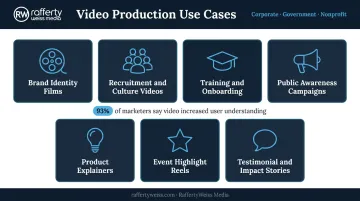
Video is the format of choice when an organization needs to demonstrate process, convey personality, or create a memorable emotional impression:
- Brand and organizational identity films that communicate mission and culture
- Employee recruitment and culture videos (one client saw a 25% increase in job applications after producing a culture video)
- Training and onboarding content formatted for LMS delivery
- Public awareness and advocacy campaigns that require voice, testimony, and emotional resonance
- Product and service explainers — 93% of marketers say video increased user understanding, per Wyzowl's 2026 data
- Event highlight reels and sizzle reels that extend the reach of a live event
- Testimonial and impact stories for nonprofit and government communications
For organizations where compliance, multi-language access, or complex information is the norm — federal agencies, healthcare organizations, associations — video often isn't optional.
RaffertyWeiss Media's work for AARP's SmartDriver program illustrates this directly: 20 explainer videos in five languages, used nationally in live training sessions, earning nearly a dozen industry awards and still active in AARP's curriculum.
When Both Formats Work Together
The most effective organizational communications campaigns deploy stills and video in tandem. Video creates the narrative centerpiece; photography builds the durable asset library that supports everything else.
RaffertyWeiss Media's FourBlock campaign is a direct example. Synchronized production crews and still photographers deployed across five cities in 48 hours — capturing veterans' success stories for brand videos, social media, and a photo library for grant applications and fundraising.
Standardized technical specs and creative direction across all five locations kept the video and photography assets visually cohesive.
Planning for both formats from the start is what makes a hybrid approach cost-efficient. Shared locations, talent, lighting setups, and creative direction reduce overall cost and ensure the assets feel like a single campaign rather than two disconnected productions.
How RaffertyWeiss Media Can Help
Choosing between stills and video requires more than a checklist. It means understanding the communication goal, audience, channel mix, and budget reality of a specific project — then executing with enough skill that the format choice pays off.
RaffertyWeiss Media has spent over 25 years producing corporate image films, training videos, PSAs, TV spots, and still photography for clients including the CDC, Department of Labor, Lockheed Martin, American Red Cross, Georgetown University, and AARP.
That range of work spans corporate marketing, federal compliance campaigns, multi-language training programs, and high-stakes advocacy — giving the team a clear picture of what works across formats, sectors, and audiences.
Patrick Rafferty and the production team work with clients through strategic planning, creative direction, production, and final delivery. The format decision gets made intentionally — not by default — so the investment translates into content that performs.
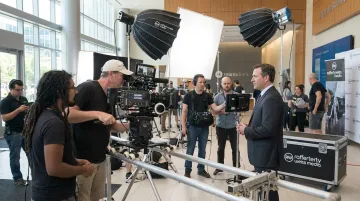
Key reasons organizations work with RaffertyWeiss Media:
- 25+ years of experience in corporate, government, and nonprofit production
- Full-service production from concept development through post-production and delivery
- Equally skilled in still photography and video, including hybrid productions
- Collaborative process with clear communication at every stage
- High production standards without inflating budgets
Frequently Asked Questions
What is the difference between video and still photography?
Still photography captures a single frozen moment in a high-resolution image; video captures a sequence of frames that creates motion and sound. For organizations, the practical difference is in communication style: stills deliver precision and fast recognition, while video delivers narrative depth and emotional arc.
Can you take still photos from a video?
Yes — frames can be extracted from high-resolution video (4K produces approximately an 8.3-megapixel still). These frame grabs work adequately for social media and internal digital use, but they typically lack the resolution and intentional composition needed for print, press kits, or hero images. They work best as supplemental assets, not replacements for dedicated photography sessions.
When should a company choose video over photography for its marketing?
Video is the stronger choice when the goal is to tell a story, demonstrate a process, or convey emotion. It's most effective when sequence and sound add meaning a single image cannot — think brand films, training content, employee testimonials, and public awareness campaigns.
Is video more expensive to produce than photography?
Yes, in most cases. Video requires crew, audio capture, and post-production editing — so compare full end-to-end costs, not just shoot-day fees. Photography carries real costs too, but the overall production footprint is smaller.
What types of corporate content work best as video?
Content that relies on sequence, sound, or narrative benefits most: training and onboarding modules, recruitment and culture videos, executive thought-leadership pieces, event highlight reels, and product or service explainers.
How do I decide if my organization needs stills, video, or both?
Start with five factors: communication goal, target audience and channel, budget and timeline, emotional impact required, and content shelf life. When budget allows, a coordinated stills-and-video plan — built as a unified effort from day one — delivers the most flexibility across platforms and use cases.