The disconnect isn't effort. It's design. Most onboarding programs front-load everything into the first week, overwhelming new hires at exactly the moment they're least equipped to absorb it.
Microlearning addresses this directly — not by dumbing content down, but by delivering it in short, targeted modules tied to what employees actually need at each stage of their first 90 days. The concept sounds straightforward. Getting the implementation right is what separates programs that accelerate time-to-productivity from ones that just add another digital task to an already crowded inbox.
Key Takeaways
- Microlearning breaks onboarding into focused 3–10 minute modules that reduce cognitive overload and improve retention
- It works when mapped to onboarding phases — not delivered as a single upfront dump
- Video-based modules, scenario-based compliance training, and role-specific tool walkthroughs produce the strongest results
- Start with a content audit, role mapping, and a delivery platform — before building any modules
- Avoid the top three failure points: oversized modules, no role personalization, and front-loading week one
Why Traditional Onboarding Falls Short
Most new hires spend their first days sitting through presentations, reading policy handbooks, and clicking through hour-long compliance courses — all before they've sent their first work email. Cognitive load theory explains why this doesn't work: working memory has finite capacity, and when information exceeds that capacity, retention drops sharply.
The result is predictable. New hires feel overwhelmed, retain a fraction of what they've been shown, and spend weeks asking questions that the onboarding program technically "covered." The program checked the box; the knowledge didn't transfer.
Microlearning flips this by following one principle: each module covers one concept with one clear outcome. Instead of a six-hour onboarding day, employees get a 5-minute module on submitting a timesheet the week before they file their first one. A 45-minute compliance course becomes three focused 8-minute scenario modules, spaced a week apart.
That spacing matters more than most organizations realize. Research by Cepeda et al. found that optimal spacing intervals produce a 64% increase in final recall compared to massed learning with no gap between study sessions. Distributing the same content across time doesn't just feel better — it produces measurably higher retention.
Microlearning also solves an access problem traditional onboarding ignores. A recorded Zoom orientation can't be searched at 3pm on a Tuesday when a new hire needs to remember the escalation protocol. A 4-minute LMS module can.
This shift — from one-time event to searchable reference library — addresses some of the most consistent failures in traditional onboarding:
- New hires can't locate information from day-one sessions weeks later
- Compliance content delivered all at once is forgotten before it's needed
- Managers field repeat questions that onboarding technically "covered"
- There's no reinforcement mechanism once the orientation ends
How to Implement Microlearning in Your Onboarding Program
Effective microlearning onboarding requires a deliberate structure tied to the actual phases of a new hire's first 90 days — not just shorter versions of the same slide decks.
Step 1: Map Phases and Learning Objectives First
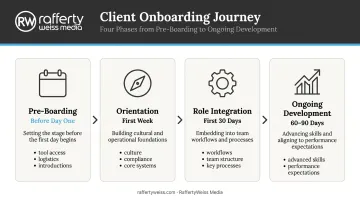
Before building anything, define four onboarding phases:
- Pre-boarding (before day one): tool access, logistics, meet-the-team
- Orientation (first week): culture, compliance basics, essential systems
- Role integration (first 30 days): job-specific workflows, team structure, key processes
- Ongoing development (60–90 days): deeper skills, performance expectations, advanced tools
For each phase, write concrete learning outcomes — not topic lists. "Understands HR policy" is not an outcome. "Can submit a PTO request without manager assistance" is.
Then separate universal content (compliance, company values, core tools) from role-specific content (technical workflows, product knowledge, team protocols).
This distinction shapes your entire module library and prevents a field technician from sitting through content built for a compliance officer.
Step 2: Build Modules Around Single Objectives
Each module covers one objective. That's the rule. When you're tempted to combine two related topics in a single module "for efficiency," you're recreating the information overload problem microlearning exists to solve.
Format selection matters:
- Short explainer videos work well for culture overviews, policy walkthroughs, and leadership welcome messages
- Scenario-based modules are best for compliance, harassment training, and decision-making practice
- Screen-capture walkthroughs suit software tools, CRM navigation, and ticketing systems
- Quick-reference job aids (checklists, escalation paths, contact directories) handle the rest
Production quality directly affects whether new hires engage with the content. A shaky webcam recording signals that the organization doesn't take onboarding seriously — and new hires notice. RaffertyWeiss Media produces LMS-ready microlearning videos for federal agencies, associations, and corporations, bringing professional scripting, broadcast-quality audio, and motion graphics to onboarding modules that hold attention from start to finish.
Step 3: Sequence and Space Delivery
Assign specific modules to specific days or weeks, tied to what the new hire will actually encounter in their role at that moment. A content library with no delivery schedule won't drive behavior change — it just accumulates.
Spaced repetition should be built in: revisit compliance content and core workflows at intervals of roughly one to two weeks rather than covering them once at the start. Research on spaced practice consistently shows that distributed review outperforms massed review for long-term retention — especially for compliance and procedural content.
Step 4: Measure and Iterate
After each phase, run brief knowledge checks or pulse surveys. Look for:
- Low module completion rates (content too long, wrong timing, wrong format)
- Consistent knowledge check gaps (module didn't cover what mattered)
- Recurring manager questions (signals a content gap)
Microlearning's short format makes iteration practical. Updating one 6-minute module is a different task entirely from overhauling a 4-hour onboarding day.
The Best Onboarding Topics for Microlearning Format
Not every onboarding topic fits a 5-minute module. Relationship-building, mentorship, and hands-on skill practice require human interaction. The following content types are where microlearning consistently works.
Pre-Boarding and Culture
Send 2–3 short modules before day one — tool access instructions, what to bring, a quick video introduction from the team lead. This reduces first-day anxiety and frees orientation time for actual connection rather than logistics.
Company culture transfers better through short video than through a values slide deck. A brief message from leadership, a 3-minute history of the organization, or a video showing core values in action creates far more connection than a bullet list in a handbook.
For government agencies and nonprofits especially, mission alignment is a key driver of early engagement. This content deserves real production investment.
Compliance Training
Compliance is required but notoriously low-engagement in long-format courses. Training Magazine reported an 83% completion rate for a 10-minute microlearning course compared to 20–30% for standard-length courses.
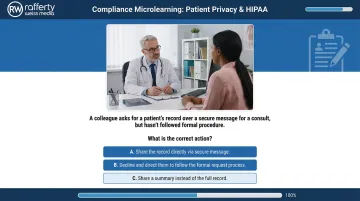
Short scenario-based modules work better here than lecture-style content. Put the learner in a realistic situation, require a decision, and follow up with the correct reasoning. RaffertyWeiss Media has produced this type of workplace conduct training for federal agencies and healthcare organizations, using scenario-driven formats that require active decision-making rather than passive viewing.
Role-Specific Tools and Workflows
Compliance training covers rules; tools training covers execution. These are different problems that need different content. A short screen-capture walkthrough showing exactly how this team uses the CRM is more useful than a vendor's general tutorial.
Practical format options for this category include:
- Screen-capture recordings of actual team workflows
- Step-by-step click-through interactions
- Short video demonstrations of key processes
Modules should be referenceable after the first watch. New hires should be able to return to the "how to submit an expense report" module on the day they actually submit one.
First-Week Milestones
Structure week one as a sequence of achievable microlearning checkpoints. Each completed module creates a concrete sense of progress. Embed human touchpoints directly in the sequence: "schedule a 1:1 with your manager," "introduce yourself in the team Slack channel." Microlearning handles information delivery — it shouldn't try to replace human connection.
What You Need Before You Launch
A microlearning onboarding program is only as good as the infrastructure behind it. Skipping these foundations leads to low adoption and poor outcomes.
A Delivery Platform With Mobile Access and Tracking
You need an LMS that assigns modules by role, tracks completion, and works on mobile devices. According to Training Magazine's 2025 Training Industry Report, 89% of organizations now use an LMS for training delivery.
Without completion tracking, you have no visibility into what's working. SCORM or xAPI compliance ensures modules report learner status, scores, and time spent back to your platform — essential for compliance documentation and program measurement.
A Content Inventory and Role Map
Before building new modules, audit what already exists: handbooks, slide decks, recorded sessions. Map each piece to a specific role and onboarding phase, identifying what converts well to microlearning format.
This prevents both content gaps and redundancy. The same policy explained in three different modules is a real problem in programs built without this step.
Stakeholder Alignment
HR shouldn't build this in isolation. Manager input on what new hires actually struggle with in the first 90 days is more valuable than any content strategy document.
Department heads need to sign off on role-specific content, and someone needs clear ownership of module maintenance. Without that accountability, your onboarding library becomes outdated within a year.
Common Mistakes That Undermine Microlearning Onboarding
Even well-intentioned microlearning programs fail in predictable ways. Here are the most common structural mistakes to avoid.
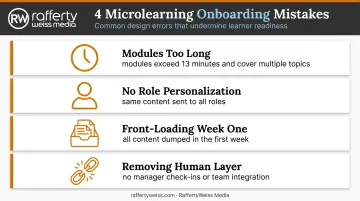
Modules that aren't actually micro. If a module runs 20–30 minutes and covers three topics, it's not microlearning — it's a traditional e-learning course with a new label. According to ATD Research, the most effective microlearning modules run 2–5 minutes, with 10 minutes as the practical ideal and 13 minutes as the outer limit before the format's benefits erode. Each module should cover one objective and lead to one clear action.
No role-based personalization. Sending every new hire the same content library regardless of role or department wastes their time and signals that the program wasn't built with them in mind. The modularity of microlearning is designed to enable role-specific learning paths — so build them that way from the start.
Front-loading everything in week one. Many organizations treat the first week as the window to cover everything, then go quiet. This recreates information overload inside a microlearning framework. A well-designed program distributes content across 30, 60, and 90 days — delivering each module when the new hire actually needs it.
Removing the human layer entirely. Microlearning handles information efficiently. It does not build relationships, provide mentorship, or integrate new hires into a team culture. Programs that rely entirely on digital modules without pairing them with manager check-ins and team introductions produce well-informed but disconnected employees.
Frequently Asked Questions
What are the 4 phases of employee onboarding?
The four phases are pre-boarding (before day one), orientation (first week), role integration (first 30 days), and ongoing development (60–90 days). Microlearning supports each phase by delivering the right module at the right moment: logistics before day one, tool walkthroughs during role integration, and skill-building content through the 90-day mark.
How long should a microlearning module be for employee onboarding?
Most practitioners target 3–10 minutes per module, with ATD Research citing 13 minutes as the upper boundary before effectiveness drops. Modules beyond that threshold tend to recreate the cognitive overload that microlearning is designed to solve, and completion rates fall accordingly.
What onboarding content works best in microlearning format?
Compliance training, tool walkthroughs, culture and values overviews, and role-specific workflow modules translate well. Mentorship, relationship-building, hands-on skill practice, and nuanced judgment development are better handled through direct human interaction, not short modules.
Can microlearning replace traditional onboarding entirely?
No. Microlearning handles information delivery efficiently, but onboarding also requires manager meetings, team introductions, and hands-on experiences that no module can replicate. The most effective programs use microlearning for content delivery while preserving human touchpoints for connection and integration.
How do you measure the effectiveness of a microlearning onboarding program?
Track module completion rates, knowledge check scores, time-to-productivity for new hires, and 90-day retention rates. Pair these with pulse surveys from new hires. Quantitative data tells you what's happening; direct feedback from the people going through the program tells you why.
What is the difference between microlearning and a standard e-learning course?
Standard e-learning courses typically run 20–60 minutes and cover multiple topics in a single session, designed for scheduled completion. Microlearning modules are 3–10 minutes, focused on one objective, and built for on-demand access. They function as on-demand reference tools, not courses.