
Custom corporate sales microlearning modules address this directly. By breaking training into short, focused units tied to specific sales situations, teams can build skills incrementally rather than front-loading everything into a two-day kickoff that's forgotten by Thursday.
The challenge is that designing modules that actually shift sales behavior requires more than just cutting a webinar into smaller pieces. Format choices, scripting decisions, and reinforcement sequencing all matter. This guide walks through exactly how to build them.
Key Takeaways
- Custom sales microlearning modules are short, focused units — each targeting a single sales skill or knowledge gap
- Effective design starts with a revenue-linked performance objective, not a generic learning goal
- Video-led, scenario-based modules outperform text-heavy formats for sales audiences
- Spaced repetition is what separates a one-off training asset from a program that drives lasting behavior change
- Skipping needs analysis and overloading a single module are the two most common reasons custom modules underperform
How to Design Custom Corporate Sales Microlearning Modules
Step 1: Define a Revenue-Linked Performance Objective
Every module must start with a specific, measurable outcome tied to a real sales KPI — not a vague goal like "understand the product."
The format that works: "After completing this module, the rep will be able to [specific action] in [specific sales context]."
For example:
- "Handle the 'too expensive' objection during a closing call without discounting"
- "Articulate the three technical differentiators that matter most in a procurement conversation"
- "Run a discovery call that surfaces the buyer's budget timeline in the first 15 minutes"
The difference between a learning objective and a performance objective is specificity. One describes what someone will know; the other describes what they'll do differently on their next call.
According to the CSO Insights 2019 Sales Enablement Report, organizations with structured sales enablement reported a 49% win rate on forecast deals versus 42.5% for those without — a gap that widens when enablement is tied directly to performance outcomes.
Step 2: Isolate One Skill or Knowledge Gap Per Module
The single-topic rule is non-negotiable. Each module addresses one discrete gap:
- Handling the "we already have a vendor" pushback
- Navigating a procurement stakeholder who wasn't in the initial demo
- Articulating a specific product differentiator against a named competitor
Bundling multiple skills into one module is the most common design error, and it compounds quickly. A module that starts as "objection handling" often ends up covering pricing logic, competitive positioning, and product features — none of which get enough depth to actually change behavior.
How to identify the right gap:
- Pull CRM pipeline data — where are deals stalling or dropping off?
- Review call recordings for patterns in rep behavior at specific stages
- Interview top-performing reps and sales managers about what separates their approach
The best gap to train first is the one showing up in your pipeline data right now.
Step 3: Choose the Right Format for the Sales Context
Format should follow function. According to the 2023 ATD/Highspot State of Sales Training report, 69% of organizations use scenario-based learning and 66% use video as primary sales training methods — and high-performing organizations are nearly twice as likely to use simulations and role plays.
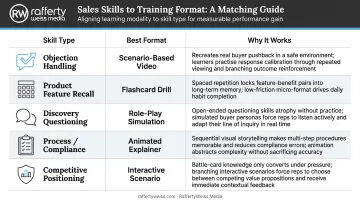
Format selection guide:
| Skill Type | Best Format | Why |
|---|---|---|
| Objection handling | Scenario-based video | Replicates real conversational pressure |
| Product feature recall | Flashcard drill | Optimized for quick, repeated retrieval |
| Discovery questioning | Role-play simulation | Requires practice, not just observation |
| Process or compliance | Short animated explainer | Simplifies sequential logic |
| Competitive positioning | Interactive scenario | Forces decision-making under realistic conditions |
Video consistently drives the highest engagement for sales audiences — particularly when it features realistic scenarios and contexts that mirror what reps actually face. A rep who sees a buyer who looks and sounds like their real buyers will engage with the training differently than one watching generic stock footage.
That's why production quality is a strategic decision, not just an aesthetic one. Scenario realism — scripted role-plays, live-action shoots, LMS-ready delivery in SCORM or xAPI — determines whether experienced reps take the content seriously. RaffertyWeiss Media builds exactly this kind of training video for corporate clients, with delivery formats compatible with platforms like Cornerstone and Articulate 360.
Step 4: Script and Structure the Module
Every effective sales microlearning module follows a four-part structure:
- Real-world sales trigger — Open with the specific situation the rep will recognize ("You're three minutes into a demo and the buyer says, 'We actually already have something that does this'")
- Correct technique demonstration — Show, don't just describe, the right approach
- Interactive knowledge check — A short scenario that requires the rep to make a decision, not just recall a fact
- Action item or coaching cue — One specific thing the rep can apply in their next call
Scripting considerations specific to sales content:
- Use real objections and buyer language pulled from your actual call recordings — not textbook language
- Avoid corporate jargon; write the way your buyers actually talk
- Keep on-screen text minimal when video is the primary medium — the visual should carry the story
- Write for a skeptical audience; experienced reps will tune out anything that feels generic or scripted for a different industry
Step 5: Build In Spaced Repetition and Reinforcement
A single module is a tactic. Behavior change requires repetition.
Research backs this up: Gartner recommends consistent reinforcement and verification of applied behaviors as the mechanism for making training retention durable. In practice, that means building a content cadence — not one module, but a sequence.
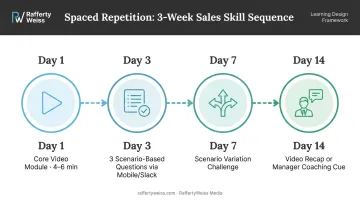
Sample 3-week reinforcement sequence for one skill:
- Day 1: Core video module (4–6 minutes)
- Day 3: Short quiz nudge — 3 scenario-based questions, pushed via mobile or Slack
- Day 7: A second scenario challenge presenting a variation of the original situation
- Day 14: A brief video recap or manager coaching cue tied to an observed deal
Trigger delivery by time intervals or live deal data. A rep who just lost a deal at the pricing conversation stage should receive the objection-handling module within 24 hours — not during the next scheduled training cycle.
When Does Custom Sales Microlearning Make Sense?
Off-the-shelf microlearning works for foundational soft skills and general compliance content. Custom modules are necessary when the sales process, product set, or buyer persona is specific enough that generic scenarios lose credibility with the people watching them.
Custom is the right choice when:
- Launching a new product that requires fast rep ramp across the field
- Running a complex B2B sales cycle with objection sets that don't appear in any off-the-shelf library
- Onboarding for specialized verticals — government contracts, healthcare procurement, financial services
- Enabling distributed field sales teams who need content that mirrors their specific market and buyer
Custom is likely overkill when:
- Training entry-level hires on foundational selling skills that any generic program covers adequately
- Meeting one-time compliance requirements where long-term retention isn't the goal
- Running a single training event without a reinforcement plan behind it
High-performing organizations are more likely to have dedicated internal functions building custom training content: 56% versus 40% of organizations overall. The reason is straightforward — experienced reps recognize generic content within the first few minutes and tune out, which kills both completion rates and knowledge retention. Custom content built around real scenarios, real objections, and real buyers closes that gap.
What You Need Before You Start Designing
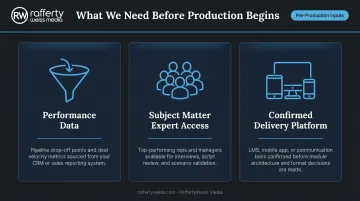
Three inputs determine module quality more than anything that happens in production:
- Performance data — Where in the funnel are deals stalling? CRM pipeline drop-off points, conversion rates by stage, and deal velocity by rep segment all point directly to trainable gaps.
- Subject matter expert access — Top-performing reps and sales managers hold the real scenarios, objections, and language that make training credible. No SME access means the module gets written from theory, not from the field.
- Confirmed delivery platform — Whether modules live in an LMS, a mobile app, or a communication tool like Slack determines format decisions before a single script is written.
These three inputs also shape your technical requirements — here's what the platform side needs to support.
Equipment and Platform Requirements
- Supports mobile access — most reps complete training between calls, not at a desk
- Hosts video natively if modules include recorded or scenario-based content
- Includes assessment and quiz tools for knowledge checks
- Meets SCORM compliance requirements for enterprise LMS integration
RaffertyWeiss Media delivers LMS-ready content compatible with SCORM, xAPI, Cornerstone, Docebo, and Articulate 360, so content is ready to deploy without format troubleshooting after production wraps.
Skill and Stakeholder Readiness
Technical readiness alone won't drive adoption — sales manager endorsement is just as critical.
Modules that aren't endorsed by sales managers rarely see adoption. Buy-in from sales leadership isn't optional — it's a distribution mechanism. Align with sales ops or enablement on KPI definitions before a single script is written. The metrics you're trying to move should shape how every module is structured — not the other way around.
Key Variables That Affect Module Effectiveness
Module Length and Cognitive Load
Sales reps have limited tolerance for training that runs long. Brandon Hall Group suggests keeping microlearning modules in the range of 3–5 minutes as a practical guideline, while ATD identifies 13 minutes as an upper boundary based on talent development practitioner input. A 2025 systematic review of microlearning research found no universal consensus on duration, though engagement typically peaks around 5–8 minutes.
The cognitive load test is straightforward: if a module covers more than one decision point, split it. Two tighter modules outperform one sprawling one.
Scenario Realism and Sales Specificity
The closer a scenario mirrors the rep's actual buyer, industry, and sales stage, the more likely the learning transfers to a real call. "Imagine you're selling a software product to a mid-size company" is not a realistic scenario for a rep selling defense contracts or healthcare compliance solutions.
Source scenario inputs from:
- Call recordings and conversation intelligence platforms
- Win/loss interview debriefs
- Sales manager post-deal reviews
- CRM notes on deals that stalled at specific stages
Assessment Design and Feedback Quality
Knowledge checks must go beyond simple recall. A question like "Which response is most likely to advance this deal?" requires the rep to simulate a decision — which is entirely different from "What are the three steps in our sales process?"
Research from a peer-reviewed medical education study found that conceptually focused feedback — explaining why an answer is right or wrong — produced meaningfully higher knowledge transfer than right/wrong-only feedback. Learners spent a median of 52 seconds reading conceptual feedback versus just 3 seconds for a simple correct/incorrect flag.
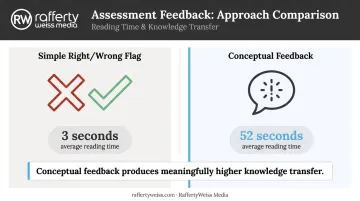
In sales training, the same logic holds. Feedback that explains the sales reasoning behind a correct answer builds the mental model reps need in the field. A simple "incorrect" flag doesn't.
Delivery Timing and Performance Triggers
The same module delivered before versus after a rep encounters the situation in the field produces different results. Pre-encounter delivery builds anticipation; post-encounter delivery hits when the experience is fresh and motivation to learn is real.
Performance-triggered delivery is concrete: a rep who just lost a deal at the pricing discussion receives the relevant module within 24 hours, not during the next scheduled training week. ATD has documented mobile devices enabling exactly this kind of just-in-time refresher — a rep reviewing content in a customer parking lot before walking in for the meeting.
Common Mistakes When Designing Sales Microlearning
Most sales microlearning programs fail for the same four reasons — and all four are avoidable at the design stage.
Scope Creep at the Module Level
A module that starts as "objection handling" ends up including product knowledge, pricing logic, and competitive positioning. Once that happens, retention drops and the behavioral outcome gets lost. Enforce one skill, one outcome per module before a single frame is scripted.
Generic Scenarios That Don't Match Your Reps' Reality
Textbook buyer personas erode trust fast. A rep who sells to hospital procurement officers will tune out the moment they see a scenario set in a fictional "mid-size software company." Ground every scenario in actual sales team language and real deal contexts your reps recognize.
No Measurement Plan Before Production Starts
Many teams build modules without deciding how success gets measured — which makes ROI impossible to defend later. Define these metrics before production begins:
- Completion rate
- Knowledge check scores
- Downstream KPI shifts: conversion rate, deal velocity, upsell attach rate
Mobile Experience Treated as an Afterthought
Most reps access training between calls or in transit, not at a desk. Before publishing, run three quick checks:
- Does text stay readable at mobile screen sizes?
- Does video play without rotating or zooming?
- Can navigation be completed with one thumb?
Conclusion
Custom corporate sales microlearning works when it's built around specific revenue objectives, realistic sales scenarios, and a reinforcement cadence. A single polished module with no follow-up sequence is a content asset, not a training program.
The decisions that matter most happen before production starts: knowing exactly which performance gap to close, getting real sales context from the people in the field, and choosing formats that match how reps actually work. Production quality — particularly for video — is what converts a well-designed module into one that reps trust and engage with. Working with an experienced video production team ensures the scripting, on-screen performance, and post-production all reinforce the learning objective — not undercut it.
Design is where strategy lives. Production is where it becomes something reps actually watch.
Frequently Asked Questions
How do you create custom corporate sales microlearning modules?
Start with a specific sales performance gap identified from pipeline data or call recordings. Design one focused module per skill, choose a format matched to how that skill is applied in the field, then build a spaced reinforcement sequence to drive retention beyond the initial viewing.
What are examples of custom corporate sales microlearning modules?
Common formats include:
- A 4-minute video scenario on handling a pricing objection
- A flashcard drill on competitive differentiators
- A mobile simulation of a discovery call
- A short scenario module on navigating a procurement stakeholder who wasn't part of the original evaluation
What are the top 3 sales skills to train with microlearning?
Objection handling, product knowledge recall, and discovery questioning techniques are the three highest-impact areas. Microlearning's focused format and spaced repetition produce measurable results in all three because each skill is focused enough to cover in a single module.
How long should a sales microlearning module be?
Most modules run 3–5 minutes, per Brandon Hall Group guidance; ATD places the upper boundary at 13 minutes. Recall-based content works best at the shorter end. Scenario-based modules can run a bit longer, but anything over 10 minutes generally stops functioning as microlearning.
What is the difference between microlearning and traditional sales training?
Traditional training is long-form, scheduled, and comprehensive. Microlearning is short, targeted, and on-demand. Microlearning works best as a reinforcement and on-demand support tool inside a broader training program — not a substitute for onboarding or certification programs.
How do you measure the effectiveness of sales microlearning modules?
Track results at three levels:
- Immediate: completion rates and quiz scores
- Intermediate: behavioral changes in calls or deal progression
- Downstream: conversion rate improvement, shorter sales cycles, or increased deal size tied to the trained skill