For organizations used to producing polished corporate films, long-form training videos, or broadcast spots, this shift can feel disorienting. The rules are different. The format is different. But the opportunity is real — and for communications professionals, marketers, and organizational leaders who haven't yet built a short-form video strategy, the cost of staying on the sidelines is growing.
This guide covers what short-form video is, why it dominates social media, how to use it effectively across platforms, and what organizations with complex messaging needs — corporate, government, nonprofit — should know before hitting record.
Key Takeaways
- Short-form video generates the highest ROI of any content format — 49% of marketers rank it #1, ahead of long-form video at 29%
- TikTok, Instagram Reels, YouTube Shorts, and LinkedIn Video each serve distinct audiences with different strategic purposes
- The first 3 seconds determine whether viewers stay or scroll — mastering the opening is the most critical production skill
- Recruitment, public awareness, and stakeholder communications are proven use cases for corporate, government, and nonprofit organizations
- Most organizations can start immediately by repurposing existing long-form content into short clips
What Is Short-Form Video Content?
Short-form video is mobile-first, vertically formatted video designed for fast consumption in scrollable feeds. Most definitions put the sweet spot between 15 seconds and 90 seconds, though platform limits now allow much longer uploads. The format lives or dies on immediate clarity: viewers haven't chosen to watch, so attention must be earned within the first two seconds.
Vine launched in January 2013 as Twitter's six-second video app, proving that constrained length could drive creative intensity. It shut down in 2017, but the concept held. TikTok consolidated the space in August 2018 when ByteDance merged Musical.ly's 100 million monthly active users into its platform, reaching 1 billion monthly active users by 2021.
Instagram launched Reels in August 2020, YouTube Shorts followed a month later, and every major platform has since built short-form video into its core product.
What makes short-form different from traditional corporate video:
- Rewards immediacy and directness over narrative build-up
- Favors platform-native authenticity over broadcast-style polish
- Assumes a viewer who hasn't opted in — attention must be earned in seconds
- Designed for vertical, mobile screens, not horizontal broadcast or desktop viewing
For organizations with established video programs, this isn't a replacement — it's a different communication register. The same organization might produce a 12-minute corporate overview film and a 45-second LinkedIn clip from the same shoot. Each format serves a different audience moment and a different stage of engagement.
Why Short-Form Video Dominates Social Media
The volume problem is real. YouTube Shorts alone averages over 200 billion daily views, and the platform has more than 2 billion logged-in monthly users watching Shorts. When that much content competes for attention, only formats that match how people actually scroll survive.
The Algorithm Factor
Platforms don't distribute all content equally. TikTok's For You feed ranks videos based on user interactions, video information, and device settings — prioritizing content that holds attention. Instagram is explicit about it: Reels over 3 minutes will not be recommended to new audiences. That's not a soft guideline — it's a hard distribution cutoff built into their system.
The practical implication: shorter content doesn't just perform better with audiences, it gets more algorithmic distribution. For corporate and government communicators, that algorithmic reach opens doors that paid promotion alone can't replicate.
Shareability as a Distribution Multiplier
Meta reported that Reels were reshared more than 2 billion times every day during Q1 2023 — a figure that had doubled over the previous six months. A single piece of short-form video content can travel well beyond an account's existing followers through DMs, Story reposts, and embeds. Long-form content simply doesn't move through networks the same way.
The Feedback Advantage
Short-form video also gives communicators faster learning cycles than almost any other format. Key performance signals — completion rates, shares, saves, and comments — typically surface within 24–48 hours of posting. That quick feedback window lets organizations test messaging and refine their approach without waiting for quarterly reporting cycles.
Key Platforms for Short-Form Video
Each major platform serves a distinct audience and strategic purpose. Treating all platforms as interchangeable wastes resources.
| Platform | Best For | Key Stat |
|---|---|---|
| TikTok | Viral reach, discovery, younger audiences | 63% of U.S. adults under 30 use it; 62% of 18–24s search on TikTok |
| Instagram Reels | Cross-generational audiences, brand extension | 2B+ daily Reels reshares; 2x engagement rate vs. standard video posts |
| YouTube Shorts | Funnel tool driving viewers to long-form content | 2B+ logged-in monthly users; 200B+ daily views |
| LinkedIn Video | B2B, corporate, government communications | Video consumption up 36% year over year; creation growing 2x faster than other post formats |
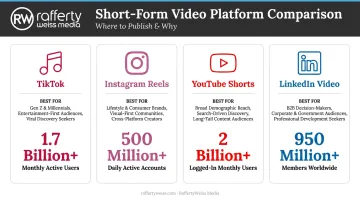
Each platform has a distinct role in a well-planned strategy:
- TikTok functions as a search engine for younger audiences. Keyword-rich captions drive discovery, not just hashtags.
- Instagram Reels benefits organizations with an existing Instagram presence looking to extend into video without rebuilding from zero.
- YouTube Shorts works best as a funnel: short clips drive viewers to a brand's longer video library, making it valuable for organizations that already produce corporate films, explainers, or event coverage.
- LinkedIn Video is the most relevant platform for corporate, government, and institutional communicators. The platform rewards professional insight in an informal, vertical format ("edutainment"), and the growth numbers justify real investment.
How to Hook Viewers in the First 3 Seconds
This is where most organizational video fails. Not because the content is bad — but because it starts too slowly.
TikTok's own creative research found that over 63% of videos with the highest click-through rates highlight the key message or product within the first 3 seconds. Meta's platform research shows that 65% of viewers who watch the first 3 seconds continue for at least 10 seconds — and 45% continue for 30 seconds. Those first three seconds determine whether the rest of the video gets seen at all.
Hook Techniques That Work
- Start mid-action — drop the viewer inside the story, not at the setup
- Lead with the result, then work backward to explain how you got there
- Open with a question the viewer actually wants answered
- Challenge an assumption — a counterintuitive fact stops the scroll faster than a polished introduction
Short-form feeds condition viewers to expect certain visual and audio patterns. Content that breaks those patterns — an unexpected framing, a direct address to camera, an unusual graphic element — stops the scroll before conscious attention kicks in. This is the "pattern interrupt," and it works precisely because the viewer doesn't see it coming.
For corporate and institutional video, none of these techniques require gimmicks. A compelling human story, an urgent problem statement, or a bold organizational fact can function as a hook just as effectively as entertainment. The American Red Cross, for example, doesn't need viral tricks — a single statistic about lives saved, delivered directly and immediately, is immediately compelling.
Authenticity and directness work. What doesn't work is a 10-second logo animation before the first word of actual content.
Building a Short-Form Video Strategy
Random posting isn't a strategy. Organizations that see results from short-form video are working from a framework, not just reacting to trends.
Content Mix
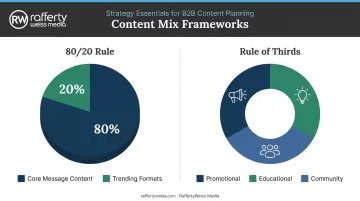
Two frameworks worth adapting:
- 80/20 rule: 80% original content anchored to your core message, 20% trending formats or conversations your audience actually follows
- Rule of thirds: One-third promotional, one-third educational or informational, one-third community-focused — responses, behind-the-scenes, human moments
Neither framework is rigid — but both prevent the trap of posting only promotional content, which drives follower attrition on every platform.
Repurposing as an Entry Point
Most organizations already have usable raw material sitting in storage. Before producing new content, inventory what you already have — common sources include:
- Training videos and eLearning modules
- Event recordings and conference keynotes
- Executive interviews and testimonials
- Explainer films and product demos
A 20-minute keynote might yield four or five compelling 45-second clips. A testimonial interview often contains two quotable moments worth isolating on their own.
RaffertyWeiss Media's production process includes delivery optimization across platforms — meaning assets produced for long-form use can be structured from the start for short-form extraction.
Metrics That Matter
| Metric | What It Measures |
|---|---|
| Video views | Reach — how many people saw the content |
| Completion rate | Content quality — did viewers finish it? |
| Engagement rate (likes, shares, saves, comments) | Resonance — did the content prompt a response? |
| Click-through rate / conversions | Business impact — did it drive action? |
Vidyard's business video benchmarks found that 65% of viewers stay engaged to the end of videos under one minute — compared to only 20% for videos over 20 minutes. For organizations weighing video length, the retention gap is hard to ignore.
Short-Form Video for Corporate and Institutional Brands
The assumption that short-form video is only for consumer brands is outdated. Content Marketing Institute research found that 58% of B2B content marketers used short-form video in the previous 12 months. Government agencies have demonstrated this works too: Singapore's Gov.sg generated 1.5 million views for its #SGUnited TikTok campaign, 1.2 million for #StayHomeForSG, and 10,000 shares — showing that public-sector content can generate real reach when adapted to platform-native behavior.
The Production Quality Question
Lo-fi content performs well on consumer platforms. That creates a real dilemma for institutional brands: Wyzowl reports that 89% of consumers say video quality impacts their trust in a brand — and for organizations whose credibility is a core asset, that trust signal is non-negotiable.
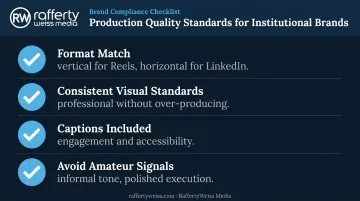
The goal is appropriate production quality: content that feels native to the platform while still looking professionally executed. For institutional brands, that means:
- Matching format to platform (vertical for Instagram Reels, horizontal for LinkedIn)
- Maintaining consistent visual standards without over-producing
- Including captions — which drive engagement and meet accessibility requirements
- Avoiding anything that reads as amateur, even if the tone is informal
For organizations managing complex messaging, brand standards, or compliance requirements, striking this balance requires experience. RaffertyWeiss Media has spent over 25 years producing video for federal agencies, national nonprofits, healthcare institutions, and universities, and produces short-form content optimized for LinkedIn, Instagram, Facebook, and YouTube.
That institutional knowledge — government procurement norms, association communications, compliance-sensitive messaging — is what keeps a short-form video from becoming a liability.
Frequently Asked Questions
What is short-form video content on social media?
Short-form video is brief, vertically formatted video content typically under 3 minutes and designed for mobile-first platforms like TikTok, Instagram Reels, and YouTube Shorts. It's defined less by exact length and more by its context: fast consumption in scrollable, algorithm-driven feeds where viewers haven't actively sought it out.
Is TikTok a short-form video platform?
Yes — TikTok popularized the format and still leads the space. While TikTok now technically allows videos up to 10 minutes, its algorithm and culture are built around content under 60 seconds. Longer uploads exist, but the platform's core behavior remains short-form.
What is the 5-5-5 rule on social media?
The 5-5-5 rule is a community engagement guideline: engage with 5 accounts, leave 5 comments, and ask 5 questions per session. It's a behavioral framework for building audience relationships, not a content production rule, with its value rooted in growing organic reach through reciprocal interaction.
What is the ideal length for a short-form video?
The general sweet spot is 15–60 seconds for maximum reach and engagement on most platforms. Longer short-form content (up to 90 seconds or 3 minutes) works well for storytelling, tutorials, and professional content, on LinkedIn. The key constraint: Instagram won't recommend Reels over 3 minutes to new audiences.
Can short-form video work for corporate and government organizations?
Yes. Organizations across sectors use it for public awareness, recruitment, stakeholder communications, and issue education. The key is matching production quality and tone to both the platform's norms and the organization's credibility standards — and that balance looks very different on TikTok than on LinkedIn.
How do you measure the success of short-form video content?
The right metrics depend on the campaign's goal. Core options include:
- Video views for reach
- Completion rate for content quality
- Engagement rate (likes, shares, saves, comments) for resonance
- Click-through rate or conversions for business impact
A public awareness video should be measured on reach and completion, not click-throughs.