Online revenue for nonprofits grew 15% in 2025, according to M+R Benchmarks, confirming that donors are increasingly comfortable giving through digital channels. The organizations capitalizing on this shift aren't just moving events online — they're rethinking what a fundraising event can accomplish.
This guide walks through the most effective virtual fundraiser formats available today, the strategies that separate high-performing events from forgettable ones, and a practical framework for deciding which approach fits your organization.
Key Takeaways
- Virtual events eliminate venue costs and remove geographic barriers for donors
- Virtual galas and online auctions raise the most revenue when paired with live giving mechanics and strong video storytelling
- Peer-to-peer campaigns excel at expanding reach beyond your existing donor list
- Start promotion 4–6 weeks out; post-event follow-up within 24–48 hours is non-negotiable
- Format choice should match your donor demographic, fundraising goal, and internal capacity
Why Virtual Fundraising Works for Nonprofits
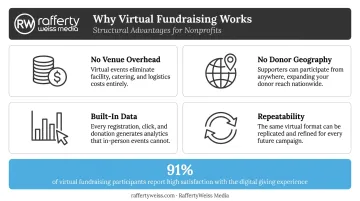
The case for virtual fundraising goes beyond convenience. Three structural advantages make it worth building into your permanent calendar:
- No venue overhead: In-person galas carry catering, AV rental, staffing, and venue deposit costs that can consume 30–50% of gross revenue before a single dollar reaches your programs. Virtual events shift that budget to production and promotion — where it generates returns.
- No donor geography: Your most passionate supporters may not live within driving distance. Virtual formats let anyone attend, turning national and international supporters into active participants rather than check-writers who miss the experience.
- Built-in data: Virtual platforms capture registration analytics, session engagement, donation timing, and bidding behavior in ways in-person events simply can't replicate. That data becomes the foundation for smarter future campaigns.
- Repeatability: Once your team has selected a platform and built a workflow, subsequent events require a fraction of the original setup time.
The donor appetite for these formats is real: a Classy survey of 1,000 U.S. event attendees found 91% of virtual attendees were satisfied with their experience, and 82% said they'd attend another virtual event from the same organization.
Best Virtual Fundraiser Ideas for Nonprofits
The right format depends on your audience, mission, and goal. Here's a breakdown of the formats with the strongest track records:
Virtual Gala or Live-Streamed Celebration
The virtual gala mirrors a traditional gala's emotional arc: speakers, mission moments, live appeals, all delivered through a structured broadcast. When produced well, it sustains the energy of an in-person event.
The Tennessee Kidney Foundation converted its annual black-tie gala to a virtual format and raised $238,000 with 570 online attendees and 424 auction bids. That outcome required intentional production: Facebook Live broadcast, pre-recorded sponsor testimonials, live donation appeals, and real-time donor recognition.
Best for: Major donor cultivation, organizations with strong existing donor relationships
Online Silent or Live Auction
Mobile bidding platforms let supporters browse and compete on items from their phones during a set window. The competitive dynamic drives giving behavior that static donation asks rarely match.
Per OneCause's 2025 State of Nonprofit Auctions Report, auction donors give $529 on average — and 83% are likely to become annual donors after participating. That retention figure makes auctions a relationship tool, not just a revenue spike.
Best for: Any size organization; pairs well with live-streamed events
Peer-to-Peer Fundraising Campaign
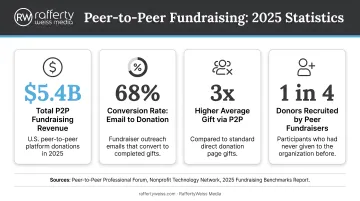
In a P2P campaign, individual supporters create personal fundraising pages and solicit donations from their own networks. Your organization gains reach far beyond its existing list — participants become mission ambassadors.
The numbers validate the model: the top 30 U.S. peer-to-peer programs raised $1.17 billion and engaged 2.63 million participants in 2025, up 3.6% year over year. At the campaign level, events with peer-to-peer components showed a 47% conversion rate in Classy platform data.
Best for: Community-driven missions, organizations with active volunteer bases
Virtual Walk, Run, or Fitness Challenge
Participants register, complete a physical challenge on their own schedule, and solicit pledges or flat donations from their networks. The format gives supporters something to do and something to share — roughly two in five P2P participants use Facebook to solicit donations, extending organic reach without paid media.
Best for: Health-focused missions, cause walks with existing participant communities
Storytelling Night or Impact Film Screening
An intimate virtual event where beneficiaries, volunteers, or partners share firsthand stories — or where the nonprofit screens a short impact film. This format isn't built for maximum transaction volume; it's built for emotional depth.
It works particularly well for mid-to-major gift cultivation, where a donor's decision to give is driven by connection rather than urgency. The video content itself carries most of the weight: a well-produced impact film or testimonial reel can shift how a prospective donor sees your mission. RaffertyWeiss Media has produced this type of content for nonprofits including the American Red Cross, United Way, and FourBlock — gala videos and impact films designed to show donors the real difference an organization's work makes.
Best for: Major donor stewardship, mission-forward organizations
Virtual Trivia Night or Gaming Tournament
Ticket sales, real-time donation prompts, and prize incentives generate revenue while keeping energy high. Gamified formats are particularly effective for reaching donors under 40, who respond to participation over passive watching.
Best for: Younger donor segments, organizations building a new donor pipeline
Key Strategies to Maximize Virtual Fundraising Impact
Choosing the right format matters — but execution inside that format is what drives donations.
Lead with Story, Not Statistics
The single most effective giving driver in any virtual event is emotional storytelling — specifically, showing donors the human result of their contribution in real time. A 2–3 minute professionally produced video featuring a beneficiary story, played during a live appeal, consistently outperforms any other conversion tactic in virtual fundraising.
Case in point: a small development team at MICC incorporated mission and impact storytelling videos into their virtual appeal and raised $300,000. The production quality mattered — a rough phone-filmed clip doesn't carry the same weight as a piece that's been scripted, filmed on location, and edited with intention.
RaffertyWeiss Media's nonprofit video work covers fundraising appeals, Giving Tuesday campaigns, and major donor presentations. Each project moves through a five-stage process: discovery, scripting, on-location filming, post-production, and platform-optimized delivery.
Use Live Giving Mechanics
Passive viewing kills conversion rates. The events that generate giving spikes use mechanics that create urgency and social proof:
- Donation thermometers — visible progress toward a goal creates momentum
- Matching gift challenges — "the next $10,000 will be matched" drives concentrated giving windows
- Real-time donor shoutouts — recognition during the event reinforces social participation
- Countdown clocks — time pressure activates giving decisions
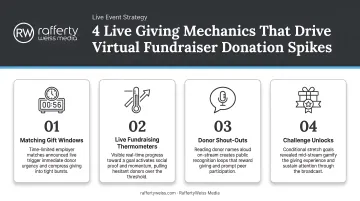
Platforms like OneCause, Givebutter, and Classy/GoFundMe Pro build all four of these mechanics directly into their event toolsets — because they work.
Build Engagement Through Gamification
For peer-to-peer campaigns and auctions, gamification keeps participants active rather than passive:
- Fundraising leaderboards for P2P participants
- Auction countdown timers visible to all bidders
- Ambassador competitions with prizes for top fundraisers
Promote Early and Consistently
Attendance predicts revenue. Promotion should begin 4–6 weeks before major virtual events, using:
- Segmented email campaigns to existing donors (M+R data shows nonprofits raise roughly $76 per 1,000 fundraising emails — volume and segmentation both matter)
- Social media countdowns and behind-the-scenes content
- Personalized invitations for major donor prospects
- Partner and board member amplification
For auction components specifically, the Tennessee Kidney Foundation opened online bidding four weeks before the event — letting excitement and competitive dynamics build before the main night.
Repurpose Everything After the Event
Your virtual event recording is a fundraising asset, not an archive file. Post-event repurposing turns a single event into months of donor touchpoints:
- Clip impact story segments for social media content
- Use recording highlights in year-end donor cultivation emails
- Share full recordings with donors who couldn't attend live
- Integrate best moments into future campaign materials
How to Plan and Launch Your Virtual Fundraiser
Set Measurable Goals First
Define a specific dollar target, an attendance goal, and your primary audience segment before selecting any platform or format. Those three inputs shape your budget, format complexity, promotion mix, and platform requirements.
A $15,000 virtual auction for 150 current donors has entirely different logistics than a $200,000 virtual gala targeting 500 attendees and major donor prospects.
Choose the Right Platform
Key features to evaluate:
| Feature | Why It Matters |
|---|---|
| Live-streaming capability | Required for gala-style events and live appeals |
| Mobile bidding | Essential for auction formats |
| Donation processing | Fee structures vary significantly |
| CRM integration | Enables post-event follow-up at scale |
| Attendee-facing usability | A clunky interface loses donors mid-transaction |
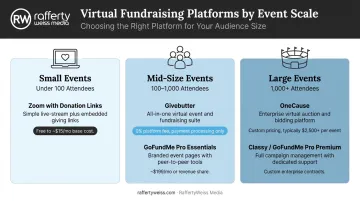
Platform options by scale:
- Small events (under 100 attendees): Zoom with donation links; nonprofits with operating budgets under $10M qualify for 50% off select Zoom products
- Mid-size events: Givebutter (0% platform fees with donor tips enabled) or GoFundMe Pro Essentials (zero subscription fees for nonprofits under $1M in annual revenue)
- Large events: OneCause (plans from $200, full auction and event suite) or Classy/GoFundMe Pro Premium
Rehearse Fully, Not Partially
All speakers, presenters, and production staff should complete a full dry-run at least one week before the event. Identify backup plans for:
- Internet outages (have a mobile hotspot ready)
- Audio failures (test backup microphones)
- Presenter no-shows (designate a fill-in for every critical role)
The live giving window is your highest-conversion moment — protect it with redundancy built in before the event starts.
Execute Post-Event Follow-Up Within 48 Hours
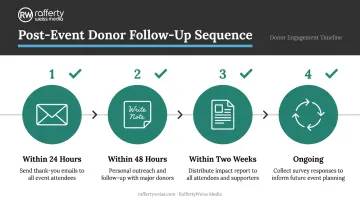
The post-event window is where donor relationships are built or lost:
- Within 24 hours: Thank-you emails to all attendees and donors
- Within 48 hours: Personal follow-up notes for major donors
- Within two weeks: Impact report shared with all attendees
- Ongoing: Survey feedback collected for next event's planning
Choosing the Right Virtual Fundraiser Format for Your Nonprofit
Three factors should drive format selection:
- Donor demographics — Older major donor audiences respond well to gala-style production with personal outreach. Younger segments engage more with gamified formats and peer-to-peer participation.
- Fundraising goal — Large goals ($100,000+) warrant the complexity of a full virtual gala or multi-format event. Smaller campaigns ($10,000–$50,000) are well served by a single-format P2P campaign or standalone auction.
- Internal capacity — Virtual galas require production coordination, speaker management, platform setup, and promotion — all at once. Start with one format before layering if your team is new to virtual events.
Once you've assessed those factors, match your experience level to the right format:
- New to virtual events: Start with a P2P campaign or standalone auction
- One or two virtual events completed: Add a live-streamed component or combine formats
- Experienced organizations: Layer a live-streamed program with an auction and P2P campaign to maximize revenue from multiple giving channels simultaneously
One more option worth understanding: hybrid events, which run simultaneous in-person and virtual attendance. They work well for organizations serving both local and remote audiences, but require more complex logistics and production coordination than purely virtual formats.
Conclusion
Virtual fundraising has moved well past backup plan status. For nonprofits focused on reaching more donors and building repeatable giving experiences, it's now a primary channel — not a fallback.
The organizations getting the most from it share a common pattern: they invest in the elements that drive emotional connection — and the most consistent driver is professionally produced video content. A compelling 2–3 minute impact story played during a live appeal moves donors in ways that even skilled speakers often can't replicate.
For nonprofits looking to elevate that piece of their next event, RaffertyWeiss Media brings more than 25 years of production expertise. Their client roster includes the American Red Cross, United Way, and FourBlock — and their work spans donor impact videos, gala films, and fundraising campaign content designed to show donors exactly where their money goes and why it matters.
If your next virtual event deserves storytelling that actually converts, schedule a strategy call with their team.
Frequently Asked Questions
How do I host a nonprofit virtual event?
Set a clear fundraising goal, choose a platform that supports live-streaming and online donations, and promote to your donor list starting 4–6 weeks out. Conduct a full technical rehearsal at least one week before going live. Most event failures are preventable with proper preparation.
What types of virtual fundraisers raise the most money for nonprofits?
Virtual galas with live appeals and online auctions consistently generate the highest revenue, particularly when paired with professional video storytelling and real-time giving mechanics like matching gift challenges. Auction donors give an average of $529, according to OneCause's 2025 data.
How much does it cost to host a virtual fundraising event?
Costs range from near-zero (Zoom-based events with free or low-cost donation tools) to several thousand dollars for platform fees, video production, and paid promotion. Givebutter charges 0% platform fees when donor tips are enabled; GoFundMe Pro Essentials has no subscription fee for nonprofits under $1M in annual revenue.
What platforms are best for virtual nonprofit fundraising?
OneCause, Classy/GoFundMe Pro, and Givebutter are the most commonly used, each offering different combinations of auctions, live-streaming, donation processing, and CRM integration. Match platform choice to your event scale and budget: Givebutter works well for smaller events, while OneCause and Classy suit larger, more complex productions.
How do you keep donors engaged during a virtual fundraising event?
Live donation thermometers, real-time donor shoutouts, auction countdowns, gamification elements like leaderboards, and short impactful video segments all reduce viewer drop-off. Keep the program moving — passive watching kills engagement faster than anything else.
Can virtual fundraising events replace in-person events entirely?
Most nonprofits do best with a hybrid model, capturing the reach and cost advantages of virtual while preserving the high-touch experience major donor cultivation requires. Pure virtual works well for expanding reach; in-person or hybrid formats suit events where sponsorship activation or personal relationships drive revenue.